

.png) Dr Suresh Mathew
Dr Suresh Mathew

The BJP governments and the Sangh Parivar offshoots are good at one thing: raking up non-issues to turn the tide in their favour when the going gets tough. Recent developments in some States ruled by the party are testimonies to these opportunistic moves devoid of any principles or rational explanation. The Karnataka government’s decision, despite stiff opposition from various quarters, to conduct a survey of the Christian churches and institutions is a case in point. It is a sinister move as various wings of the government are in possession of the complete data on this count. Moreover, the survey covers only Christians, and not every community in the State, exposes the suspicious motive behind this vile decision. Ironically, the Central government run by the same party has said an emphatic ‘no’ to a pan-India survey of castes despite political parties, commissions and organizations have been battling for the same. In fact, a caste census is imperative as in the absence of it, the existing reservation benefits have gone lopsided.
In an equally sinister decision, the Karnataka Government has proposed to introduce an anti-conversion Bill in the Assembly which is seen as yet another move to persecute Christians. There is no dearth of laws in the country that could take care of forcible conversions, if any, as alleged by the government. Hence bringing in another law is nothing but an attempt to hound Christians in every possible way. As if taking a cue from the government move, Sangh Parivar activists wasted no time in unleashing unprecedented attacks against Christians in Belagavi district in the State. They have barged into churches and prayer houses and assaulted people gathered there.
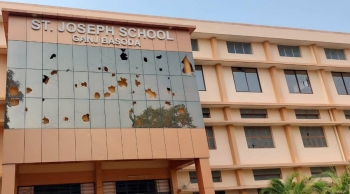
The spate of attacks, it seems, has spread to other parts of the country as a senior secondary school, run by Catholic missionaries, in Vidisha district of Madhya Pradesh, was recently attacked by hooligans, who came raising Jai Sriram slogans. The students who were giving examinations in the classrooms had a narrow escape. The reason for the attack has reportedly been a first Holy Communion function in a nearby church which the Sanghis construed as conversion.
Whatever be the excuses and pretexts given by the Hindutva protagonists, their objective is beyond doubt: Make India a Hindu Rashtra and reduce the minorities to stay as second class citizens as envisaged by M. S.Golwalkar, the second sarsanghchalak of the RSS.
Efforts are on to rake up issues that would further communalise the atmosphere. It is none other than the Deputy Chief Minister of Uttar Pradesh, Keshav Prasad Maurya, who has taken a lead in this direction. In a recent tweet he stated that preparations are afoot to build a magnificent temple in Mathura. He could not have been unaware of the Places of Worship Act 1991 which mandated that the nature of all places of worship – except the one in Ayodhya that was then under litigation -- shall be maintained as it was on August 15, 1947.
The Supreme Court too, in its Ayodhya judgment, had cautioned the State and the people not to take law into their hands and forcibly convert the religious character of the places of worship across the country. Hence the assertion of the UP Deputy Chief Minister is a blatant violation of the Court’s mandate. But the Sangh Parivar elements accept and respect no other power other than their own leaders.
.jpg)
.png) Cedric Prakash
Cedric Prakash

.jpg) Elsa Lycias Joel
Elsa Lycias Joel
.jpg)
 A. J. Philip

.png) Jacob Peenikaparambil
Jacob Peenikaparambil
.jpg)
.png) John Dayal
John Dayal
.jpg)
.jpg)
.png) Joseph Maliakan
Joseph Maliakan
.png)
.png) Robert Clements
Robert Clements
.jpg) Cedric Prakash
Cedric Prakash

 ICPA
ICPA