

.png) Dr Suresh Mathew
Dr Suresh Mathew

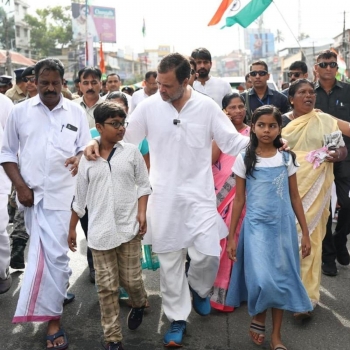
The country has seen innumerable Yatras by leaders of all walks of life. One of the most memorable ones in the modern history of India was the famous 24-day Dandi March undertaken by Mahatma Gandhi along with several followers. The historic Yatra in colonial India was to protest against the British who levied steep tax on salt. Though the country has witnessed several more Yatras in the post-independence period, the ongoing Bharat Jodo Yatra led by Rahul Gandhi, traversing the heart of several states, stands out for several reasons. At a time when the country is witnessing an unprecedented rise in hate-mongering and unleashing an aversion for the ‘other’ with disastrous results, the Yatra to unite a ‘divided’ India marks a new beginning. Its avowed objective of maintaining peace and harmony sends out a soothing message to the masses.
One may make derisive comments on Rahul Gandhi for his omissions and commissions as the party’s leader; but none can ignore the relevance and significance of the journey he is leading, raising unprecedented enthusiasm in both cities and villages. There are no political speeches hurling accusations against anyone; there is no slogan-shouting denigrating the rivals; there are no false promises to raise hopes among the people; there are no posters and banners demeaning the opponents. The focus is on sending out the message of unity and harmony among people of diverse castes, religions, regions and languages; the objective is to bridge bridges among people who have been fed with communal poison and pitted against one another; the target is to defend the values of equality, fraternity, federalism and pluralism which have come under pressure since the present dispensation at the Centre came to power.
The yatra gives a new direction to political parties that shamelessly use every opportunity to politicise issues. They see even the worst human tragedies with an eye to garner votes. It is opportune to recall two incidents to put the issue in the right perspective. When a flyover collapsed in West Bengal, which coincided with the last elections to the Assembly, Prime Minister Narendra Modi and his party saw it as an ‘act of fraud’ and made Mamata Banerjee government responsible for it. But the party and Modi have not uttered one word against the Gujarat government on the recent Morbi bridge collapse though reports suggest that the bridge was opened without even fitness certificate and it happened due to corrupt practices at several levels. Echoing the spirit of the Bharat Jodo Yatra, Rahul Gandhi, instead of reacting politically, saw it as a human tragedy which saddens everyone. It is this spirit of approaching issues humanely that would take the country forward. If the ongoing yatra can bring about a change in this direction, that would be its biggest success.
On equal measure, none can dispute the fact that the yatra is also meant to resurrect the fading fortunes of the grand old party. As it passes through 12 states covering a distance of 3500 kms, there is hope of reviving a partially moribund party. The continuous enthusiasm witnessed on the yatra route, even two months after it started, has enlivened the hopes of the party’s rank and file. The Congress seems to have learnt a lesson that negativism alone would not take it anywhere. The positive route taken by the party could be its winning mantra.

.jpg) Stanislaus Alla
Stanislaus Alla
.jpg)
.png) Cedric Prakash
Cedric Prakash

.jpg) Elsa Lycias Joel
Elsa Lycias Joel
.jpg)
 A. J. Philip

.png) Jacob Peenikaparambil
Jacob Peenikaparambil
.jpg)
.png) John Dayal
John Dayal
.jpg)
.jpg)
.png) Joseph Maliakan
Joseph Maliakan
.png)
.png) Robert Clements
Robert Clements
.jpg) Cedric Prakash
Cedric Prakash