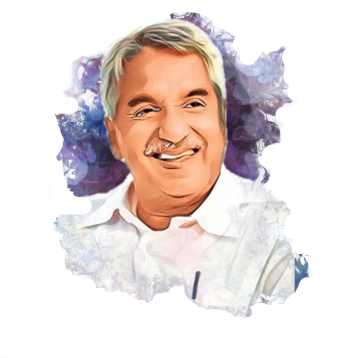


.png) Dr Suresh Mathew
Dr Suresh Mathew

The distance from Kerala’s Capital Thiruvananthapuram to Kottayam is about 145 km, a drive of less than 4 hours normally. But July 19 was an unusual day. It took close to 30 hours to cover the distance when the mortal remains of Oommen Chandy, the former Chief Minister of Kerala, was taken in a cortege.
As tens of thousands of people thronged both sides of the entire stretch, to have a last look at their beloved leader, everything moved at slower than snail’s speed. There were innumerable moving scenes on the way, mirroring the popular image of Oommen Chandy, a man of the masses, during his last journey.
Among the many uniqueness the day presented, yet another thing stood out markedly. It has never happened in the recent past, probably in the distant past too, that newspapers devoted half of the printed pages for one person on any particular day. But, it so happened on July 19. Almost all newspapers published from Kerala had pages after pages carrying every bit of news available about one person, Oommen Chandy, who had passed away a day earlier.
Not only the print media but every media platform for the next two days had nothing else to comment on but the life and times of the former Chief Minister, bearing testimonies of his large-heartedness.
What made Oommen Chandy the darling of the masses? What connected him to the people? There is only one answer to it: He lived as one among them; he moved among them; he couldn’t be seen without them; he was part and parcel of their life; he listened to their woes and sorrows; he took steps to give them solace and relief; he gave instructions to resolve their problems; he merged with them as if he was one of them.
His life could be portrayed as a role model for leaders who shamelessly keep themselves aloof from the people who elected them. Those leaders who fold their hands seeking votes during elections and show their back once elected to power should take a leaf out of the life of the longest-serving MLA of the Kerala Assembly.
Whether in or out of power, Oommen Chandy had only one style, to be with the people, come rain or shine. His ‘people-contact’ programme conducted during his tenure as Chief Minister took him through the length and breadth of Kerala. It was a unique effort and initiative to solve people’s problems by going to them rather than making them go to the authorities. He did not put up barriers between him and the people, rather he believed in making him accessible to people. This put him at a pedestal much higher than most of the contemporary leaders.
There are innumerable instances of his personal intervention in lending a helping hand to the people who thronged him; vivid descriptions of his humane approach in solving problems; graphic portrayal of his life shoulder-to-shoulder with both party workers and general public, including those from his rival parties.
This is what keeps Oommen Chandy poles apart from other leaders. There is no dearth of Good Samaritans in the society; but Oommen Chandy was undoubtedly the ‘mother of all Good Samaritans’. His life is a textbook case on how leaders should be in their personal and public life.
.jpg)
.png) Cedric Prakash
Cedric Prakash

.jpg) Elsa Lycias Joel
Elsa Lycias Joel
.jpg)
 A. J. Philip

.png) Jacob Peenikaparambil
Jacob Peenikaparambil
.jpg)
.png) John Dayal
John Dayal
.jpg)
.jpg)
.png) Joseph Maliakan
Joseph Maliakan
.png)
.png) Robert Clements
Robert Clements
.jpg) Cedric Prakash
Cedric Prakash

 ICPA
ICPA