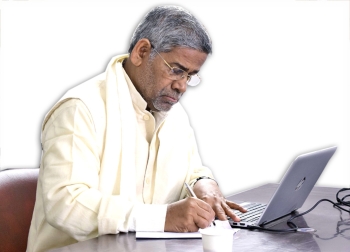


.png) Dr Suresh Mathew
Dr Suresh Mathew

A diehard optimist with a unique vision and prophetic voice; a staunch proponent of Christo-centric life; an ardent supporter of Gandhian values of peace, non-violence and communal harmony; an inspiring mentor of students; a motivational orator par excellence, a workaholic who would say ‘I am busy 24x7 but I have time for you’ .… All these could probably sum up the life of Fr. Varghese Alengaden, the founder of Indore-based Universal Solidarity Movement of Value Education for Peace, who passed away recently. Like a colossus, he strode an unlikely path -- a path chosen by few. Today he is no more, creating a vacuum in an area he marvelled himself; in a field he made a niche for himself.
A reference to the sessions and seminars he conducted, and the number of participants in them, could give a glimpse of what he was involved in the last few decades of his eventful, untiring life. He conducted more than 300 seminars for school teachers and addressed 2,15,600 parents in 235 schools and tens of thousands of students from hundreds of schools, both at his USM centre in Indore and outside. This brings out his immense faith and trust in the youth. It was this belief which led him to ask himself, ‘why not train the youth to take charge of the nation with an inclusive, broad and lasting vision.’ This probably led to the regular leadership training camps for school students, each one lasting for a week, conducted by the USM. The culmination of each camp saw scores of students leaving with new glint in their eyes and new-found resolve in their heart. Their testimonials are galore at the archives of the USM.
Fr. Alengaden’s extraordinary vision was not limited to the mission he undertook among the students. He was a champion of peace and communal harmony which was exemplified in the peace conventions he conducted across several cities in the last few years. Though he was a Gandhian without a Gandhian cap, nothing could cap his ceaseless efforts, joining hands with several civil society organizations, to motivate people to work for peace following the ideals of Mahatma Gandhi. He was a humanist to the core. He abhorred discriminating people on the basis of religion, region, caste, colour or creed. He had overcome man-made barriers to walk his talk. Readings and prayers from all religions, regularly practiced at the USM centre, stand as a testimony to what he stood for.
He was a priest who shed some of the identities without any inhibition; but Jesus Christ and His teachings were at the centre of his life. The Christo-centric retreats he had conducted for prelates, priests and religious at the USM centre were unique in many ways. His oft repeated and unambiguous stand distinguishing religiosity from spirituality is an evocative ex
Now, that smiling face, with a never say die attitude, with his ‘ho jayega’ (It will be done) maxim, is gone. The best way to describe his life would be to quote Oscar Wilde, “To live is the rarest thing in the world. Most people exist, that is all.” Yes, he lived his life, inspiring and motivating those around him, keeping the identity as a human being above all other identities.
.jpg)
.jpg) Stanislaus Alla
Stanislaus Alla

 Adv. Rev. Dr George Thekkekara
.jpg)
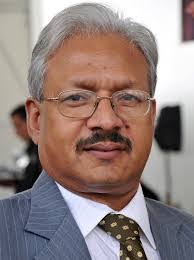 A. J. Philip

.jpg)
.png) John Dayal
John Dayal
.jpg)
.png) Jacob Peenikaparambil
Jacob Peenikaparambil

.jpg)
 P. A. Chacko
.png)
.png) Robert Clements
Robert Clements
