

.png) Dr Suresh Mathew
Dr Suresh Mathew

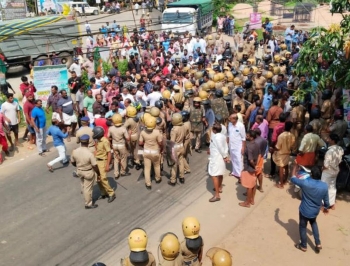
The world witnessed one of the worst episodes of human rights violation when attacks were unleashed on hundreds of fisherfolk at Vizhinjam in Thiruvananthapuram in the southern tip of Kerala; and it happened barely two weeks before the Human Rights Day on December 10.
The epicentre of violence was where the Adani Port is coming up, threatening the livelihood of tens of thousands of fishers. The port is showcased as a harbinger of development. But studies, reports, research and independent analysis by experts do not support this claim. They point to the perils to the coast and its sweeping adverse impact on the life of those who solely depend on it. The argument on development is a story mired in controversies.
Shrinking coastline is no more a tale told by vested interests. It has become a reality, sounding a death knell for the fishers whose life solely depends on the vast coast and the sea. In several places in and around the affected areas, as reports say, the coast has been eroded drastically, reducing it to a shadow of what it used to be. Those displaced due to the project are living in pigeonhole-like accommodation in cement godowns. Their rehabilitation is nowhere in sight. The government’s promises on the fishers’ demands remain merely on paper. In the face of utter apathy of the authorities, the victims stare at a bleak and uncertain future.
No words are enough to condemn the brashness of the government and some political parties branding the sons of the sea as terrorists and anti-nationals. Those who were praised as the saviours and angels, for their rescue operation in the food-hit regions of the State, have overnight become anti-nationals and their movement for survival is termed as treason and sedition.
Equally deplorable is the attempt to give a communal colour to their struggle for survival. It is unacceptable to look at the children of sea through the prism of caste, creed or religion. The government has stooped to unfathomable depth by registering cases against the Archbishop of Thiruvananthapuram and others who were not even present at the site where violence erupted last week. According to reports, violence was unleashed on people who went to the police station seeking release of those arrested for no rhyme or reason.
The easiest way to tarnish and tackle any rights movement is to smear it with ‘extremist’ or ‘anti-national’ tag; an equally malicious ploy is to brand it as a ‘conspiracy’ in connivance with those plotting against the country. Both the Central and the Kerala state government seem to be comrades-in-arms in this regard. We saw this in the Bhima-Koregaon incident in which over a dozen rights activists, academicians and intellectuals were put behind bars under Unlawful Activities Prevention Act.
The way Fr. Stan Swamy, the messiah of Tribals, was jailed branding him as a Maoist and anti-national, leading to his death in custody, is still fresh in our minds. The corporate-leaning governments did the same with the farmers’ agitation; and they do it with every human rights movement, tagging each one with ‘anti-nationalism’. Unfortunately, both the Left and Right governments and political parties are lending a shoulder to each other in grabbing the ‘share of the loaves that fall from the corporate tables.’
.jpg)
.png) Cedric Prakash
Cedric Prakash

.jpg) Elsa Lycias Joel
Elsa Lycias Joel
.jpg)
 A. J. Philip

.png) Jacob Peenikaparambil
Jacob Peenikaparambil
.jpg)
.png) John Dayal
John Dayal
.jpg)
.jpg)
.png) Joseph Maliakan
Joseph Maliakan
.png)
.png) Robert Clements
Robert Clements
.jpg) Cedric Prakash
Cedric Prakash

 ICPA
ICPA