

.png) Dr Suresh Mathew
Dr Suresh Mathew

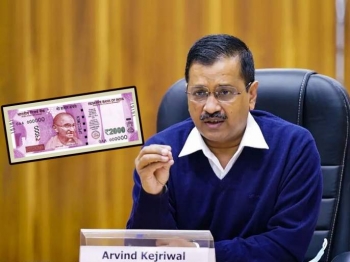
More Christian than Christ is an old cliché. It can now be paraphrased to make it contemporary. Aam Aadmi Party supremo and Delhi Chief Minister Arvind Kejriwal has turned more Hindutva than the most hardcore Hindutva proponents. His latest ‘words of wisdom’ that India’s economic downturn can be reversed, and achieve prosperity, by having the images of Lord Ganesh and Goddess Lakshmi on the currency notes, expose his expertise in political plotting. He says the blessings of the deities on the currency notes would be the panacea for the economic crisis gripping the country. What a novel idea, sirji! What a profound economic prescription! The mercurial politician who upstaged his mentor Anna Hazare and highjacked the anti-corruption movement to get his political baptism has now shown his true colours. He has no qualms to go to any length, and depth, to suit his political purpose and expand his empire.
But his prescription and the path he has chosen are nothing but ‘Tughlaqi’ on several counts. The economy of any nation can be revived only through sound policies. There is no short cut to energize a sagging economy other than implementation of planned economic schemes. Institutions like Planning Commission; Economic Advisory Council; the Reserve Bank of India and similar institutions; and counsel of well-known economists are meant to take care of the economy and its problems. Hence, the prescription of Kejriwal is nothing less than crazy and bizarre. His intention is nothing but communalizing an aera which has hitherto remained elusive to this diabolic measure. If images of deities can revive economy, the United Kingdom, which is in dire straits on economic front, can have the picture of Jesus Christ, along with that of the incumbent king, and could boost its economy. There would not have been any need for Liz Truss to resign either.
Kejriwal says that the existing picture of Mahatma Gandhi, placed at the centre of the currency note, can be retained. In that case, the image of the god and the goddess would have less prominence than the Gandhi picture which would be nothing but insult to the deities. It shows Kejriwal is playing a dangerous communal card to garner votes and outdo the BJP on electoral front. It is ridiculous that his craving for ‘Hinduism and its deities’ skyrocketed on the eve of the Assembly elections in Gujarat and Himachal Pradesh where his party is testing the waters. The Delhi Municipal Elections too are round the corner. He had started off as a liberal who vouched for secularism. He was projected as the saviour of minorities. But as time changes, he has proved to be a fast adapter, be it on issues like nationalism or Hindutva. He has no qualms in changing his ideology as fast as the chameleon changes its colour.
Kejriwal is slowly perfecting his electoral politics as an art of achieving not only the possible but also the impossible. He knows that there is no other issue other than religious ones which would garner maximum support and votes for him. Unfortunately, in attempting to attain his aim, he is plunging to the depth of communal politics. His bid to be a ‘carbon copy’ of the original Hindutva forces will do more harm to the nation than any good.
.jpg)
.png) Cedric Prakash
Cedric Prakash

 ICPA
ICPA
 ICPA
ICPA
 ICPA
ICPA
 ICPA
ICPA
 ICPA
ICPA
 ICPA
ICPA
.jpg)
 A. J. Philip
.jpg)
.png) Jacob Peenikaparambil
Jacob Peenikaparambil
.jpg)
.png) John Dayal
John Dayal