
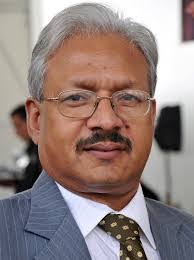
.png) Dr Suresh Mathew
Dr Suresh Mathew

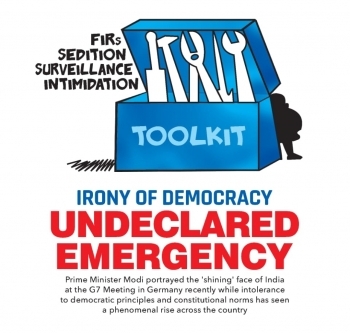
"Today, we can proudly say that India is the mother of democracy,” said Prime Minister Narendra Modi during his recent visit to Munich to attend the G 7 meeting. Addressing the Indian diaspora, he claimed: “India was a slave… now it is leading the world.” More importantly, at the summit, he, along with four other countries, signed a document on protecting the freedom of speech. But something intriguing happened back home on the same day. The Delhi police arrested Mohammed Zubair, journalist and co-founder of the reputed fact-checking website AltNews, for a tweet he did in 2018. The ‘shining’ face of India Modi portrayed in Germany was suddenly defaced by the stifling of freedom of speech and the civil society actors in India.
The hard fact is this: The government unapologetically comes up with draconian laws to put a leash on various freedoms made available by the Constitution of India. Those in the government have no qualms in trampling upon institutions to suppress the voice of the people, the soul of democracy. The rights activists are at the receiving end of the government and its agencies. Even NGOs, working in areas where the government’s development arm does not reach, are choked and made to starve for funds. The situation is akin to an undeclared emergency under the façade of democracy.
A new trend among politicians is to unleash unbridled attack on the Constitution for the ills of their own making. The Sangh Parivar outfits and leaders were in the forefront of the boisterous demand for rewriting the Constitution. Of late, the ‘virus’ has spread from the saffron brigades to the red-flag holders. The nation got to see a glimpse of it when a CPM Minister in Kerala went hammer and tongs against the Indian Constitution terming it as a means to loot the people.
The intolerance to democratic principles and constitutional norms has seen phenomenal rise in the past few years. Protests and dissent, the corner stones of democratic form of government, have become anathema to the present regime. We have seen non-violent protesters being booked under the most pernicious UAPA and sedition laws; raising slogans against the ruling party and the government has drawn the regime’s ire; forwarding tweets critical of those in power has resulted in life behind bars for weeks and months; those speaking up and acting on behalf of tribals, Dalits and the marginalized are being branded as terrorists and thrown into jails, denying bail for years. If these are not signs of undeclared emergency, what else will we name it?
It is equally important to look at what is happening on the ruling side of the fence. Those inciting violence, as seen during the East Delhi riots last year, have gone scot-free; ruling party leaders and Sangh Parivar swamis, who have publicly screamed for taking up arms to get rid of certain sections of the society, have been treated with kid gloves. The proof of the pudding is in eating. The BJP spokesperson, whose utterance denigrating Prophet Muhammad drew worldwide condemnation and unprecedented censure from the Supreme Court, remains untouched by the long arm of the law; but innocent Stan Swamy who lived for the Tribals, was made to die in custody. This is the irony of Indian democracy. The government would do well to follow what Chief Justice of India N. V. Ramana said: ‘Recognition and protection of people's rights and dignity as well as speedy justice are imperative for functioning of a healthy democracy.’
.jpg)
.png) Cedric Prakash
Cedric Prakash

.jpg) Elsa Lycias Joel
Elsa Lycias Joel
.jpg)
 A. J. Philip

.png) Jacob Peenikaparambil
Jacob Peenikaparambil
.jpg)
.png) John Dayal
John Dayal
.jpg)
.jpg)
.png) Joseph Maliakan
Joseph Maliakan
.png)
.png) Robert Clements
Robert Clements
.jpg) Cedric Prakash
Cedric Prakash

 ICPA
ICPA