
.png) Dr Suresh Mathew
Dr Suresh Mathew

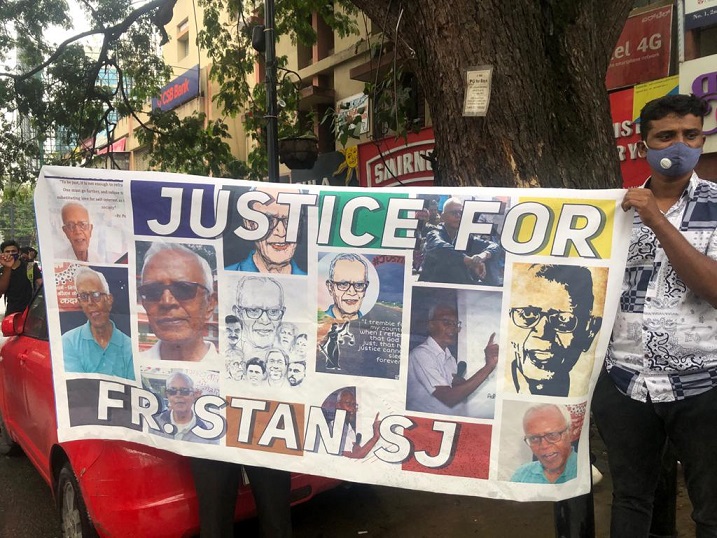
Dissent is anathema to the government; raising the issues of Adivasis is seen as an anti-national activity; helping the oppressed to seek justice is labelled as terrorist activity. The arrest and judicial custody of Fr. Stan Swamy, the 83-year-old Jesuit priest from Ranchi, is the most telling commentary on the highhandedness of the government. “If you dare to challenge us, you will face the music,” seems to be the dreaded message to the people.
The hard-earned freedom is becoming a mirage in the largest democracy in the world. Earlier, a ‘foreign hand’ was seen behind anyone who dissented from the official stand. Under the present regime, the terminology has changed. Anyone who dissents is branded as anti-national, Maoist or Naxalite. It has become the norm to equate the word ‘activist’ with ‘anti-national’. Ironically, many who are holding the reins of the present regime or working behind it were dissenters at one point or other. Hence the government would do well to take a leaf out of the lives of the activists instead of hounding them like terrorists.
Many of them, including Fr Stan Swamy, could have lived a cozy life if they had not decided to take the path of activism. But they decided to speak up for the people who are exploited. Fr. Stan Swamy realized that his call to be a priest would be meaningless if he did not identify with the people among whom he worked. In working for them and siding with them, he saw fulfilment of his prophetic mission; in raising voice for them, he was following the footprints of his Master, Jesus Christ. It is He who guided him to question the exploitation of the Tribals by corporate houses; it is He who prompted him to help hundreds of Tribal young men who were put behind bars for no rhyme or reason. The activist priest considered his work among the afflicted as his greatest badge of honour.
Fr. Stan Swamy is not alone in facing the vindictiveness of the government. There are many others like Varavara Rao, Vernon Gonsalves, Arun Ferreira, Sudha Bharadwaj, Gautam Navlakha, Anand Teltumbde and Hany Babu who too are put behind bars citing their alleged Maoists or similar links. They too, like Fr Stan Swamy, have been working for the entitlement of people whose rights to ‘water, land and forest’ are being snatched away by the government and its cronies. The government seems to be getting nervous that the hitherto suppressed people are coming out seeking their rights. They are no more docile as they used to be; they are choosing aggressive ways to challenge the government which has failed to protect their basic rights. The government sees a big threat in the rights activists as they are conscientizing people; it is probably feeling the sand slipping beneath its feet.
Fr Stan Swamy had said: “When each dissenter is put behind bars, a thorn each is removed from the flesh of the ruling class.” But he has left something unsaid. For each ‘thorn’ removed, many more ‘thorns’ could come up to challenge the oppressive, intolerant and tyrannical government. It is incumbent upon the civil society to offer full support to the rights activists against whom a smokescreen of ‘Maoist-link’ has been created to crush dissent. The Church should throw its weight behind those fighting for the people on the margins.
.jpg)
.png) Cedric Prakash
Cedric Prakash

.jpg) Elsa Lycias Joel
Elsa Lycias Joel
.jpg)
 A. J. Philip

.png) Jacob Peenikaparambil
Jacob Peenikaparambil
.jpg)
.png) John Dayal
John Dayal
.jpg)
.jpg)
.png) Joseph Maliakan
Joseph Maliakan
.png)
.png) Robert Clements
Robert Clements
.jpg) Cedric Prakash
Cedric Prakash

 ICPA
ICPA