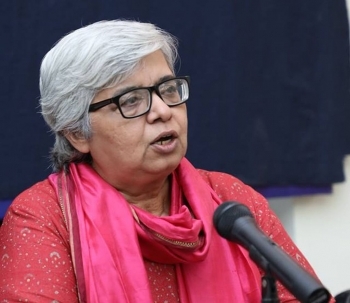


.png) Anju Grover
Anju Grover

The hijab controversy of Karnataka has gone national as several political leaders have expressed serious concern in Parliament and outside. Political analysts find a link between Uttar Pradesh elections and the hijab controversy. They allege that the Bharatiya Janata Party (BJP) is apparently trying its best to ensure Muslim votes get splintered in Western Uttar Pradesh on the back of this spiralling protest. Then there are informed Muslim voices who say that wearing a hijab is not necessarily a compulsory part of Muslim culture. They say that right-wing leaders from the Muslim community have given the matter a political and religious twist. In the midst of all, several people have gone to the courts.
Anju Grover for Indian Currents spoke to political activist Shabnam Hashmi on the hijab controversy. Hashmi has condemned the issue saying that it has been blown out of proportion by those with political or religious interest. She said whether Muslim girls should or should not be allowed to wear hijab in the pre-university colleges where a uniform dress code is in place should be sorted out between the agitating Muslim girls and the management of the colleges concerned. But the manner in which it has been converted into a Hindu versus Muslim conflict by the saffron scarves clad pro-Hindutva boys taking to the streets was not acceptable, she lamented. Hashmi is against hijab as it is not an identity. The activist said that wearing hijab by choice is the result of patriarchal/feudal conditioning of Muslim girls when they are young.
Q: Your views on hijab issue?
A: I condemn the attack on women on the hijab issue. The way they are being hounded by various sections is not acceptable. But hijab is not my identity or pride. It is problematic. A lot of women activists have different views on the issue. For many women, it could be their choice. But these choices have been constructed over a period of time. The conditioning is done by the society in the form of choices. I am not going to stop any one from wearing ‘hijab’ but I won’t glorify it.
Q: Is the issue related to women only?
A: It is a complicated issue. It is part of a larger agenda of demonizing Muslims that has been going on for over two decades and especially in the last seven years. I don’t see any problem if Udupi-based girls’ college does not allow wearing hijab. It could have been sorted out at the college level if right wing people from both the sides had not jumped into it. The issue has been blown out of proportion.
Q: Do you suspect that there is politics behind it?
A: The BJP has been trying to communalise Uttar Pradesh elections. The drama of firing on Asaduddin Owaisi's convoy failed to polarise the society. The party has made several attempts to communalise issues. I have heard that some women who were not wearing hijab belong to Campus Front of India. (It is noteworthy to mention here that the Campus Front of India has claimed that Akhil Bharatiya Vidyarthi Parishad (ABVP) members were the ones who supplied saffron shawls and provoked students.) People’s Front of India (PFI) has blown it out of proportion. It is a bigger conspiracy which serves the right wing and patriarchal forces.
Q: The law says that you practice religion at home but at work place, you have to follow rules and regulations of the institution?
A: As an activist who believes in gender equality, I am not ready to say it is fine. I am perturbed when I see three or four or five-year-old Muslim girls being wrapped up from head to foot in hijab. I don’t want children (girls) of any religion to be subjected to this kind of confinement by the feudal and patriarchal forces. Is it her choice to wear hijab when she has been conditioned to wear hijab?
Q: Your suggestions for dealing with hijab issue?
A: There is no magic wand to solve this problem. So, it is a big challenge for the judiciary to deal with this issue. Whichever way it goes, it will create more problems. Fundamentalists from both sides are going to gain regardless of court ruling.
Q: How do you see the role of Karnataka government in handling this issue?
A: The Karnataka Minister’s statements are deplorable.
.jpg)
.png) Cedric Prakash
Cedric Prakash

.jpg) Elsa Lycias Joel
Elsa Lycias Joel
.jpg)
 A. J. Philip

.png) Jacob Peenikaparambil
Jacob Peenikaparambil
.jpg)
.png) John Dayal
John Dayal
.jpg)
.jpg)
.png) Joseph Maliakan
Joseph Maliakan
.png)
.png) Robert Clements
Robert Clements
.jpg) Cedric Prakash
Cedric Prakash

 ICPA
ICPA