

.png) Jacob Peenikaparambil
Jacob Peenikaparambil

Religious conversion or conversion from one religion to another has been a bone of contention in India for many years. Even before the independence the issue was taken up by organizations like Hindu Mahasabha. The Sangh Parivar organizations consider Buddhism, Jainism and Sikhism as the offshoots of Hinduism, and Islam and Christianity as foreign religions. They also hold the view that the forefathers of Muslims and Christians in India were forcibly converted to these religions and hence they are to be brought back to the Hindu fold. That is why they have been engaged in reconversion or Ghar Wapsi programmes.
The issue of religious conversion has been used by the Sangh Parivar and the BJP for polarizing people and creating bad blood between the Hindus on the one hand and Muslims and Christians on the other hand. That is why the states ruled by the BJP have passed anti-conversion laws. This strategy got an extraordinary momentum after the BJP came to power at the Centre in 2014 under the leadership of Narendra Modi.
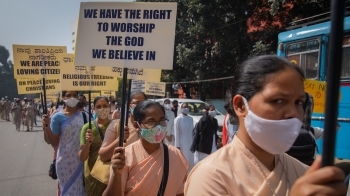
Hate speech and violence against Muslims and Christians on the pretext of conversion also increased exponentially after 2014. The days preceding Christmas 2021 witnessed a large number of incidents of violence against Christians. A very stringent and conspicuously anti-minority, anti-conversion law with provisions seemingly anti-constitutional was passed by the Karnataka Assembly despite widespread protests by the Christian community and other Civil Society Organizations. Once it is passed by the Legislative Council it will become another draconian law.
Against this backdrop, the Forum of Religious for Justice and Peace (FORUM) organized a webinar on 5th February 2022 in view of educating priests and the Religious on various aspects of this issue and the precautions they can take to prevent violence under the guise of conversion. During the webinar, Dr. Kalapana Kannabiran, a sociologist, lawyer and human rights activist, explained that the issue of conversion is to be understood in the light of the preamble of the Indian Constitution, Fundamental Rights and Directive Principles of State Policy. Freedom of ex
Dr. Kannabiran also said that reconversion or Ghar Vapasi also comes under the ambit of conversion. Hence the exception given to reconversion in the laws passed by some of the states is not constitutionally tenable. While concluding her talk she suggested a popular movement to get rid of these laws and confronting specific instances of violence against the minorities.
The second speaker, advocate Robin Christopher from Bangalore explained how violence is inflicted on the Christian faithful and how it can be prevented. Filing cases against the perpetrators of violence is one of the effective means to stop violence, but very often the victims of violence are not ready to file cases mostly due to the fear of further violence.
One of the questions appeared in the chat box, during the webinar, is very pertinent. There are thousands of students, especially from the elite sections of society, who have been the beneficiaries of Christian educational institutions and they are in various influential positions. Why do they remain silent in the face of attacks on the Christian community?
Another question raised during the interaction with the speakers was related to approaching the courts for declaring the anti-conversion laws null and void. “In the prevailing socio-political scenario, it is unlikely that the courts will declare the laws out rightly unconstitutional,” replied Dr. Kannabiran. It was mentioned during the interaction that the anti-conversion laws were passed first by the Congress governments in Orissa and Madhya Pradesh in the 1960’s. Very recently Arvind Kejriwal, the head of the Aam Aadmi Party, batted for a law against forced religious conversions. He also said that conversion through influence, money or threat is wrong.
As part of the organizing team of the webinar and an active participant, I wish to emphasize four points related to the issue of conversion. First of all, there is an urgent need for followers of Jesus aligning with people of all religions who are committed to secular democracy and protecting the Constitution of India. Freedom of religion is one of the fundamental rights. In the present scenario, the Constitution and the fundamental rights are in danger. In fact, India has become a de facto Hindu Rashtra, according to many political analysts. In the absence of implementing the provisions of the Constitution, freedom of religion will be a mirage.
The followers of Jesus will have the moral courage to fight for their rights, including freedom of religion, only if they practice the values of the Constitution: secular or pluralist democracy, justice, equality, liberty, fraternity and respect for individual dignity. Hence one important point of introspection for Christians is how much they value the core constitutional principles and what efforts they are making to practice and promote the core Constitutional values. Do they accept, appreciate and celebrate diversity, the millennial heritage of India which is being destroyed by the right-wing groups today?
The second point is related to the empowerment of Christians in India. Compared to 2.3% Christians, the Jains in India are only 0.36, according to the 2011 census. But their influence and political clout appear to be several times more than that of Christians. The institutional presence of Christians especially that of Catholics in India is several times more than their proportion in the total population. The main reason for the weakness of the Christian communities appears to be lack of their empowerment. Lack of empowerment is the reason for their reluctance to file cases against the violators of their rights.
Often the pastoral care of the Christians is limited to a set of prayers, rituals and catechism. In the context of the Indian Christians, the ultimate goal of pastoral care should be holistic empowerment of Christian families and communities.
It may include 1) enabling the Christian faithful to live the values and principles of Jesus and become role models of Christian living; 2) each Christian family having an assured income to meet its needs; 3) all young members of Christian families having an education equal to graduation; 4) no Christian youth remaining unemployed; 5) coaching given to Christian youth for competitive exams, especially civil service exams; 6) providing leadership training to all Christian youths; 7) all Christians becoming sensitive and compassionate to needy people; and 8) all Christians becoming agents of peace and harmony by accepting, appreciating and celebrating diversity in religion, culture, language etc.
The third point is related to the educational apostolate of Christian Churches. According to the CBCI Office for Education and Culture, the Catholic Church in India has 54,937 educational institutions, 26,96,850 teachers and 5,19,48,600 students. It means that at any point of time, the Catholic Church has the reach to 5.2 crore families and majority of these families are not Christian. Every year lakhs of students are leaving the portals of Catholic educational institutions after completing their studies. A large number of them remain in the same school from Lower KG to Class 12, i.e. fourteen years.
What extent those who are in charge of the Catholic educational institutions have been successful in influencing their students with the core values of Jesus and the values and principles of the Constitution? If the alumni of these institutions are keeping silent when attacks take place on Christians, if the parents of 5 crore students who are studying in more than 50,000 Catholic educational institutions do not speak against injustice and violence on Christians, it is an indication of a serious lacuna in the approach of the Church. It tells that the Catholic Church has not succeeded in instilling in the students the core values of Indian Constitution, especially the value of secularism/pluralism. The priests and the Religious who are involved in education apostolate and the leaders in the Church have to take immediate steps to reinvent the educational apostolate in view of the tectonic socio-political changes taking place in India.
The fourth point is concerning the varying understanding of evangelization by different Christian denominations, including the Catholic Church. They have to come to a consensus that evangelization is continuing the mission of Jesus in the present context by adopting ways and means that are culturally and religiously sensitive to the people of India. Jesus’ mission was bringing about transformation in Individuals and society by accepting and practicing the values of forgiveness and reconciliation, sensitivity and compassion, justice and non-discrimination, respecting the dignity of all and selfless service.
The followers of Jesus have to focus on individual and social transformation through various ministries in view of facilitating the reign of God. The reign of God envisaged by Jesus and the vision of India articulated in the Constitution, especially in its preamble, are more or less the same. If the Christians focus on following the way of Jesus and his mission as depicted in the Gospels, especially in the Sermon on the Mount, a lot of unnecessary controversies can be avoided and the issue of religious conversion will gradually be forgotten.
.jpg)
.png) Cedric Prakash
Cedric Prakash

 ICPA
ICPA
 ICPA
ICPA
 ICPA
ICPA
 ICPA
ICPA
 ICPA
ICPA
 ICPA
ICPA
.jpg)
 A. J. Philip
.jpg) Jacob Peenikaparambil
Jacob Peenikaparambil
.jpg)
.png) John Dayal
John Dayal