

.jpg) Novin Christopher
Novin Christopher
.jpg)
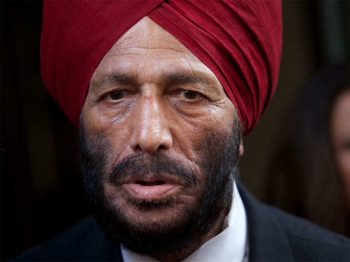
I first saw Milkha Singh, the Flying Sikh, in 1972. He had visited our athlete practice ground where I was training for 400 meters hurdles to participate in Annual Naval Athletic Meet. The moment I saw him, my focus involuntarily shifted to his feet, as all my life I had heard stories of him running barefoot.
When I was a child, my grandfather made me walk barefoot on green grass every day at the crack of dawn, but I could never dare explore this curious idea of running without shoes. I always wondered how someone could run barefoot on hot, scorching tracks.
Milkha Singh ran barefoot even when he participated in the Army meets. In his early days, he trained himself without the availability of modern facilities such as, Running Spikes, Tracksuits and proper Tracks. This legend of Indian Athletics ran the 400-meter race barefoot at the MCG during the 1956 Melbourne Olympics. Another person to have run barefoot and acclaim glory in Olympics had been famous Ethiopian marathon runner Adebe Bikila, who set a world record, winning the Marathon at the 1960 Rome Olympics.
Milkha Singh was born in a Sikh Rajput family in a village named Govindpura, 10 km from Muzaffargarh city in Punjab Province, British India. He was one of 15 siblings, eight of whom died before Partition in 1947. His parents died in the violence during the riots that took place during partition. Anticipating further troubles, Milkha Singh escaped to Delhi. He was even imprisoned for a brief period at Tihar Jail for travelling on a train without ticket. Before taking accommodation with his sister, he spent some time at a refugee camp in Purana Qila and later at Shahdara resettlement colony, both in Delhi.
Life wasn’t easy for him as he worked at roadside restaurants to make ends meet. He got disillusioned, and became more and more cynical and misanthropic. It was at this point that his brother Malkhan Singh persuaded him to join the Indian Army. Milkha tried to enroll himself thrice in 1948 and 1949. But it was only in 1951 that he managed to get himself recruited in Electrical Mechanical branch. It was here that his athletic prowess emerged. His everyday 10 km distance run to and from school as a child helped him get noticed by the army athletic coaches, who nurtured him as a sprinter.
G.K. Nielson said: “Successful people are not gifted; they just work hard, then succeed on purpose”. Milkha’s mission in life was based on these lines. He wanted to excel in running; therefore, he worked very hard on his training, practicing day and night, no matter what the circumstances. He knew that to perform at the highest level against the best in the world, he had to be motivated by the desire to do better than his personal best. He had to be patient and composed when working on his skills and keep his focus on winning every race. In addition to working on his running ability he also emphasized on improving personality traits by developing self-confidence, self-discipline, strong sense of motivation and sense of belonging.
His best race for which he became very famous was his fourth-place finish in the 400-meter final at the 1960 Olympic Games. His fourth-place time of 45.73 seconds remained an Indian National record for four long decades, till it was broken by Paramjit Singh in 1998.
Milkha Singh had the distinction of winning Gold for India in 400-meter race at the1958 Commonwealth Games. He also won Gold medals in 1958 and 1962 Asian games. He was awarded the Padma Shri, India’s fourth highest civilian honour, in recognition of his sporting achievements.
There are many unforgettable memories of his greatness but one is worth mentioning. After he completed the 440 yards (400 meter) race as a Winner in 1958 Commonwealth Games, the entire stadium erupted and chanted Milkha…Milkha. Everyone was shocked at how a boy from rural India had won Gold in such a big event. Milkha was in tears when he stood on the Podium, watching the tricolor being hoisted. After the ceremony, Vijay Laxmi Pandit congratulated him and said that her brother -- Prime Minster Pt. Jawaharlal Nehru -- wanted to know what he would like as a reward. Out of simplicity all he asked was that the Prime Minister declare a day’s holiday in India, and he did.
In the same year, he was invited to take part in 200-metre race at an International Athletic Meet in Lahore, which he initially declined. But after Nehru’s pursuance he agreed to attend. His main rival was none other than Abdul Khaliq, then known as the fastest man of Asia. Despite the huge local support for Khaliq, Milkha Singh prevailed over him and won the prestigious race. General Ayub Khan, then president of Pakistan, during the medal ceremony, announced that Milkha was not “Running” but “Flying”. He bestowed upon him the title “Flying Sikh” and the nickname stuck for the rest of his life.
His successes in 1958 got him promotion from the rank of Sepoy to Junior Commissioned Officer (JCO). He was further promoted to the rank of Captain (Honorary) for his contribution to Athletics. He retired from the Army in 1998 and eventually became the Director of Sports in the Punjab Ministry of Education.
The Sporting Icon of India, who now rests in peace, had 77 international race wins to his credit. It is now up to the new generation to fulfill his dream of seeing the Tricolor hoisted in the Olympics Arena by winning Gold in Athletics.
(The writer is an ex-Merchant Naval Officer and ex-Naval Athlète.
E-mail:novinchristopher@gmail.com)
.jpg)
.png) Cedric Prakash
Cedric Prakash

 ICPA
ICPA
 ICPA
ICPA
 ICPA
ICPA
 ICPA
ICPA
 ICPA
ICPA
 ICPA
ICPA
.jpg)
 A. J. Philip
.jpg)
.png) Jacob Peenikaparambil
Jacob Peenikaparambil
.jpg)
.png) John Dayal
John Dayal