

.jpg) F. M. Britto
F. M. Britto
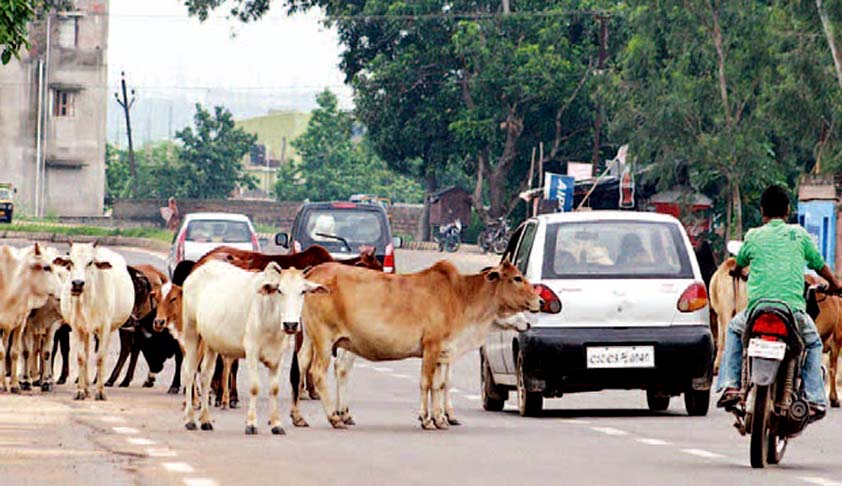
The bright light opposite me was blinding my eyes. Suddenly, I noticed a huge black bull lying leisurely on the road. Before I could halt my bike, it hit that beast, and I fell on the road. Parking their car at the side, a good driver and the owner lifted me from the middle of the road and laid me on the side. The driver fed me water from his bottle while its owner called my people to come to attend to me. Lifting up my damaged bike, they kept it on one side.
Thank God I survived. However, there were 919 reported deaths and 3017 wounded in a total of 3,383 such road accidents that occurred during the last five years in Haryana State alone, informed the State's Agriculture and Husbandry Minister J. P. Dalal in the Assembly. Who is responsible for the loss of so many innocent lives? The government gives no compensation for these deaths and accidents, however poor these victims are. Even if no compensation is paid, is the government seriously taking measures to curb this menace?
Listening to the public petition, the Chief Justice of Chhattisgarh, Ramesh Sinha, and Justice Ravindra Kumar Aggarwal asked on July 8, 2024, what measures were taken to prevent this menace. The government lawyer had nothing to answer. When the public petition was filed in 2019, the court in Bilaspur gave many suggestions. The high court gave directions on September 9, 2015, but they all remain only on paper. Attending again to the petition in March 2024, Justice Sinha said it was a major problem and sought a response from the government.
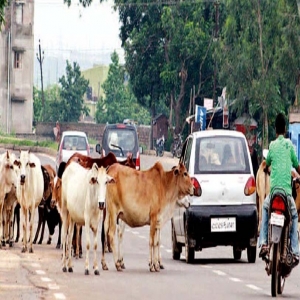
Hundreds of bulls, cows, and buffaloes lie not merely on rural roads but also on city streets and national and state highways. Are there no owners for these domestic animals? Villagers say they are no longer interested in keeping the cattle. They now plough their fields by tractors. In many villages, there is no one to graze them, unlike in the earlier days when every village had cowherds.
More animals come to take shelter on the roads at night. During the monsoon, the farmers guard their fields from these cattle. Since the cattle cannot graze the crop and no owner searches for them, the public road becomes their cattle shed.
After the saffron party came to power in Delhi, many state governments built gaushalas to shelter stray cows. According to basic animal husbandry statistics, there are 7676 gaushalas in the country. Rs 19,94,000 is allotted to each in Chhattisgarh to care for these stray cattle. But the gaushalas lie vacant, and the cattle are out on the road.
What is more precious for the government: the lives of human beings or cattle? If the government does not care for people, why would the people care for that government?

.jpg)
.png) Joseph Maliakan
Joseph Maliakan
.jpg)
 A. J. Philip
.jpg)
.png) Jacob Peenikaparambil
Jacob Peenikaparambil
.jpg)
.png) John Dayal
John Dayal
.jpeg)
.png)

.jpg) Thomas Menamparampil
Thomas Menamparampil
.png)
.png) Robert Clements
Robert Clements
 Jacob Peenikaparambil