

 Pachu Menon

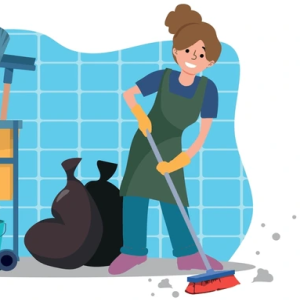
The other day, a banker friend phoned me to ask whether I could help her search for a good housemaid. A good housemaid! Therein lies the crux of the whole matter! When it comes to maids, the quality of being good or bad is a perception. Otherwise, they are generally what they are made out to be.
Moreover, these searches are usually tantamount to a literal 'combing operation' where the quest for reliable help involves spreading the word. As rare 'commodities' whose demands have only gone up with the changing times, searching for a maid is a challenging task and one that could be grouped as one in the realms of impossibility.
These are not so much about the ramblings of a distressed heart as they are of the pangs of disillusionment entrusted with a job that is easier said than done. Akin to searching for a needle in the haystack, the task is cumbersome. Ranging from the ever-dependable to the equally unreliable domestic help, while maintaining a routine and demeanour that has served to flatter many, has clearly disappointed others. But it is the assurance that the usual household chores will be taken care of while the owners get on with other, more pressing matters which has made domestic help a great draw with the urban population.
As with all the other professions, this line of work has evolved into an industry that commands a huge market. 'Ramu Kakas', as an indispensable part of the families in the past, are now remnants from the pages of history. It is now the age of 'Bais' who are central to the very essence of the city and the homes that they work in.
The disintegration of traditional joint families, many believe, has led to the sudden cessation of an age-old practice where those employed in such households thought it a pride to be serving these families. Generations serving the same lineage were not unheard of in the past. But today, the nuclear family is considered the 'traditional' family, consisting of a mother, father, and children. Accordingly, the need to have many servants in the house is regarded as an impractical indulgence bordering on extravagance.
The 'servant problem' has once again swept across the country. Despite the technological advancements that helped transform household work, families continue to see it as a constant, unrelenting burden. I have reframed a few lines from an article I came across on LinkedIn regarding domestic help during the pandemic. Cost-cutting or for whatever other reason. "In modern times, giving up domestic help is perhaps symbolically the supreme sacrifice a household can make."
In India, domestic help is more of a necessity than a luxury now. How has such a situation come about? When it is claimed that housemaids are an integral part of the Indian middle class, especially in urban cities, it implies that the middle class is responsible for the burgeoning culture and, in a way, has nurtured the belief that life without them would be impossible.
These days, Goa has a higher percentage of maids from the tribal belts of the country employed in various homes across the state. They are procured either through agencies or they are family members of migrants who are employed in factories and construction sites across the state. Live-in workers are most sought after by families, with both the husband and wife employed and pursuing independent careers. While some have been lucky enough to have their parents doubling up as glorified babysitters, it is those unfortunate few who have had to depend solely on help for not only their domestic chores but also to take care of their children.
Then there have been the 'piece-rate' maids who charge by the number of jobs they handle for their 'clients'. With this being the rage in modern cities, several maids are doing the rounds of residential colonies. There was a time when domestic workers faced tough times as home appliances and smart cleaning gadgets cut into their employment opportunities in various homes. Today, it is a different story altogether. The washing machines, vacuum cleaners, and dishwashers at home, which should have ideally reduced the housewives' dependence on maids, have only made work all that easier for the maids. In fact, as the latest fad, we have maids insisting on employers providing them with these gadgets.
At the same time, it is all the more disheartening to note that having maidservants has become a status symbol for many upper-middle-class families in India. When changing one's routine has become the demand of the times with lifestyle diseases causing quite a lot of problems among people, it is shocking to note that there is a distinct dislike even then for doing regular household chores and one has to depend on paid help to manage the affairs of one's house. One can understand health issues compelling the hiring of domestic help. But for a perfectly healthy family, the idea does appear preposterous!
An 'ayah' coming in to prepare 'Chapatis' or help when parties are hosted apparently signifies classiness among the upper middle class, where this sophistication is a measure of one's position. The working women often find they can't do without the services of a maid at home. But what could describe the frantic search for domestic help when all that it serves is to help maintain one's social standing! But then, that is the way things are!
While word-of-mouth helped secure the services of a housemaid some years back, it is now the placement agencies supplying maids, cleaning women, cooks, nannies, gardeners, and even drivers and guards to various households raking in the moolah. But the influx of working hands from distant states who readily find employment as maids and ayahs here does not come without its share of threats to the employers. Generally implicated as prime suspects in most reported household theft cases, it becomes pertinent to thoroughly check the antecedents of their domestic help. A system is in place where the employers could get this done by getting details of their workers submitted at the local police station for verification. However, the urgent need for a maidservant makes house owners oblivious to the need to comply with such statutory obligations and usually end up inviting trouble for themselves. That is not to say honest and loyal servants are a vanishing breed! But considering the economic background of those hired, employers tend to get sceptical.
It would, however, be a gross injustice if one is not to mention the ill-treatment met out to many domestic helpers by their employers. Ample instances abound where maidservants have been mercilessly tortured and underpaid by their employers. With the emphasis on how well she does her work and her behaviour towards the household members, employers tend to forget that they, too, are human beings and need to be treated as such. Harassment by employers is a common complaint that falls on deaf ears. Despite allegations of exploitation, authorities usually turn a blind eye to such matters.
Organizations like the National Domestic Workers Movement (NDWM) have championed the rights of domestic workers, children in domestic work and migrant domestic workers since 1985. According to a report published by 'Women in Informal Employment: Globalizing and Organizing' (WIEGO) way back in 2014: "Generally domestic workers come from vulnerable communities and backward areas. The majority are poor, illiterate, unskilled and do not understand the urban labour market. Their work is undervalued, underpaid and poorly regulated". "Lack of decent wages, work conditions and defined work time, violence, abuse, sexual harassment at work place, victimization at the hands of traffickers/placement agencies, forced migration and lack of welfare measures, to name a few, are the major issues they face."
Some steps have been taken by the Government of India in recent years to provide legal protection and social security to domestic workers. However, the rampant employment of minors as domestic workers is indeed a cause of concern. Moreover, "an analysis of labour legislations in India shows that domestic workers are not included in the scope of several labour laws because of constraints in the definitions of 'workman', 'employer' or 'establishment'." Necessary measures to correct the lacunae need to be adopted, and proper laws to meet the requirements of regulating this sector ought to be implemented.
.jpg)
.png) Cedric Prakash
Cedric Prakash

 ICPA
ICPA
 ICPA
ICPA
 ICPA
ICPA
 ICPA
ICPA
 ICPA
ICPA
 ICPA
ICPA
.jpg)
 A. J. Philip
.jpg)
.png) Jacob Peenikaparambil
Jacob Peenikaparambil
.jpg)
.png) John Dayal
John Dayal