

.jpg) F. M. Britto
F. M. Britto
.jpg)
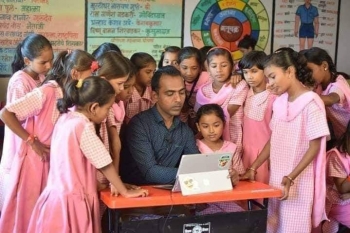
A village government school teacher became the first Indian to win the Global Teacher Prize 2020, selected from over 12, 000 nominations from over 140 countries. The excited Ranjitsinh Disale then declared to share half of his $1 million prize money with the other nine finalists (each will get about Rs 40.57 lakh).
The 32 years old Disale was declared the winner of the prize on Dec 3, 2020 for his works of girl child education and revolutionising text books in India.
“I am lucky that I chose teaching and could bring change in students’ lives,” he declared then. “Teachers are the real change makers who are changing the lives of their students. Teachers work for outcome and not income, and these teachers (the finalists) also are doing tremendous work and they should also get the reward. I want them to feel like winners and be equally happy. Together we can change this world because sharing is growing,” he announced.
Hailing from tiny Paritewdi village of Sholapur district in Maharashtra, Disale wanted to become an IT engineer. But due to ragging and bullying, he left the engineering college. His father advised the reluctant boy to take teaching profession. At the teacher’s training college Disale realized that the teachers are the real change makers in the world.
His first appointment was at the Zilla Parishad Primary School in 2009. The school was located between a storeroom and cattle shed. Most of the girl students being tribals, their education was not taken seriously and were given in marriage before age. He also found the text books not in their mother tongue Kannada.
So Disale learned Kannada and redesigned the text books from grade 1 to 4 so that the students can comprehend the subjects better. He included quick response (QR) codes into text books in order that his students can get links to audio poems, video lectures, assignments and stories. This innovation helped students develop problem-solving skills, creativity and better communication.
He also demonstrated scientific experiments from the science lab built by him. Campaigning to eliminate girls’ child marriages, he encouraged their education.
His efforts bore fruit with hundred percent of girls’ attendance and no child marriage. His school was awarded the Best School in the district in 2016.
Impressed by his innovation, the Maharashtra government introduced in 2017 QR codes in textbooks of all grades. The Ministry of Human Resource Development announced in 2018 that all NCERT textbooks would include QR codes in future.
Disale also teaches students from other parts of the world through Microsoft Educator Community Platforms and takes them to virtual trips. Becoming part of ‘Let’s Cross the Borders’ project, Disale is also connected with over 19, 000 students from eight countries to bring peace at conflict zones.
With his prize money he also wants to start recruiting 5000 students from war torn areas to Peace Army. He also wants to donate some of the prize money to establish a Teachers’ Innovation Fund.
.jpg)
.png) Cedric Prakash
Cedric Prakash

 ICPA
ICPA
 ICPA
ICPA
 ICPA
ICPA
 ICPA
ICPA
 ICPA
ICPA
 ICPA
ICPA
.jpg)
 A. J. Philip
.jpg)
.png) Jacob Peenikaparambil
Jacob Peenikaparambil
.jpg)
.png) John Dayal
John Dayal