

.jpg) Alexander Crasta
Alexander Crasta

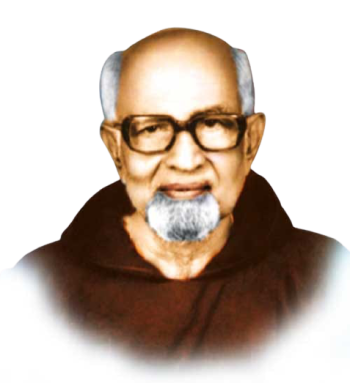
The SERVANT OF GOD, Fr. Alfred Roche, was born in a small island called Pandeshwar belonging to St. Peter’s Parish at Barkur in the Diocese of Mangalore (presently Diocese of Udupi) in 1924. His parents, late Mr. Isaac Roche and late Mrs. Carmine Monteiro, were farmers. But, Mr. Isaac Roche could find time to go to his parish church every morning and render his service as the sacristan for nearly 50 years, having daily crossed the Sita River on a small boat.
The baptismal name of Fr. Alfred Roche was Peter John. He was commonly known as Piti. He was the leader of the altar boys while he was in the elementary school. He joined the Capuchin Order in 1944, and in the novitiate he received the new name Alfred. Then, having finished his initial formation (seminary studies), he received the Sacerdotal Ordination in 1951.
Fr. Alfred Roche OFM Cap rendered his precious service in 4 places: 10 years at Monte Mariano Novitiate, Farangipet (Diocese of Mangalore) as a formator to the novices; 18 years at Holy Family Church, Brahmavar, Diocese of Mangalore (presently Diocese of Udupi); 3 years at St. Anne’s Church, Binaga, and 12 years at St. Joseph’s Church, at Lower Kasarkod, Diocese of Karwar.
At this juncture, one may ask: How and where did Fr. Alfred Roche acquire this new name, “Our Father”? Normally, if not the family members who are priests (by the grace of God I have two brothers who are priests, whom we call “Our Father/s”), we do not call the parish priest “Our Father”. But, the case of Fr. Alfred Roche is quite different. His pastoral ministry was unique. On account of his simplicity of life and dedicated pastoral ministry, solidly founded on the spirit of faith in God as well as his deep concern towards his flock entrusted to his care, he could mingle with every category of people, irrespective of caste and creed, age and stage.
His prime concern towards the faith-formation of his flock in and through catechism, down-to-earth sermons based on the Word of God and liturgical music; his special attention towards the education of the children and the youth even by helping them economically through friends and benefactors; his constant efforts to find adequate jobs to the youth and the jobless; his regular visits to the sick and the aged; his accompanying some of them even to the hospitals since he had personal contact with some of the doctors and nurses; his gentle and patient approach in repairing the wounded relationships within the family-circles and with others; his yeomen service in bringing back the sheep scattered owing to schisms and ruptures. All these evangelical virtues that he imbibed, spending time in the company of the Divine Master, the Supreme Pastor, enabled him to be not only a loving and compassionate pastor of the faithful and good shepherd of the flock entrusted to his care but also to be a loved and respected member of every family. That is how he gained this beautiful and meaningful name “Our Father”. For, he became the Father of all.
.jpg)
.png) Cedric Prakash
Cedric Prakash

 ICPA
ICPA
 ICPA
ICPA
 ICPA
ICPA
 ICPA
ICPA
 ICPA
ICPA
 ICPA
ICPA
.jpg)
 A. J. Philip
.jpg)
.png) Jacob Peenikaparambil
Jacob Peenikaparambil
.jpg)
.png) John Dayal
John Dayal