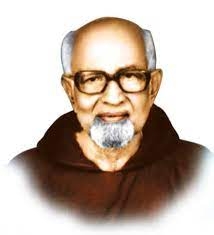


.jpg) Patrick Crasta
Patrick Crasta

As we know Pope Francis is a lover of children. On different occasions we see him approaching children, lifting them up, and caressing them. It is a sign that he has a soft corner towards children. Why? We know what the adage says: ‘As is the master so is the disciple.’ Pope Francis has imbibed this divine attitude from the life-pattern of Jesus, the Master par excellence, who was a lover of children. He fondly welcomed them and made them feel at home in His Company. When He saw that His disciples were getting irritated, when they saw little children being brought to their Master, He said: “Let the little children come to me, and do not stop them; for it is to such as these that the kingdom of heaven belongs” (Mk 10, 14).
As we know, the Servant of God, Fr. Alfred Roche OFM Cap, was a kind-hearted, simple, and loving person. The all-loving Father had endowed Fr. Alfred with the divine grace of loving the little children in a very special way. Owing to this grace embedded in his nature, children were attracted towards him and spontaneously flocked around him. So much so, often the presbytery became children-home and youth-centre. Highly gifted in music, he taught them catechism, liturgical music, popular songs, and accompanied them for picnics, singing with them and eating with them.
In order to make the children happy and creative, he gave new names to them. Fr. Santa Lopes, who is presently the vice-postulator for the Cause of Beatification of Fr. Alfred, writes in his book, Fr. Alfred Roche: A Capuchin After the Heart of Jesus: “One thing, which I observed very much, was that he called children by various names, like doctor, engineer, musician, violinist, lawyer, judge, secretary and others.... To be frank, though I did not have an office or files in my hands, and though I found it difficult to pronounce the word ‘secretary’, he called me his secretary. Oh! I was very proud of my title, whenever he called me secretary before others” (pp. 11-12). This was how he was instilling in them genuine interest to be someone great in life. This was Fr. Santa’s personal experience from St. Joseph’s Church, Lower Kasarkod.
His pedagogy was one and the same from place to place where he served as a pastor. Sr. Lucy Rodrigues, Snehalaya, Solur, would like to add something more from her personal experience from Holy Family Church, Brahmavar: “Every Sunday Fr. Alfred would sit in the confessional and wait for the children. No child could escape his sight because he loved the little ones tenderly. He followed them very closely. He won the heart of the little ones. As for me, I could never hide anything from Father. All my inner secrets I used to reveal him. If I were to hide anything I would be disturbed, such was the holiness of this great person. Just looking at us he would know from our face” (witness no. 58).
While meeting and talking to the children and the youth, the common affectionate term that he used was ‘PUTHA’ (son/daughter); and while addressing the elders the affectionate terms that he employed were ‘BABA’ (brother) and ‘BAE’ (sister). That was the reason why everyone lovingly called him ‘AMCHO PADRYAAB’ (our father).

.png) Jacob Peenikaparambil
Jacob Peenikaparambil
.jpg)
 A. J. Philip

.png) Cedric Prakash
Cedric Prakash

.png) John Dayal
John Dayal

.png) Jaswant Kaur
Jaswant Kaur
.jpg)
.jpg) Jessy Kurian
Jessy Kurian

.jpg) Prakash Louis
Prakash Louis
.png)

.jpg) Thomas Menamparampil
Thomas Menamparampil
.png)
.png) Robert Clements
Robert Clements