

.png) John Dayal
John Dayal

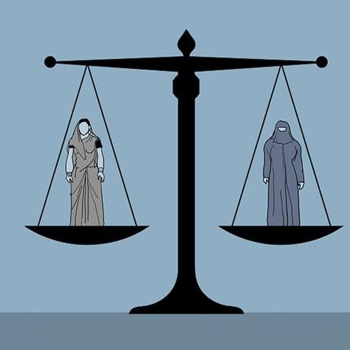
“Modi hei to Uniform Civil Code Mumkin hei” (‘Uniform Civil Code is possible if Modi is there’) – PM wants to ramrod compulsory monogamy on Muslims, scoring a notional conquest of their personal laws, and completing his, and the BJP’s, promise of a Hindu Rashtra to the extent it is possible in a world of Quad, armed UAVs, and dreams of a Security Council seat. But he may have spooked other religious minorities, particularly Sikhs, Tribals, and above all, women whose support he had taken for granted.
Political soothsayers in New Delhi predict that Prime Minister Narendra Modi will succeed in getting the Uniform Civil Code passed by Parliament when it meets later in July, hopefully in the new building that he has got constructed just in time before he leads his party into a third victory in the general elections scheduled next year.
The drafts of the UCC, which his predecessor Atal Behari Vajpayee could not produce in eight years, are said to be near ready. The 22nd Law Commission of India, headed by retired Justice Ritu Raj Awasthi, and a special committee of the Uttarakhand Government headed by retired Supreme Court Judge Ranjana Prakash Desai, are ready to submit their reports well in time for the Bill to be presented in the Monsoon session.
These are handpicked Commissions; and are working to a pattern. Their methodology is also singular. While the Uttarakhand committee began with close interactions with the Governor and the Chief Minister to know their mind, the Law Commission is conducting a “Google-type” survey with a peculiarly devised input methodology that in effect seeks a yes/no binary answer to the question if the citizen is in favour of a UCC or not. Nuances are lost.
Little wonder that at last count, more than 40 lakh Indians have given their opinion on the Uniform Civil Code. One does not have to be a magician to understand that if it were a national referendum on the UCC, most of India wanted this law, and now.
Their actual reports are expected to call for monogamy as a rule, cutting across religions, with personal and customary laws of Indigenous persons, in sharply identified regions, as the only exceptions. In simple English, this would mean that the Sharia permission for up to four wives to a Muslim at any one time, seldom actually practiced, will no longer be permissible.
Government hopes for a major success through a surgical strike much on the lines of the banning of Triple Talaq despite loud protests and lamentations by the community.
As with Triple Talaq, Mr Modi is banking on the support of section of women of the community who are articulate in seminars and social media against polygamy, genital mutilation as practiced in some sections of the Bohra community in Maharashtra and Gujarat, and "halala", which requires a divorced woman to cohabit with a second man if she wants to remarry her first husband.
There is a growing feeling among former acolytes of Mr Modi that while the Hindutva Card may still be potent in electoral matters, an ennui is fast setting in for want of cogent policies on employment, social welfare including health and real economic growth.
While the RSS cadres may still obey the diktat, middle level and town level leaderships of the party are getting restless, as a columnist wrote this week. Muslim-bashing as a national policy may suddenly not seem as attractive as it was last year, or even before the Karnataka elections.
Statistical data on polygamy, particularly bigamy, in India does not indict Muslims. They come at number three with Christian in the Tribal belts, and Hindus across the country, leading by far in the first and second positions. Neither government nor social groups have been able to adduce any data on “Halala”. There is evidence that genital mutilation is indeed practiced in some families on their young girls.
The 21st Law Commission, set up during Mr Modi’s first term, had in its 2018 report said a Uniform Civil Code was neither necessary nor desirable.
The government took its time appointing the 22nd Law Commission, and gave it shape once Justice Awasthi, who had given several judgments favouring the government, was available to be appointed as its chairman.
Mr. Modi may perhaps discover that the strike may be surgical, but the going will be tough, specially among the women. Muslim women have learnt a bitter lesson in the triple talaq law. The law criminalises the man who utters triple talaq. But his marriage remains intact. He will serve a three-year-term in prison but his wife, who in law is still not divorced, could well have to beg for food. Muslim households have since then also seen criminalisation and persecution of their men in the guise of love jehad, and conversions.
Contentious issues remain beginning with the very concept of marriage as understood in Islam and in other religions, and also on age of consent, prohibited relationships, the Islamic rejection of the concept of adoption as understood in other religions, and inheritance by women who stand to inherit from their husband, and also from a second husband if they remarry after a divorce or widowhood.
The Goa Civil Code, imposed by the Portuguese who ruled the state till its liberation, is no longer the holy grail it had seemed when Mr Vajpayee first supported it as a possible national law. The Code, infamously, allowed Hindu men to take a second wife if the first one had no child. The code is also criticised by women as being unfair in its heavy patriarchal setting.
Various groups of women, Muslims within themselves, and as part of secular groups, have met all over the country, but there has been no singular decision taken in favour of the sort of UCC expected from the law mills of Mr Modi. Christian women lawyers have spoken of the futility of answering any questions on the UCC without the government showing even a shred of a draft Bill.
The lack of a draft, the unholy political haste in thrusting the Bill down reluctant throats, and increasing doubt – specially in Christian circles – on Mr Modi’s motives and thinking on religious minorities, have precipitated a near unanimous response from Sikh, Christian and Muslim minority communities, and their various denominations, sects and their civil society. Political parties, led by the DMK as well as the TMC and the JD(U), have also focussed on similar points.
Responses, by mail and on paper through courier seeking personal meetings, have been sent by the Kerala Catholic Bishops Conference, the Catholic Bishops Conference of India, the National Council of Churches in India, the Federation of Catholic Associations of the Archdiocese of Delhi, law groups and activists.
The Muslim Personal Law Board has given a 100-page memorandum. The Jain community has cast its lot with the Hindus, as it – together with other “Indic” religions, Buddhism and Sikhism -- is a beneficiary of the Hindu Undivided Family laws with their taxation and other benefits.
The Sikhs have vehemently opposed the UCC as a betrayal of the agreement with the community at the time of the partition that its voice will be heard, and consent taken, in the forming of new laws. The Shiromani Gurudwara Prabhandhak Committee and the Shiromani Akali Dal have voiced their opposition.
Support for the UCC has come from the Aam Aadmi Party, though there seems to be a schism with the Sikhs in Punjab, with the party unit and the government there opposing the Modi code, as some call it.
The various factions of the Shiv Sena in Maharashtra continue to support the Modi government on the UCC as on some other issues such as Love Jihad.
The North-East states, barring the BJP governments in Manipur and Assam, have opposed the UCC as violating their customary laws including a matrilineal system of inheritance, forcing Union Home Minister to issue the first exception – the UCC will not apply to Tribal Christians. They are also, by the way, allowed to eat beef, otherwise banned in most states of India.
Government has not been able to convince anyone on the urgency for the UCC, specially as the 21st Law Commission had dismissed it almost in its entirety after detailed analysis and listening to minority and gender groups.
Many of the group representations have highlighted several issues in the context of the Government’s unholy haste to enforce a Uniform Civil Code on a country of 1.4 billion people and myriad cultures. These include how urgent are directive principles; how honest is government’s commitment to gender justice; and finally, how much interference can governments do in personal laws which do not impact public health, morality or law and order.
In this context, one has to see the persecution of Muslims, and now targeting of Christians as seen in Manipur’s ethnic strife, with Mr Modi’s tactical and strategic silence for three months. This puts the spotlight on the government's intentions towards the safety, security, and preservation of cultures of all religious minorities.
Experts maintain that the Directive Principles of State Policy are to guide how government functions, and the laws they make. By themselves, the directive principles are not laws. If the founding fathers and mothers so wanted, they could immediately have translated them into laws.
The government truncated Dalit rights by limiting it to the Hindus through the Presidential Order of 1950. That made religious discrimination acceptable in the Constitution, and in turn led to laws which favour one religion or sect or community. The Hindu Undivided Family law gives undue advantage to Hindu, Jain, Buddhist and Sikh faiths on Income tax and properties.
It is widely accepted that the government should encourage communities to carry on reforms in areas of religious practices and laws which have got stuck in time for various reasons.
Government can and should ban personal practices that put children at risk, and serious crimes in the guise of religious practices. Despite strong opposition, this was done when Sati was banned during the British Raj. Hindu law was codified despite resistance within the ruling party.
But religious reforms should be left to the communities themselves, with the government gently preparing ground conditions in which it becomes easier to happen. Communities under threat of violence or feeling majority pressure are less likely to carry out speedy reforms.
Much as the British government banned Sati, and the Sharada Act was brought in, in the face of opposition from the majority community to fix the age of consent as puberty – though it was a concept accepted long ago by the Aramaic communities across the world — it is possible for the government to bring individual laws to ban anything that comes in such categories of gender justice. The government did bring the law to ban triple talaq which was claimed as a reform the women of the community wanted.
Women have pointed out that if the government is keen to follow Directive Principles on gender justice, it could bring an omnibus law that includes equal opportunity in employment and salaries for women, 50 per cent reservation in all elective posts in the country including the Lok Sabha and the Rajya Sabha, and in educational institutions and scholarship.
Artificial uniformity and coercion will injure all religions, including the majority one which has the most diversity within it than any other faith.
Unfortunately, it is also true that the average Christian -- Catholic, Protestant, Evangelical or Pentecostal -- has never been educated on issues of constitutional rights. Nuances of the UCC have consequently been left to lawyers, or gender activists without a real debate or churning in the community as such. Legal and Constitutional education is in fact the real urgency if freedom of faith and religious rights are to be safeguarded in an increasingly hostile environment.
.jpg)
.png) Cedric Prakash
Cedric Prakash

.jpg) Elsa Lycias Joel
Elsa Lycias Joel
.jpg)
 A. J. Philip

.png) Jacob Peenikaparambil
Jacob Peenikaparambil
.jpg) John Dayal
John Dayal
.jpg)
.jpg)
.png) Joseph Maliakan
Joseph Maliakan
.png)
.png) Robert Clements
Robert Clements
.jpg) Cedric Prakash
Cedric Prakash

 ICPA
ICPA