
 P. A. Chacko
.jpg)
A recent video about a humanitarian act has been heart-warming at a time when we are enveloped by an avalanche of hate speeches, minority bating and perverted policies against the Muslims. The Muslim neighbours of a Hindu family have taught us a simple lesson that human kindness and human solidarity are hallmarks of human beings, and nothing else.
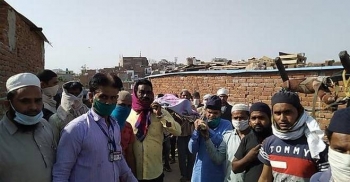
Seeing their neighbour, 37 year old Hindu man Rajendra Bagri, who died of throat cancer at Bajarang Nagar in Jaipur, Rajastan, and that his far away family members could not be present to pay their last respects due to Covid restrictions, the Muslim neighbours rose to the occasion. They carried the bier, chanting ‘Ram Nam Satya Hai’ and also carried the necessary accessories for the cremation. While Bagri’s brother lit the pyre, those who attended the funeral included Hamid Kayamkhani, Fahim Qureshi, Hanif Shah, Irfan Qureshi and Abdul Waheed.
The gesture was more than a Hindu ceremonial send off. It was, above all, a human fellowship bordering on a divine gesture. Should not our Hindu friends, fanatically hating and baiting Muslims, learn a lesson or two when their own community person was accorded an honourable cremation send off by Muslims as an act of human fellowship?
Should not our hate-spewing Sadhus and Sadwins and their politically loud-mouthed patrons prostrate before such people in humility and ask pardon for all the crimes and hatred perpetrated against the Muslim community?
But, that is not going to be. Sensitivity and humility appear not to be in their dictionary. Operation Ayodhya Verdict is not enough. Now another operation is underway. Operation Gyanvapi mosque, ordered by a Varanasi court, to see if it was built over a Hindu temple! Such claims can go on and on, and, in this majoritarian feelings dictating atmosphere, mosques and churches can be razed to the ground on mere allegation.
The way the government is permitting millions of devotees crowding at the Maha Kumbh Mela without social distancing, without mask, without Covid test, has raised alarm bells nationally and internationally. And such free-for-all celebrations are favoured by the ruling dispensation while, in contrast, the Muslims were taken to task for their Tabligi Jamaat at the Nizamuddin Markaz in New Delhi last year. That was a gathering of about 3500 persons even before any announcement of the Covid as pandemic in India. A political ‘jihad’ was unleashed against the Muslim community, not even sparing even Muslim vegetable vendors, by using ‘abusive and degrading’ terms like ‘corona jihad.’
Wasn’t it a slap on the face of the ruling mahouts when eight months after 11 state governments filed 20 FIRs against 2765 Tabligi Jamaat members, not one was convicted? The courts nationwide strongly criticized the ‘malicious’ prosecutions devoid of evidence.
But, when it comes to Kumbh Mela, statements of politicians reek with illogical, unethical and communal overtones. Uttarakhand C M Tirath Singh Rawat declared that ‘Maha Kumbh Mela and Tablighi are not comparable. The Mela should go on. There should be no impediments. Faith in God will overcome the fear of the virus.’
What happens when the millions of Kumbh Mela devotees travel back and get to their villages? What assurance the government can give to the nation that the after effects of such celebrations will not turn into a national disaster? It is reported that hotels and public halls are being converted into Covid treatment centres. If the pandemic spreads like wild fire, even schools, community halls, stadiums, Panchayat Bhavans and night shelters have to be kept ready. But, the more important question is, how serious is the government in preventing such tragic situations?
On the other hand, electioneering and festivals like Kumbh Mela are described as ‘uncontrollable situations’. When it comes to Good Friday or Easter Celebrations of Christians, or Id gatherings of the Muslims, the government has another standard for measuring restrictions.
When politicians let their moral compass go haywire, they take the nation to a precarious precipice, and leave the citizens in the lurch to fend for themselves. What else can we say when the ruling dispensation acts with discrimination, favouring one groups of religious community while negating the identity of other religious minorities or communities? Such communally biased and politically motivated acts from our elected representatives are totally unacceptable.
.jpg)
.png) Cedric Prakash
Cedric Prakash

.jpg) Elsa Lycias Joel
Elsa Lycias Joel
.jpg)
 A. J. Philip

.png) Jacob Peenikaparambil
Jacob Peenikaparambil
.jpg)
.png) John Dayal
John Dayal
.jpg)
.jpg)
.png) Joseph Maliakan
Joseph Maliakan
.png)
.png) Robert Clements
Robert Clements
.jpg) Cedric Prakash
Cedric Prakash

 ICPA
ICPA