

.jpg) Dr. Anto Joseph
Dr. Anto Joseph

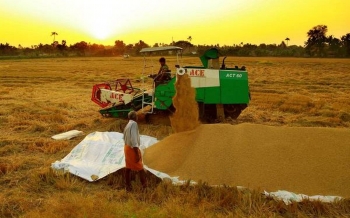
I have been planning since long to write a few words on the farmers’ protest in India. Permit me to start from my own home. Ours had been a farming family. We had a long stretch of farm just outside our home on the side of a river. On the day of harvesting, women would come early morning, line up, waiting for the headman to whistle announcing the start of harvesting. No sooner than the whistle, women waved the sickle in lightning speed. They would have harvested quite a distance in no time. I still remember the movement of the sickle in women’s hand with a speed not less than a machine. That was those days.
We are four brothers. Three of us left home years ago for different reasons. The brother who remained home, continued farming. I remember the many quarrels we have had at home when we brothers came together for holidays. These quarrels were centred on farming. Two of my elder brothers argued that my brother at home should stop farming. Farming incurred loss. They argued. They wondered why my farmer brother failed to understand the changing times. He did make loss, year after year. He used to say, “what if I make loss. Don’t we have rice to last for the year? If I don’t farm, hunger is at our doorstep”. During one such quarrel, my eldest brother told my farmer brother: “how much rice do you need for a year? I shall deposit in your account the amount you need to purchase rice to last through a year.” Oh, it sounds good! I had thought. “Why should my brother be farming, if he gets rice without farming?”
My brother still cultivates. When there is excess rain, the crop is lost. If everything goes well, he gets good harvest. With government support system such as MSP, compensation for crop loss, etc., he is able to hold on to his farming. All through the quarrels, my heart resonated more with my farmer brother than with the others. Somebody has to farm for others to have food, I argued. Some way or the other a farmer pulls his family out of poverty and hunger even if the final tally turns out to be a loss in economic calculus. I can state this with absolute certainty from my years of experience in rural Bihar that a household with some land as theirs experiences greater dignity and wellbeing. For a farmer, lose - making farm is a more secure means of livelihood than the CAPITAL that a third person promises to give.
Let me leave my home story and come to my second home where I joined as a Jesuit aspirant. It had been a large beautiful campus with mango groves, paddy fields, vegetable gardens, banana trees, well cared cows, and so on. Our fields provided employment to many women. They transplanted, weeded, and harvested; they cut grass and carried it on their shoulder to cowshed; they sang and smiled. It was late 80s. About 10 to 15 years after, whenever I returned to this home, I heard whispers, “why should we cultivate when it is making loss? As years went by this opinion gained strength. My farmer brother was able to withstand the onslaught of other brothers on loss making economic logic. But we Jesuits, who do not depend on farming for survival, could not withstand the all-powerful economic argument: farming is a loss, hence stop farming! It was only a matter of time, when we stopped farming.
Opening of a college in the same campus was the last nail. The college has to grow. We cannot continue farming; be rational – so went the argument. Everyone agreed as everyone wants to be rational. We cannot farm, we can’t keep incurring loss. We became rational. We stopped farming! Last year I found some of those women carrying bricks and cement. Theirs is a journey from sickle in hand and paddy on the head to carrying of bricks and cement. A typical story of our country’s development. Bricks and cement is mightier than the sickle; college is mightier than paddy fields! The bricks, cement and the college – the CAPITAL will have the last laugh. Farming is a loss, it must be stopped! We must carry bricks and cement! It gives us a satisfaction that we have arrived in the league of ‘developed nations’.
In layman’s language, I understand that this as crux of the agrarian crisis in India. There was a time when agriculture was the main contributor to country’s GDP. Moreover, agriculture was our heartbeat. From land and farming, we drew our sense of dignity of being human and developed our personhood with rights and freedom. Freedom and rights are antithetical to CAPITAL. For CPITAL to succeed, agriculture must die. Land must be freed from us!
Agriculture now is relegated to third position in terms of its contribution to country’s GDP. ‘Economic Theory teaches us with conviction that as economy grows, industry, commerce, service should gain pre-eminence. When agriculture is relegated to second, third, fourth position in terms of its contribution to GDP and reinvestment of the surplus, one must know that economy is growing; so says the economic theory that we teach our children! Agriculture is treated as secondary. Step by step, year after year, budget after budget, agriculture had been pushed back with the onslaught of the CAPITAL. Protest of farmers is a survival protest!
The new farm laws are the culmination of the ever increasing and intentional degradation of agriculture. The three farm laws tell us that the farmers are no longer indispensable. Not just indispensable, farmers shall be dispensed with. The Prime Minister, who facilitates with brute force the onslaught of the CAPITAL, qualifying farmers protest as pavitra (pious)is absurd and a lie. The niyati (intention) and content of laws are clear: it is not AGRICULTURE, but CAPITAL that the government shall choose and it is not to FARMERS but to CORPORATES that the country shall gift the future. What if the farmers built this nation and its economy! It is the past.
In the final analysis, agriculture from where we developed our culture and spirituality, personhood, dignity and sense of rights is dead. The laws are here! Food will be produced, but there shall be no agriculture. My brother will not be a farmer. He will not be his own man. He will be deprived of his land and dignity. He may still have rice by the mercy of capital, his master, as scraps of food fallen from corporate tables.
Going around the villages, I had been wondering why the government doesn’t invest anything in agriculture. How often I have desired that the government sets up a food processing unit anywhere in the district where I work. When I see the youth or hear about stories of their migration, alas, if there was one factory, one food processing unit, I desired! But that is not the case to be, not because it is impossible. It is the design! THE MODEL.
Corporates would amass land and its produce and design the food –size, colour, and taste - to feed the nation. They would be the annadatas! All this, of course, done with government loan to be written off in the darkness of a night. For corporates to come, it is necessary that profit skyrocket. Profit comes from cheap labour. The farm laws ensures labourers would be waiting in millions, mostly consisting of farmers of today, deprived of land, dignity and rights. Our Prime Minister has rightly described the would-be status of the farmers as parajivi – ever dependent on the corporates.
The wilful noninvestment of surplus back into agriculture, the successive governments ensured that farmers are freed from agriculture, reduced to the status of wage labour only to crowd the labour market to build cities, bridges, and high ways. Many hundred millions of migrants, whose pathos this nation had witnessed during the pandemic and the lockdown were once upon a time farmers who made a living from agriculture. As agriculture has been unsustainable, farmers who depended on land, migrated only to be welcomed by CAPITAL, hungry for cheap labour. To trap fish we used to place net on one end of the pond and disturb the water on the other end. The fish moves forward only to be trapped in the net! The government of the capital, by the capital and for the capital has placed the net at sunset. My brother shall cease to be a farmer at the rising of the sun.
It is a moment of reckoning. We have to choose between farmers-farm-dignity-freedom-rights on the one hand and CAPITAL-corporates-Sedition-UAPA-Hindutva on the other. During those quarrels at home I did not grasp why my brother adamantly wanted to remain a farmer. Farming is not just about its produce; it is about our personhood and dignity, freedom and liberties, and rights and entitlements. The farmers have made the right choice. They are on the high ways through winter and summer. Land and farming are ours. They should remain so. With all my love to my farmer brother, I salute every farmer and labourer of our country.
.jpg)
.png) Cedric Prakash
Cedric Prakash

.jpg) Elsa Lycias Joel
Elsa Lycias Joel
.jpg)
 A. J. Philip

.png) Jacob Peenikaparambil
Jacob Peenikaparambil
.jpg)
.png) John Dayal
John Dayal
.jpg)
.jpg)
.png) Joseph Maliakan
Joseph Maliakan
.png)
.png) Robert Clements
Robert Clements
.jpg) Cedric Prakash
Cedric Prakash

 ICPA
ICPA