

.jpg) Mathew John
Mathew John
.jpg)
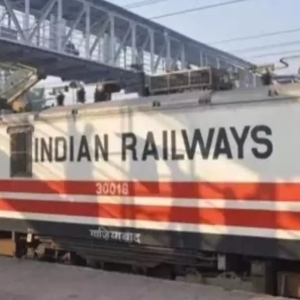
Writing about any government organisation today must be based on official handouts, published news, anecdotal evidence and putting two and two together because the present regime is obsessive about concealing everything that shows it in poor light. On Indian Railways (IR), the pall of fear is so palpable that no serving official is prepared to divulge the unvarnished truth of what's happening. Quite clearly, there is much to hide. So, it is only appropriate to state at the outset that my diagnosis of the state of IR may be touching only the tip of the iceberg. But what's revealed here is cause enough for worry.
Indian Railways (IR), the country's largest industrial undertaking, is grappling with a dangerous "Modified" world. This government is tearing apart traditions and systems developed over the decades in the oldest institution in the country. The brute reality is that bar in the sphere of largely unpreventable technology progression, IR is being vandalised, body and spirit, by a regime that is hell-bent on undermining, when not erasing, the past to project its own performance and burnishing the image of the only man who matters in the country today.
The leader sets the tone for an organisation. IR today, caught up in the all-pervasive cultism stalking our land, is headed by a former bureaucrat who never tires of telling us that until Modi took matters in hand, IR was a sector that was neglected. But his boss, the doctor of spin, has set the pace for such overweening hubris that he denies credit to anyone who preceded him.
In June last year, while flagging off the Dehradun-Delhi Vande Bharat Express, the PM dismissed all the IR had achieved before his reign with this brag: "All-round work to transform the Railways began only after 2014. Everyone was clueless before this." With this sneer, he belittled the invaluable contribution of railwaymen and women across the six-odd decades since Independence.
He didn't stop there. Even more preposterous was his claim, in the same self-congratulatory speech, that handling the pandemic and roll-out of vaccines was an unmitigated success. Such fanciful fiction is being peddled because he knows that dolts that we are, we have shrugged off the millions of deaths, the myriads gasping for oxygen in the corridors of hospitals, the burning pyres in makeshift crematoriums in parking lots, the sea of bodies floating on the Ganga whose banks were littered with little mounds festooned with saffron cloth that were graves. The country's greatest tragedy has been alchemised into a concocted success story.
The dishonesty at the top has percolated and badly affected every aspect of government work, including statistical bookkeeping, which is critical to assessing performance and making significant decisions. Today, government organisations are so mired in statistical fudging that most government-released data lack credibility. Amidst this universal deceit, one recalls a time when our country was renowned for the authenticity of its statistics. A critical component of Chinese Premier Zhou Enlai's visit to India in 1956 was his interaction with a team of statisticians headed by the legendary PC Mahalanobis. But from being a cutting-edge statistical powerhouse, the country has degenerated to a stage where our statistical figures are wishful rather than factual and increasingly at odds with the data and assessments of international rating agencies.
IR has also been infected by this malaise. As a former railwayman, I know that IR is sometimes cavalier about the statistics put out in the public domain. Still, this regime has gone over the top in manipulating statistics, mainly because of the ordained imperative of showing performance improvement compared to the position before 2014. Despite the fog of secrecy and tight control over what information can be released for public consumption, the 'doctoring' in some cases has come to light only because it is so brazen.
The average freight train speeds which were 27.2 kmph in 2010-11 declined to 24.4 kmph in 2019-20 but then, quite inexplicably, shot up to 43.2 kmph in 2020-21 and 37.3 kmph in 2021-22 by employing the simple artifice of deducting the period of major detentions en route. Regarding financial performance, even the otherwise pussy-footed CAG has pointed out the fudging of the operating ratio by removing pension expenditure appropriated to the Pension Fund from the computation of profitability. Likewise, there is rigging in calculating the punctuality of trains, the duty hours of loco pilots and a lot else hidden behind the Railways' iron curtain, where officers cower in complicit silence.
IR has historically been the mode of transport for the aam janta, who have hitherto been the Railway management's prime focus. The "Vision Statement" of 2011-12 stated that "Indian Railways shall provide safe, efficient, AFFORDABLE, customer-focussed…" transport, clearly spelling out its concern for the common man, i.e. the second-class traveller. But this regime is on an elitist binge, with its energies and finances concentrated on spectacular, high-profile projects such as the Vande Bharat clutch of trains, the Bullet train and profligate electrification. This lopsided fixation on glitzy projects has deflected managerial focus from the core areas associated with safety, such as maintenance and replacement of worn-out assets and upgrading safety infrastructure.
The glamorous Vande Bharat trains cater only to the well-heeled, reflected in the fact that while the cost of an ordinary second-class sleeper ticket by Express train between Delhi and Kanpur is Rs 300, the minimum fare by Vande Bharat is a whopping Rs 1115. Despite protestations of concern for the most disadvantaged sections, IR is replacing ordinary sleeper coaches from trains running at 130 kmph with AC-three-tier (economy) coaches, the fare of which is more than double that of ordinary second-class coaches. In the last few years, no new Jan Shatabdi train has been introduced, which caters mainly to the second-class passenger segment. A brutal capitalistic ethic reigns behind the veneer of 'sabka saath sabka vikas' socialism.
The railway minister constantly harps on how the Railways in this regime's watch has seen real transformation, a radical reformation of systems. But the havoc wreaked, apparently on the ill-conceived advice of a cabal of pet consultants, could more appropriately be described as institutional bombing that has undone systems and structures developed and nurtured over the decades. These guys are fecklessly advocating change for the sake of change, oblivious to the damaging effects on the system.
Take the merger of the Railway Budget with the Union Budget in 2016, disregarding the compelling rationale that the Railways needed to be independent, nimble-footed in decision-making and insulated from the rigid bureaucratic practices that typify government working, A catastrophic consequence of the institutional degradation has been a loss of focus on financial performance and balancing profitability with social obligations. With the subsuming of the Railway Budget into the General Budget, public oversight and scrutiny of our leading carrier is also no longer possible, and that suits a regime that thrives on cloak-and-dagger functioning.
Another radical but disastrous decision is the total revamp of the Railway management structure in 2019 based on a half-baked understanding of the complexities of the Railways. The wholesale "homogenisation" of the management cadre was done to combat departmentalism, a term coined to describe the rivalry and hostility between departments within the Railways. However, what's been done is akin to burning down a house to smoke out a rat. Almost five years on, the Ministry is still floundering on the rules regarding recruitment, seniority, and appointment to key positions.
The most disturbing spin-off from this godawful mess is the fishy new selection method for the top managerial positions. The traditional, time-tested system of assessment based on the record of service as reflected in the annual confidential reports twinned with vigilance clearance regarding integrity has been given the heave-ho in favour of an AB De Villiers-like "360 degree" assessment, which, like the great South African's pyrotechnics, observes no rules. In 2022, using the crutch of merit in lieu of the time-tested system of seniority-cum-suitability based selection, the Ministry chose only 8 officers from a pool of 130 aspirants for the coveted post of General Manager.
Factored into the selection was an assessment of the candidates by an establishment-preferred group of retired bureaucrats who played Solomon, apart from subjecting the candidates to a dubious psycho-analytical test to assess their "emotional quotient". What's obvious is that this highfalutin procedure is a mere crutch for the powers-that-be to choose whoever they want in the top managerial positions. Never has the morale of Railway officials been as low as it is today.
In conclusion, one cannot help taking note of how unrestrained this regime has been in its psychotic eagerness to erase, diminish or appropriate whatever was achieved before 2014. Even the Railways' invaluable heritage has not been spared. In the war with the past, culturally evocative artefacts and institutions have been uprooted to make way for newfangled replacements associated with this regime.
The iconic Darjeeling Hill Railway (DHR) steam locomotive of 1925 vintage, which for decades adorned the front of the Rail Bhawan in New Delhi, was shunted out to the Rail Museum and replaced with a Vande Bharat replica. But what has traumatised railwaymen, past and present, has been the uprooting of the Railway Staff College in Vadodara, renamed National Academy of Indian Railways (NAIR), which since 1952 has been the seat of learning for officers of the IR. A few weeks ago, the Ministry directed the NAIR to hand over all its assets to Gati Shakti Vidyalaya (GSV), a "Central University envisioned by PM Narendra Modi." In one fell sweep, an institution of learning steeped in railway lore and culture has been expelled to make way for yet another pretentious vanity project of the authoritarian.
A leading historian has observed that while history is in the past, heritage is in the present. It provides a visceral link with the spirit of the past and helps inspire a better perspective and understanding of our present. Or to modify what Marcus Garvey said, an institution without knowledge of its history, origin, and culture is like a tree without roots. But the Philistines who call the shots today couldn't care less for such soulful niceties. For them, it's all about one man and his image!
.jpg)
.png) Cedric Prakash
Cedric Prakash

.jpg) Elsa Lycias Joel
Elsa Lycias Joel
.jpg)
 A. J. Philip

.png) Jacob Peenikaparambil
Jacob Peenikaparambil
.jpg)
.png) John Dayal
John Dayal
.jpg)
.jpg)
.png) Joseph Maliakan
Joseph Maliakan
.png)
.png) Robert Clements
Robert Clements
.jpg) Cedric Prakash
Cedric Prakash

 ICPA
ICPA