

.jpg) Mathew John
Mathew John
.jpg)
As an early comer of the Baby Boomer generation and now on the cusp of dotage and maybe something more final, this -- for me -- is the time of memory and remembrance. Admittedly, the recurrent rummaging into the past has been accentuated by the forced incarceration brought on by this monstrous pandemic.
One also realizes that what one recalls of the ghosts of the past is deeply influenced by one’s present state of mind, which brings me to the point of this essay. At a time when our freedoms are being systematically compromised if not decimated, one harks back to the other dire period when this nation was in thrall of a dictatorship.
Forty-seven years ago, on 26th June 1975, Indira Gandhi declared a state of internal emergency, zoomed in on political opponents, trade unionists, and student activists who were packed into overcrowded jails even as all civil liberties were suspended. On the first night, electric power to newspaper offices was cut off and law enforcement officials were swarming all over the place. It was brutal stuff!
Denizens like me who lived through those twenty months of blatant abuse of democracy are invariably drawn to comparing that dark period with what’s happening today. The most obvious and glaring difference is that the Emergency was straightforward police and (Sanjay Gandhi) goonda raj, which was markedly different from the creeping, insidious authoritarianism behind the veneer of democratic functioning that is the modus operandi today.
During the Emergency, the regime’s opponents were marched off to jail misusing the omnibus emergency powers whereas the present dispensation has invoked punitive laws such as the NSA, UAPA, AFSPA and Section 124 A of the IPC to round up the “enemies” of the State. The UAPA, in particular, is being used with devastating effect to keep dissidents indefinitely in jail with no hope of bail.
The arch enemy is clearly the Muslim but anybody opposing the majoritarian Hindutva agenda is fair game. Lurking in every nook and corner are the regime’s storm troopers, primed to mete out summary street justice under the benign gaze of the State. During the Emergency, the critics were ambiguously labelled “forces of disintegration”, but now dissenters and adversaries are accused of the gravest crime of treason and branded as “anti-national” by cunningly equating the government with the nation.
With a brute majority in Parliament, Indira Gandhi forced through critical amendments to the Constitution, not so much to buttress her already absolute hold on power as to legitimise her illegal reign. The infamous 38th Amendment prohibited judicial review of the Emergency. The 39th Amendment ruled that the election of the Prime Minister could not be challenged by the Supreme Court but only by a body constituted by Parliament.
Of course, there is nothing more odious than a compromised, lily-livered Supreme Court, with the honourable exception of Justice H.R Khanna, deciding in the famous habeus corpus petition that detentions without trial were legal under the Emergency. In subtle contrast, this Government has taken the more devious route of cleverly manipulating and interpreting the extant provisions of the law to achieve its objectives without bothering to consider the spirit of the Constitution or the sensibilities of the people affected. The abrogation of Article 370 and the CAA are the most infamous examples of such dishonourable heavy-handedness.
The Emergency, presided over by Sanjay Gandhi’s thugs, was brazen fascism, but if there was a saving grace, it was the fact that the perceived enemy was not identified and picked out because of his community or caste. In fact, Indira Gandhi repeatedly claimed that “communal passions are threatening our integrity as a nation.” Her fascism was all about holding on to power through intimidation and fear but was definitely not about divide-and-rule on the basis of caste or creed. How different from today when communal polarisation is the cornerstone of this regime’s world view!
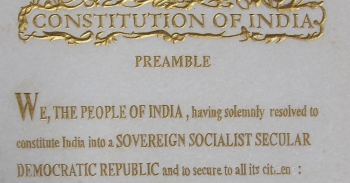
The present dispensation has launched an all-out assault on the nation’s soul, on the very idea of India that has been so clearly and succinctly expressed in the Preamble to our Constitution. Decades of indoctrination regarding ‘Hindu hurt’ and the need for cultural homogeneity has resonated with large sections of the Hindu community, generating what Sumit Sarkar calls a “communalised common sense”. The majoritarian impulse spurred on by this government threatens the entire secular and democratic foundation of our republic.
Among other things, political analysts have described fascism as an instrument in the service of big business. But equally true is the proposition that big business support is critical for the establishment of fascism, as evident in Nazi Germany, where the Junkers and industrial houses provided Hitler with the financial muscle. Indira Gandhi, however, was unashamedly socialist in her political stance, and was viewed with suspicion by the industrialists of her time. Her twenty-point programme was an ode to socialism.
In sharp contrast, today a brutal neoliberal creed operates behind the façade of welfarism. The three Farm Laws are the latest addition to the neoliberal songbook. During the many months of pandemic trauma, when millions have lost jobs, Gautam Adani added $16.2 billion to his wealth and Mukesh Ambani a modest $ 8.5 billion. The stock markets are booming like never before even as 230 million Indians have sunk below the poverty line due to the pandemic. That’s how “Sabka Vikas” is playing out on the ground!
Fascists need sycophants to fan their egos. In this regard, the two leaders with hyper-inflated egos have wallowed in unmitigated toadyism. Dev Kant Barooah’s grovelling declamation that “India is Indira and Indira is India” takes pole position in disgusting obsequiousness, though less known but even more reprehensible was Zail Singh’s fawning servility that he would “sweep the ground that Indiraji walked on”.
But such simpering flattery cannot compare with what’s happening today, when the entire thrust of the humungous multi-media publicity machinery of the government, the ruling party, the various wings of the establishment, amplified by the smarmy media, is concentrated on singing hosannas to the Supreme Leader.
The PM’s “inspirational” role in our fabulous Tokyo Olympics achievement is currently getting more media space and attention than the sterling performance of the individuals who won us the medals.
Fascists need factotums to do their bidding and carry out their orders. Hitler had his paramilitary SS squads and Mussolini his Blackshirts. In our country, we have the bureaucracy, inappropriately called “the steel frame”, which performs this role for whoever is in power.
As a junior functionary on Indian Railways during the Emergency, I am ashamed to admit that I was a collaborator of that iniquitous regime. Bear with me as I use anecdotal evidence, the much-maligned subjective experience, to describe the challenges that Indian democracy had to contend with during the Emergency.
Indian Railways, with its country-wide spread and gigantic workforce, is a microcosm of our great country and what happened on IR during the Emergency was a mini version of what was happening in the rest of the country. The two years preceding the Emergency were a promiscuous period of wildcat strikes and agitations on IR, a painful ex
It is indisputable that during the Emergency, there was increased productivity, improved punctuality, a sharp drop in accidents but in the bargain the basic features of democracy were set aside. The issues that mattered to labour – working hours, the dearness allowance formula, bonus – were unmentionable subjects. It must be said that so long as there was no active dissidence against the government, the management functioned without hindrances and with complete freedom, which was often misused to oppress the workers.
Apologists of the regime have justified its actions on the specious grounds that though freedoms were restricted, we had become more efficient! Nevertheless, though the Railway managers enjoyed untrammelled executive powers during the Emergency, most heaved a sigh of relief when Indira Gandhi was thrown out. After all, freedom is so precious that even storm troopers hate having to look over their shoulders all the time, but which bureaucrats did fearfully through the Emergency.
The present government has a much more insidious plan of action which demands not just blind obeisance but commitment to its ideology and agenda. From the looks of it, the current lot of bureaucrats have not been found wanting in the only trait that matters – abject servility. Every institution of government has been damaged by the cowardly bureaucrats’ failure to resist palpably unjust diktats. The law enforcement and security agencies, in particular, have blood on their hands. As hatchet men of this regime, they have wreaked terror and perpetrated injustice.
The massive fudging of key statistics, the silent acquiescence and abject failure to counsel against suicidal decisions such as demonetisation, the sudden lockdown, the scatter-brained restructuring of Railways management et al, reflect an all-pervasive cowardly inability to speak truth to power. L.K. Advani’s admonition of the Indian media during the Emergency applies to today’s bureaucrats: “You were asked to bend but you chose to crawl!”
We are in a bad way. At this grimmest of times, one is reminded of Hegel’s enigmatic assertion: “The owl of Minerva spreads its wings only with the falling of the dusk.” Did he mean that wisdom will finally dawn and bring forth light, or that we will understand things fully only when it is too late?
(The writer is a former civil servant)

.jpg) Stanislaus Alla
Stanislaus Alla
.jpg)
.png) Cedric Prakash
Cedric Prakash

.jpg) Elsa Lycias Joel
Elsa Lycias Joel
.jpg)
 A. J. Philip

.png) Jacob Peenikaparambil
Jacob Peenikaparambil
.jpg)
.png) John Dayal
John Dayal
.jpg)
.jpg)
.png) Joseph Maliakan
Joseph Maliakan
.png)
.png) Robert Clements
Robert Clements
.jpg) Cedric Prakash
Cedric Prakash