

.png) Jacob Peenikaparambil
Jacob Peenikaparambil
Pope Francis frequently addresses two pressing global issues: caring for the earth, "our common home," and fostering interfaith harmony through dialogue and cooperation. His commitment to these causes is evident through his travels, meetings with religious leaders, and joint declarations that emphasise the need for collaboration among faiths. One notable example is the Document on Human Fraternity for World Peace and Living Together, co-signed with the Grand Imam of Al-Azhar, Ahmad Al-Tayyeb, in February 2019.
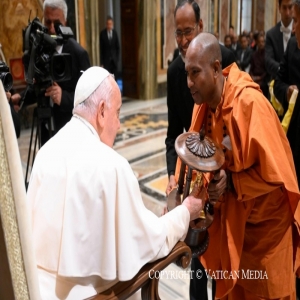
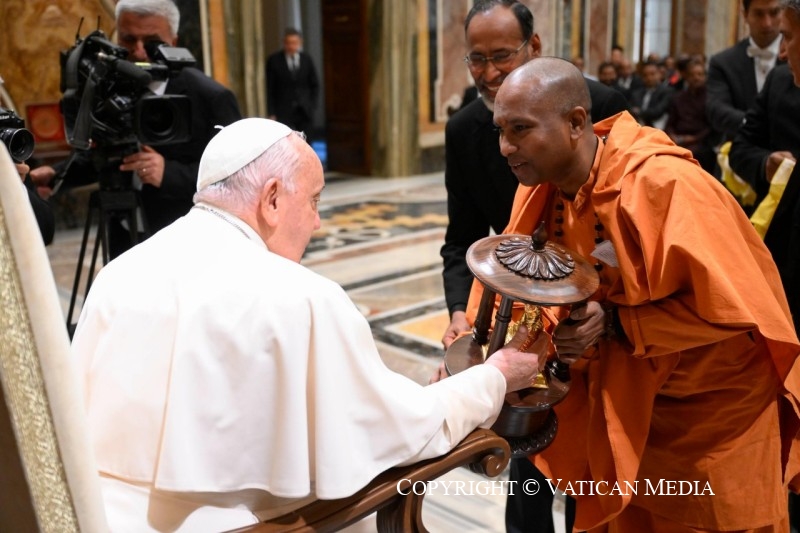
A recent testament to his dedication was his address on December 1, 2024, to faith leaders and representatives gathered at the Vatican to commemorate the centenary of the all-religion conference organised by Sree Narayana Guru in Aluva, Kerala. Supported by the Dicastery for Interreligious Dialogue, this event brought together prominent religious leaders from Kerala. Sree Narayana Guru (1856–1928), a revered spiritual leader and social reformer, championed interfaith harmony, advocating that "the human being must strive to be good, irrespective of religion."
In his speech, Pope Francis underscored the relevance of Sree Narayana Guru's teachings in today's world, where intolerance and hatred between communities and nations are rising. He highlighted the Guru's central message that all people belong to a single humanity and condemned discrimination based on race, language, ethnicity, religion, or culture. The Pope also quoted from the Document on Human Fraternity: "God has created all human beings equal in rights, duties, and dignity and has called them to live together as brothers and sisters."
Pope Francis attributed religion-based conflicts to the failure to adhere to the noble teachings of faith. He emphasised the importance of unity in diversity, harmonious coexistence amid differences, and peace-making despite challenges. He urged participants to cultivate a culture of "respect, dignity, compassion, reconciliation, and fraternal solidarity."
Pope Francis' message is very relevant to India, where discrimination, exclusion, hatred, revenge and violence against certain religious communities have become part of the electoral politics of the ruling party and many policies of the central and certain state governments. In the words of a prominent Indian lawyer, Dushyant Dave, "peace and harmony are compromised on a daily basis in the name of love jihad, vote jihad, bulldozer justice, and mob lynching." The divisive and polarising policies and strategies are being implemented in view of converting India into a Hindu Rashtra where Muslims and Christians will be treated as second-class citizens or even non-citizens without any rights. Hindu Rashtra envisages a majoritarian rule in which Muslims and Christians have no role.
Unfortunately, a large section of the majority community in India subscribes to the ideology of Hindutva. According to a Pew Research Center report, 64% of Hindus in India believe that it is "very important to be Hindu to be 'truly' Indian." Hindus tend to see their religious and national identities as closely linked. 80% of Hindus who believe it's essential to be Hindu to be Indian also think it's crucial to speak Hindi.
The tendency to make an allegation that underneath some mosques, there are remains of temples, followed by filing cases in courts for verification, has become a menace, leading to communal violence. The latest instance is the communal violence in Sambhal in UP in pursuance of a district court's order to conduct a survey of Sambhal Shahi Jama Masjid by the Archaeological Survey of India. In fact, an oral observation on May 20, 2022, by former Chief Justice of India (CJI) DY Chandrachud on the Places of Worship Act, 1991, while hearing a dispute over the Gyanvapi mosque in Varanasi, opened a pandora's box.
Chandrachud said that the Act does not prohibit ascertaining the religious character of a place of worship; only changing the nature of a religious place is not permitted. After that, several cases have been filed in courts claiming temples are under a particular mosque, triggering conflicts between two communities, often leading to violence and death, as happened at Sambhal.
Against this backdrop, how can inter-religious cooperation and dialogue be promoted? The Constitution of India provides for a secular (pluralistic) state in which all religions are to be treated equally, and all citizens have the right to "profess, practice and propagate" the faith of their choice. Therefore, educating people, especially young people, about the Indian Constitution is vital to fostering inter-faith understanding and cooperation.
Secularism, in the context of India, is consonant with India's millennial heritage- unity in diversity. It is not a concept borrowed from the West, as some right-wing groups claim.
As peacebuilding is integral to the mission of Jesus, Christians have a responsibility to engage in dialogue and reconciliation. Despite being targeted by right-wing groups, Christians must strive to act as agents of peace.
Self-reflection is essential. While many allegations against Christians—such as prioritising foreign allegiances or disregarding Indian culture—are baseless, Christians should ensure sensitivity to local traditions. For instance, forbidding students or employees from wearing cultural symbols like tilak or mehndi can appear insensitive. Similarly, practices like removing shoes while lighting a lamp during ceremonies, a sign of respect in many cultures, could be adopted.
Christian institutions can promote inclusivity by displaying ethical and moral quotes from various religious scriptures alongside the Bible and by creating interfaith prayer spaces. Events celebrating festivals of all religions can also foster understanding.
To counter accusations of forced conversions, Christians must clarify their mission of evangelisation as a means of social and individual transformation, emphasising values like compassion, justice, and reconciliation while respecting all faiths.
Jesus told his disciples to become "light and salt" to fulfil their mission. The disciples of Jesus are expected to influence others through their exemplary lives. What is important for the disciples of Jesus is not the quantity but the quality, as a bit of salt is needed to make a large amount of food tasty. As salt, the disciples of Jesus have to preserve society from being corrupted, give taste to societal life, make it joyful and harmonious, and heal people's social and psychological wounds.
Christians may take the initiative to collaborate with the followers of other religions to highlight social issues like violence against women and children, environmental degradation, drug addiction, etc. and find solutions for them.
Whenever any conflict occurs between communities, Christians may take the initiative to resolve the dispute and restore peace and harmony. Christian leaders shall maintain excellent public relations with the leaders of other religions in view of working as mediators of conflict resolution.
Christians have to be alert against fundamentalism taking hold of their religion. One reason for conflict among followers of different religions is the growth of fundamentalism or fanaticism within the religions. One aspect of religious fundamentalism is the belief that my/our religion is the only true religion or the best religion and that all should accept it.
Within the same religion, one group may interpret the faith from its narrow understanding and try to impose it on the other followers, even by force - yet another dimension of religious fundamentalism. The fundamentalists believe that their religion is beyond any form of criticism, and anyone who appears to be a threat to their beliefs will be dealt with violence. Religious terrorists belong to this group.
Logical explanations and scientific evidence have no place in the belief systems of fundamentalists. For fundamentalists, religion dictates every sphere of their daily lives. Fundamentalism generally shuts off the doors to accepting modern ideas and scientific principles and exchanging thoughts among societies worldwide. The Taliban in Afghanistan is an example of the worst form of religious fundamentalism. Engaging with fundamentalists of any particular religion from the perspective of dialogue is nearly impossible. Hence, Christians should not allow the fundamentalists to take over the leadership and control the believers.
Building and nurturing harmony among followers of various religions requires averting their politicisation and commercialisation and preventing the emergence of fundamentalism. India and the world need interfaith harmony. Pope Francis is a beacon of hope for building and nurturing interfaith harmony.
.jpg)
.png) Cedric Prakash
Cedric Prakash

 ICPA
ICPA
 ICPA
ICPA
 ICPA
ICPA
 ICPA
ICPA
 ICPA
ICPA
 ICPA
ICPA
.jpg)
 A. J. Philip
.jpg) Jacob Peenikaparambil
Jacob Peenikaparambil
.jpg)
.png) John Dayal
John Dayal