

 P. A. Chacko
Are they parasites? Are the people receiving state help or freebies?
YES and NO!
Let us start with the 'No!'
No, if the state, under citizens' Fundamental Right to Life (Art. 21), reaches out to the really indigent and deserving people so that they are not exposed to a lack of basic necessities of life. The state has a bounden duty to protect the unprotected and to preserve citizens' lives. Such beneficiaries are not parasites.
In our top-heavy system, controlled by the socially, economically and politically powerful forces, there are helpless victims unable even to survive. Are they parasites if the state comes to the help of such victims?
However, this should only be the first step as far as the state's duty is concerned. What is required of the state is that it should primarily tackle the unjust top-heavy system that allows the rich to become richer and the poor to grope in the tunnels of misery.
When the state demolishes unjustly and unjustifiably people's homes and properties, compensating the victims does not equate to making them parasites. Rail travel concessions for senior citizens or stipends to deserving students are not criteria for considering them parasites.
Reservations under Constitutional provisions are not meant to produce a class of parasites. They are temporary provisions to achieve some parity. But if such reservations are made eternal, they will definitely promote parasitism without tackling unjust socio-economic imbalances.
Yes, depriving the Adivasis of their resources and allowing corporations to grab their resources and displace them, and then giving them some freebies as a band-aid, is an agenda-based act of shutting their mouth and turning them into parasites.
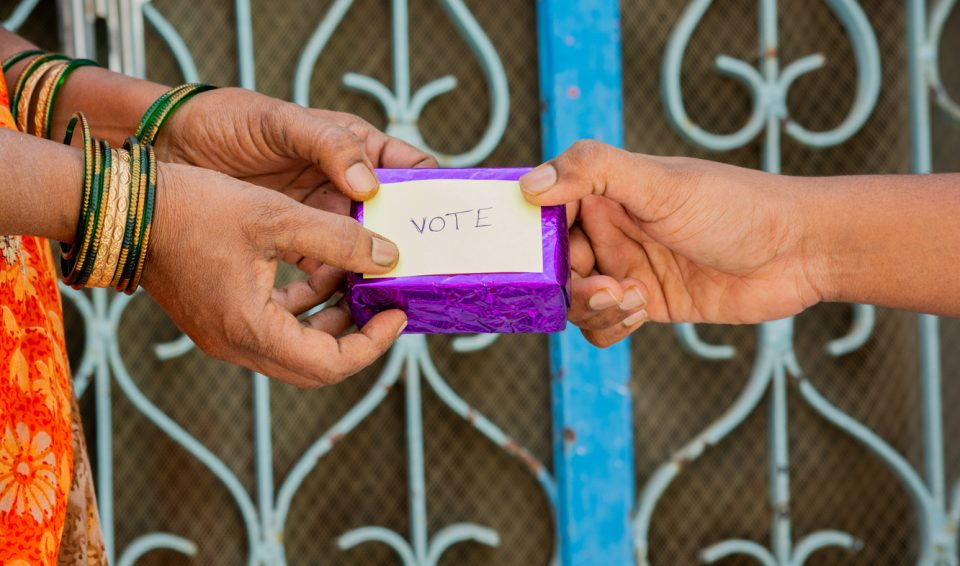
You make people parasites if you hoodwink them by rolling out red carpets for them on election eves and dole out benefits to them as if they are beggars. You think and treat them as if they are buffoons and parasites when you unbundle, in Lalu style, dhotis and saris to cover your 'naked' ambitions.
You treat them like idiotic parasites when your political aides bring truckloads of idiot boxes, in Jayalalithaa style, into their slum dwellings. Your revadies and doles are but lollipops to make them keep on sucking and hanging on to your apron strings for more.
Today, our politicians have perfected the art of throwing revadis before prospective and gullible voters so that the latter may cling to them like parasites. You need crowds wherever you go. You need them to crawl before you to balloon your prestige and massage your ego. So, across political parties, the revadi culture has captured the central stage. Each party is competing to woo voters and followers. Free electricity, free water, free gas, free, free, free. But not freedom of speech, freedom of ex
None of the political parties will allow research into the root causes of poverty and marginalisation. They will announce umpteen programs to alleviate poverty but not actually eradicate it because they have to continue currying favour with industrialists and business tycoons, sup with the rich and the social muscles, and bed corrupt and unholy elements. They need funds. Without the Ambanis and Adanis, Tatas and Birlas, they cannot make do.
Building up India on the lines of justice and equality should remain confined to the first page of the Constitution, the Preamble. That is what any party in the ruling chair will prefer. The caste system has to flourish and let Dalits be eternally Dalits so that those at the bottom of the caste/social/economic ladder remain where they are. They need to be there as long as we need recipients of our benevolence and revadies.
Let Gandhi and Ambedkar take eternal holidays. Here, we churn out the philosophy and political ideology of our choice. So, creating parasites suits the interests of politicians.
The Constitutional provisions under Art 38(2) are on a different terrain. They are meant to minimise income inequalities and disparities in social status until at least a semblance of socio-economic balance is achieved.
But, throwing freebies, like carrots before the horse by political windbags of all hues is decidedly a condemnable attempt to disrobe people of their human dignity and treat them like beggars, hoping that they remain devoted parasites.
.jpg)
.png) Cedric Prakash
Cedric Prakash

 ICPA
ICPA
 ICPA
ICPA
 ICPA
ICPA
 ICPA
ICPA
 ICPA
ICPA
 ICPA
ICPA
.jpg)
 A. J. Philip
.jpg)
.png) Jacob Peenikaparambil
Jacob Peenikaparambil
.jpg)
.png) John Dayal
John Dayal