

.png) Jacob Peenikaparambil
Jacob Peenikaparambil
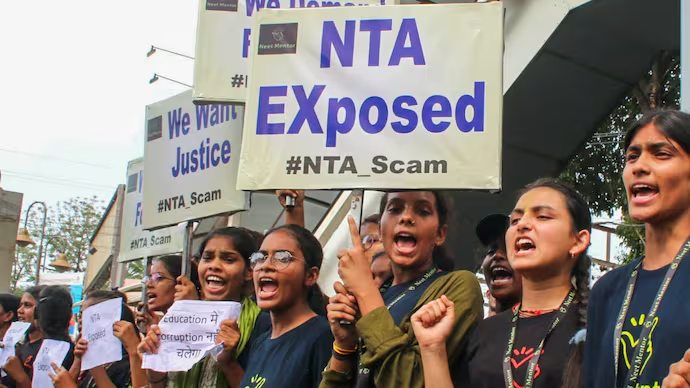
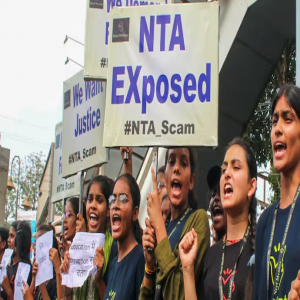
The confusion and corruption in Indian higher education are blown up with the exposure of malpractices in the NEET UG exam, the cancellation of the UGC-NET exam, and the postponement of the NEET PG exam. The National Testing Agency (NTA), which is responsible for conducting these exams, is in soup. The government has removed its director because of the agitation all over India and stringent criticism from the opposition parties. After remaining in denial of the paper leak in this year's NEET, the education ministry finally ordered a CBI enquiry on Saturday, June 22. The government has set up a high-powered committee to examine NTA's functioning and recommend ways for fair conduct of exams.
The NDA government appears to be in a firefighting mode to control the damage. Because of the inefficiency, carelessness and even connivance of the agency and the officers entrusted with conducting the high-profile examinations, the future of millions of young people is in danger. Quick-fix solutions cannot root out the rot in the education sector. Thorough investigation, cleansing and review are necessary to restore their sanctity. The first and most significant step in overhauling the educational sector should be the de-saffronisation of education.
The BJP, the political wing of RSS, will only intensify the saffronisation of education that started during the Vajpayee government and deepened during the last ten years. Civil society and the opposition parties must pressure the government to cleanse the mess in the education sector.
Saffronisation of education means instilling in children and young people through education the ideology of Hindutva. According to M S Golwalkar, the second sarsanghchalak of RSS, whom the RSS calls guruji, India belongs to Hindus; Muslims and Christians have to either become Hindus or remain in India as second-class citizens without any rights or privileges, including "citizenship right". RSS has been inculcating the ideology of Hindutva into the minds of children through its schools, like Saraswati Vidya Mandirs. During the last decade, the RSS got the opportunity to aggressively spread the Hindutva ideology across the country by capturing educational agencies and institutions under the government.
The BJP adopted various methods like rewriting history, distorting and manipulating history, changing syllabi, rewriting textbooks by deleting those portions which are not in agreement with the Hindutva ideology, etc., to instil Hindutva in young minds. According to RSS and the BJP, after Independence, India followed the colonial education system introduced by Macauly, which denigrated Indian culture and Indian contribution to science and medicine. It is totally wrong to say that India, after Independence, continued without any change in the educational system introduced by the colonial rulers. The educational system was reformed in light of the ideals of the Indian constitution and the needs of India as a developing country.
The deficiencies and drawbacks are to be corrected. However, it is an evolutionary process. Unfortunately, the saffronisation of education that was implemented during the last ten years was an uncritical glorification of ancient Indian culture and Hinduism without looking into its drawbacks, neglecting Muslim art and architecture, rejecting inclusive ideas of cultural development and imposing uniformity in the place of pluralism which is a unique gift of God to India.
The most dangerous aspect of saffronisation is the appointment of RSS cadre in the premier educational and academic institutions like the University Grants Commission (UGC), the National Assessment and Accreditation Council (NAAC), the Indian Council of Historical Research (ICHR), the National Council of Educational Research and Training (NCERT). RSS people are appointed to the posts of Vice Chancellors and teachers in Central Universities. The main criterion for their selection and appointment is their commitment to Hindutva ideology, not their capability and integrity. The result is inefficiency and corruption.
According to Rahul Gandhi, the reason behind the paper leak is that the education system has been captured by the BJP's parent organisation. "It's happening because all our institutions have been captured. Our Vice-Chancellors are placed not based on merit, but because they belong to a particular organisation. And this organisation and the BJP have penetrated our education system and destroyed it," alleged Rahul Gandhi.
In states without a BJP government, the BJP-RSS uses governors to appoint VCs and recruit teachers aligned to Hindutva ideology. This leads to constant conflicts between the governors and the state governments regarding appointments. Examples are Kerala, Tamil Nadu, and West Bengal. Another method the BJP uses to saffronise education is National Education Policy (NEP) 2020. As education is on the concurrent list, the state and central governments have equal powers in formulating educational policies. Through NEP 2020, the RSS-BJP government reduced the powers of the states. It highly centralised the formulation and implementation of educational policies to spread Hindutva throughout India. For example, the entire school education format has been changed through NEP-2020 and the National Curriculum Framework (NCF) 2023.
The zeal of the BJP government to centralise everything, including the examination system, is replete with inefficiency and loopholes for manipulation and corruption. As Pratap Bhanu Mehta wrote in his article in The Indian Express on June 25, "Just as the form of privatisation in Indian Higher Education was driven by a politician-educator nexus, the creation of centralised exams is also driven by a political economy of coaching. In this government, this shift in education has also been marked by a deadly combination of ideological control and administrative incompetence".
Another strategy for promoting Hindutva is imposing uniformity in place of unity in diversity. The NCF 2005 was a broad framework for the states to prepare curricula, syllabi, and textbooks. On the contrary, NCF 2023 is a highly detailed document of 625 pages in which even minor details have been elaborated. This is in view of pushing the Hindutva ideology of one nation, religion, and culture.
Replacing universal values with Indian feudal values is another aspect of the saffronisation of education. Under the guise of lightening the burden on children, the syllabus has been reduced by axing portions that promote liberal, scientific and pluralistic values. Chapters related to Mughals from History, references to Gandhi's assassination and ban on RSS from political science, references related to the Gujarat pogrom from Sociology textbooks, the chapter on Democracy from 10th class Social Science, Charles Darwin's Evolution Theory and Naxalite Movement have been removed. Indeed, this is an attempt to blunt logical and scientific thought processes and replace the liberal Indian constitutional values (liberty, equality, fraternity) with the traditional Indian feudal values.
Some of the latest controversial changes introduced in school textbooks are very damaging. The revised Political Science textbooks for class 12 do not mention the Babri masjid but refer to it as a three-domed structure. The deleted sections from the book include BJP's rath yatra from Somnath in Gujarat to Ayodhya, the role of kar sevaks, communal violence in the wake of the demolition of the Babri Masjid, President's rule on BJP-ruled states and BJP's ex
Prejudicial and pejorative terminologies invented by RSS-BJP leaders to target minorities and opposition parties have found a place in school textbooks. The tweaks mentioned above violate the fundamental premise of education, which is to inculcate critical thinking or a "scientific temper that helps in developing Secularism, Humanism and Spirit of enquiry and reform" (Article 51 A clause h of the Indian Constitution).
Linking superstitions and rituals to university education is another aspect of saffronisation. Departments of Astrology, Vastu, Rituals, etc., have been opened at many central universities, such as Allahabad and Gorakhpur. Programmes of superstitions are promoted under the guise of value promotion. The opposition parties will plausibly confront the government in parliament about corruption and inefficiency in conducting exams like NEET and NET. However, the opposition parties and civil society must go beyond just the examinations. The whole education sector needs detoxification of communal venom and cleansing of corrupt practices by removing mediocre and ideologically tainted heads of institutions.
Fifty per cent of the population of India is below the age of twenty-five. If India wants to take advantage of the demographic dividend, it has to invest substantially in education to provide quality education to all young people. Various studies, including Mercer Mettl's India Graduate Skill Index 2023, reveal that only 45% to 50% of fresh Indian graduates are deemed employable by industry standards. In other words, about 50% of graduates in India are not employable. Hence, quality enhancement is as essential as employment generation.
The BJP government's top priority in education is brainwashing the younger generation with the Hindutva ideology. People committed to that ideology are appointed to head educational agencies and institutions. A struggle to put education on track following the core values and principles of the Indian Constitution is the need of the hour. Are the opposition parties and civil society ready for this struggle?
.jpg)
.jpg) Jacob Peenikaparambil
Jacob Peenikaparambil

.png) John Dayal
John Dayal
.jpeg)
.png) Joseph Maliakan
Joseph Maliakan

.png) Dr Arnald Mahesh SDB
Dr Arnald Mahesh SDB

.jpg) Jose Vattakuzhy
Jose Vattakuzhy
.png)

.jpg) Isaac Gomes
Isaac Gomes
.png)
.png) Robert Clements
Robert Clements
