

.jpg) Nava Thakuria
Nava Thakuria

When two eastern neighbours continue witnessing socio-political turmoil, it undoubtedly increases security concerns for India's northeastern region. Bangladesh is currently going through political uncertainty over its 12th national election due in January 2024, and another neighbour, Myanmar, continues to witness a full-scale civil war, where the Burmese armed forces are facing unusual resistance from the anti-junta and pro-democracy groups, many of them are heavily armed. Some parts of the Southeast Asian nation have now fallen under the control of these rebels, who had recently launched a massive offensive against the military junta to overthrow the military dictators from Naypyidaw.
The land of golden pagodas has slowly slipped into an abyss of intense conflicts after the present band of dictators, led by Min Aung Hlaing, staged a coup on 1 February 2021 that ousted a democratically elected government under the leadership of Nobel peace laureate Daw Aung San Suu Kyi, whose party, National League for Democracy (NLD) recorded a massive victory in the last national polls. The pro-democracy icon was detained and later imprisoned by the military-controlled courts for many years under fictitious cases alleging her involvement in electoral fraudulence.
Along with Suu Kyi, who functioned as State Counselor in the previous government, President U Win Myint and many NLD chief ministers and ministers were booked for electoral fraud. But the polls in November 2020 were participated in by over 30 million Burmese people (out of a total population of 55 million), where the NLD nominees won in over 920 seats (out of 1,117 available constituencies). The military-supported Union Solidarity and Development Party (USDP) succeeded only in 71 seats. Even though the domestic and international observers argued that the polling was free & fair, the military dictators termed it as unlawful.
Some 141 elected NLD lawmakers (both in the Parliament and States) and over 1,900 NLD activists were arrested after the coup, and half of them are still behind bars. Many elected representatives fled the country, and at least 18 of them died of illness because of inadequate medical care during their days spent hiding. The military rulers seized properties belonging to 182 elected representatives. The junta authority even executed former lawmaker Ko Phyo Zeya Thaw following trials in the closed military courts.
Progressive Voice, a participatory rights-based advocacy organisation, claimed that by the end of December, more than 4,200 civilians were killed and over 25,000 arrested by the junta forces. The soldiers have torched at least 76,000 properties in different localities across Myanmar. No less than 150 media personnel were also detained by the military council, and some 25 are still inside various jails. At least three journalists died of military atrocities in separate incidents. A few weeks back, the Geneva-based global media safety and rights body Press Emblem Campaign (PEC) expressed grave concern over the imprisonment of working journalists in Myanmar and urged the authorities to ensure fair trials for them.
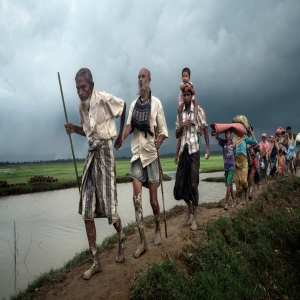
Lately, the United Nations High Commissioner for Refugees claimed that over 3,33,500 civilians were rendered homeless in the ongoing gunfight between the junta forces and ethnic armed organisations along with the People's Defence Force (PDF). More than 2 million were displaced across the country since the last military takeover. The intense fighting continues and has recently expanded into new localities with densely populated areas. From the States of Shan, Kayah (formerly Karenni), Mandalay & Sagaing divisions, the battles against the junta forces (popularly known as Tatmadaw) expanded to Rakhine and Chin States.
The latest wave of gun fighting broke out on 27 October as three ethnic minority groups (namely Myanmar National Democratic Alliance Army, Ta'ang National Liberation Army and Arakan Army) coordinated their offensive against the junta forces in northern Shan. Named Operation 1027, the offensive has achieved some successes as Tatmadaw had to lose nearly 200 military camps and nine towns till the end of November. Lately, the Arakan Army (AA) has launched an offensive in Rakhine State (bordering Bangladesh), killing many soldiers and even compelling some to surrender with arms & ammunition to AA rebels.
Amazingly, a recent public demonstration attracted the attention of political observers as it chanted slogans against China, which is usually known as a trusted neighbour and arms supplier to Myanmar. People assembling in front of the Chinese Embassy in Yangon and propagating anti-Beijing statements was unusual in the country. The seemingly pro-junta militia groups claim that Beijing was behind the recent offensive against the military regime and also supporting the PDF, the armed wing of the National Unity Government. Speculations are high that China wants to topple the current batch of Burmese military dictators.
Under pressure, the highest military authorities publicly declared their commitment to democracy and federalism. Military dictator Hlaing, who functions as Prime Minister of Myanmar, recently noted that the regime will follow the Constitutional guidelines. He also seemingly engaged pro-junta nationals to organise public rallies against the ethnic rebels and PDF members. Recently, a gathering in front of Yangon City Hall raised slogans against the elements allegedly working to divide the nation.
The rally witnessed the participants begin their program by saluting the national flag, singing the national anthem and observing a one-minute silence in honour of the fallen Tatmadaw soldiers. According to the military-run newspaper' Global New Light of Myanmar', the participants shouted slogans like 'Oppose countries which interfere in Myanmar's internal affairs', 'Stop covert support to anti-nationals', 'Down with the saboteurs', etc. The peace-loving people from other parts of the country also launched similar campaigns denouncing the terrorists, added the report.
Contrary to its mandate, the Association of Southeast Asian Nations (ASEAN) remains a mute spectator to all troubles in its member country. Over 600 Myanmar national and international organisations have recently criticised the ASEAN for failing to make the junta accountable for relentless crimes against humanity. They also urged the ASEAN leadership to take concrete actions to fulfil the demands forwarded by the Burmese people to establish a federal democratic union and bring all military dictators to justice for committing mass atrocity crimes since the illegal coup.
The troubles in various western Myanmar localities increased the influx of refugees to northeast India. Many Burmese soldiers also crossed the porous boundary to arrive in Mizoram and were later sent back by the Indian agencies. The new government in Aizawl also extended necessary support to the refugees (mostly Chin people, as they enjoy ethnic proximity to Mizos). The Chin bordering hilly State now provides shelter to thousands of asylum seekers; many of their children are even enrolled in government-run schools. Manipur and Nagaland have also witnessed the arrival of over 600 Burmese nationals in the last few days.
New Delhi had earlier directed the Indian nationals in Myanmar to register their names with the embassy in Yangon (formerly Rangoon). Given the evolving security situation there, it also asked the citizens to avoid non-essential travel to the country. Earlier, India, which shares a land border (1643 kilometres) and a maritime boundary (725 km, in the Bay of Bengal) with Myanmar, called for a cessation of gunfight between the junta forces and rebel groups near the international border. It maintained the call for the return of peace, stability, and democracy in the country.
The Buddhist-majority country also supports several northeastern militants, who have been waging war against New Delhi for various separatist homelands. No wonder most of them remained supportive of the Burmese military rulers and avoided engaging in the ongoing anti-junta battles. However, the PDF members and ethnic rebels targeted NE militants as they continued to be junta-supportive. Even a camp of the United National Liberation Front (UNLF recently joined in peace talks with New Delhi) was raided, and a large volume of arms & ammunition, along with essential documents, were seized. New Delhi needs to deal with the situation carefully to achieve a sustainable solution to the insurgency problems.
.jpg)
.png) Cedric Prakash
Cedric Prakash

 ICPA
ICPA
 ICPA
ICPA
 ICPA
ICPA
 ICPA
ICPA
 ICPA
ICPA
 ICPA
ICPA
.jpg)
 A. J. Philip
.jpg)
.png) Jacob Peenikaparambil
Jacob Peenikaparambil
.jpg)
.png) John Dayal
John Dayal