

.jpg) P. A. Joseph
P. A. Joseph

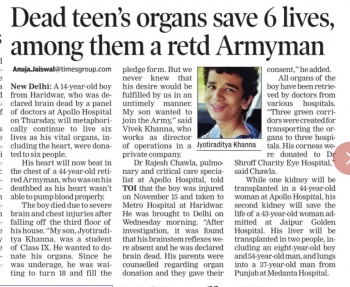
14-year-old Jyotiraditya Khanna was reading in Class IX. His ambition was to serve in the Army. He wanted to donate his organs to needy people. Being under age, he was waiting to turn 18 to fill up the pledge form. But he fell from the 3rd floor of his house in Haridwar. He was brought to the Apollo hospital on November 8, and the doctors found that due to severe injuries his brainstem reflexes were absent, and he was brain-dead. His parents were counselled regarding organ donation, and they gave their consent. Mr. Vivek Khanna, his father, while signing the consent, said that his son was very keen to donate his organs.
All his organs were retrieved by doctors. His corneas were donated to Dr. Shroff Charity eye hospital; one kidney to a 44-year-old woman at Apollo hospital; another kidney to a woman in Jaipur; his liver to an eight-year-old boy; his lungs to a man in Punjab; and his heart to a retired army man who was on death bed owing to an extremely weak heart (Courtesy: Times of India, Nov.18/2022).
All the lucky beneficiaries live healthy, and we can say that Jyotiraditya now lives in many people. We should appreciate Mr. Vivek Khanna for being so responsive and highly sensitive to his son’s desire which he had expressed some time back. Also, we can presume that all the beneficiaries were selected from the urgent requests poured in. In all certainty, we presume that most needy people were helped without looking into their religion, caste, etc. Further, to allow the doctors to operate different parts of the body of his son, Mr. Khanna showed great courage and suffering. Ordinary parents would not allow such procedure. May God bless the parents for their courage and generosity. They can be assured that their son now lives in many people. By his death he has given life to them. By this kind of generous action, one becomes immortal.
In this context we should educate the public on the need to be donors. Doctors say that it is healthy to donate blood occasionally. There are generous people who have donated one of their kidneys. One of the bishops in Kerala, Jacob Murikkan, donated one of his kidneys. It seems that the client, belonging to a different religion, was not even known to the donor. The patient was in an emergency need and Murikkan came forward to donate the kidney. It was highly appreciated among the media circles. Now he has resigned from his position as auxiliary bishop of the diocese of Pala and lives a simple life in a remote place in Kerala. This is a great challenge and a luminous witness to the affluent hierarchy especially in Kerala.
In the reflections of Dr. Abdul Kalam, he says: “The basis of all systems, social or political, rests upon the goodness of men/women. No nation is great or good because Parliament enacts this or that, but its men/women are great and good”.
Always listen to your heart,
It may be on your left,
but it is always right.

.jpg) Stanislaus Alla
Stanislaus Alla
.jpg)
.png) Cedric Prakash
Cedric Prakash

.jpg) Elsa Lycias Joel
Elsa Lycias Joel
.jpg)
 A. J. Philip

.png) Jacob Peenikaparambil
Jacob Peenikaparambil
.jpg)
.png) John Dayal
John Dayal
.jpg)
.jpg)
.png) Joseph Maliakan
Joseph Maliakan
.png)
.png) Robert Clements
Robert Clements
.jpg) Cedric Prakash
Cedric Prakash