
.png) Cedric Prakash
Cedric Prakash

World Food Day is celebrated all over the world on October 16. It is an initiative by the Food and Agricultural Organisation (FAO) of the United Nations. The first ‘World Food Day’ was observed in 194, to mark the launch of the Food and Agriculture Organization (FAO) of the United Nations. Ever since, the day is marked to highlight the need and importance of food security across the world. The significance is accentuated especially in these difficult times like the COVID-19 pandemic. The theme for 2021 is ‘Safe Food Now for a Healthier Tomorrow’, emphasising on the various immediate and long-term benefits of consuming safe and healthy food.
The FAO today plays a pivotal role in achieving the Sustainable Development Goal (SDG) mandate- ‘to leave no one behind.’ ‘World Food Day’ therefore also serves as a reminder of the necessity of this organization and helps to make the world aware of the requirement for better agriculture policies to be adopted and executed by governments all over the globe to make sure there is enough food available for everyone
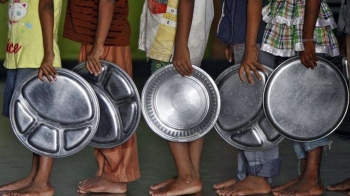
Above all, ‘World Food Day’ brings to attention the terrible plight of millions of people everywhere who are struggling with hunger and do not have adequate food to survive. Starvation is a global crisis that needs to be addressed and tackled before it is too late. Sadly enough, we live in a world of ‘haves’ and ‘have-nots’; the former, indulge in the finest of delicacies without any thoughts for others and on the other hand, the latter, are those who are desperate for a little food for their survival. Mahatma Gandhi puts it strongly when he says, “our world has enough for everyone’s need but not for anyone’s greed!”
Recently, the annual ‘Global Hunger Index (GHI) was released. The GHI prepared jointly by Irish aid agency ‘Concern Worldwide’ and German organisation ‘Welt Hunger Hilfe’ is a universally accepted document on the reality of hunger all over the world. The introduction to the report states, “Global Hunger Index (GHI) is a tool designed to comprehensively measure and track hunger at global, regional, and national levels. GHI scores are calculated each year to assess progress and setbacks in combating hunger. The GHI is designed to raise awareness and understanding of the struggle against hunger, provide a way to compare levels of hunger between countries and regions, and call attention to those areas of the world where hunger levels are highest and where the need for additional efforts to eliminate hunger is greatest”. The GHI score is calculated on four indicators: undernourishment; child wasting (the share of children under the age of five who have low weight for their height, reflecting acute undernutrition); child stunting (children under the age of five who have low height for their age, reflecting chronic undernutrition); child mortality (the mortality rate of children under the age of five).
India has fared extremely badly in this latest report. The country has slipped to the 101st position among 116 countries in the GHI 2021 from its 2020 ranking (94). India is now placed behind Pakistan, Bangladesh and Nepal. There are only fifteen other countries Papua New Guinea (102), Afghanistan (103), Nigeria (103), Congo (105), Mozambique (106), Sierra Leone (106), Timor-Leste (108), Haiti (109), Liberia (110), Madagascar (111), Democratic Republic of Congo (112), Chad (113), Central African Republic (114), Yemen (115) and Somalia (116) who have fared worse than India this year!
Obviously, the Government is not pleased and has gone on a denial mode! In an official rebuttal, a spokesperson says that the report has been published ‘without due diligence.’ A pathetic response when the Government is unable to furnish any scientific empirical evidence to prove the contrary. A few days ago, the Prime Minister lambasted human rights defenders ‘for spoiling the name of the country’ vi-a-vis the human rights situation in India. The PM does not want to be truthful and acknowledge the non-negotiable fact that it is he and his ilk who denigrate the country and in a calculated manner destroy the fundamental rights of the ordinary citizens. The ‘right to food’ should have been sacrosanct and paramount importance should have been given to ensure that. Instead, the crony capitalist friends of the regime are becoming richer everyday to the growing impoverishment of India’s millions. The nation-wide protest of farmers, which will soon complete one year, is a pointer of how those who provide us with our daily bread are being treated in the country! To build a more fair and equitable food systems, one must to listen to the voices of our farmers, to small-scale producers and rural communities.
Qu Dongyu, Director-General of the FAO, in his statement noted that ‘World Food Day’ finds the world at a critical moment; even before COVID-19, hundreds of millions of people worldwide were afflicted by hunger and that number has increased in the last year to 811 million. That's despite the world producing sufficient food to feed everyone; and that 14 percent of food is lost, and 17 percent is wasted. Alarming statistics indeed! Antonio Guterres, the United Nations Secretary-General in his address says, “the way we produce, consume and waste food is taking a heavy toll on our planet. It is putting historic pressure on our natural resources, climate and natural environment --- and costing us trillions of dollars a year; but the power to change is in our hands.”
In a pointed message to Qu Dongyu, Pope Francis says “The annual celebration of World Food Day brings us face to face with one of humanity's greatest challenges: overcoming hunger once and for all is an ambitious goal.” He points to a paradox with regard to food access, noting that while more than three billion people do not have access to a nutritious diet, almost two billion are overweight due to poor diets and a sedentary life style. Stressing the need for all to play a role he says, “If we do not want to jeopardize the health of our planet and our entire population, we must encourage active participation in change at all levels and reorganize food systems as a whole.” Pope Francis highlights four areas in particular where urgent action is needed: in the field, at sea, at the table, and in reducing food loss and waste. He says, “although individual lifestyle choices and daily consumption practices influence global and environmental dynamics, we must encourage producers and consumers to make ethical and sustainable choices and raise awareness among the younger generations of the important role they play in making a world without hunger a reality.”
Whether anyone is listening to these world leaders and will actually pay heed to what they are saying – is anyone’s guess! In the meantime, given our hypocritical religiosity and flair to abuse God by dividing people in his/her name, let us at least take cognizance of the words of Mahatma Gandhi “God comes to the hungry in the form of food!” and help make their prayer “Give us today our daily food…” a reality!
*( Cedric Prakash SJ is a human rights, reconciliation and peace activist/writer. Contact: cedricprakash@gmail.com )

 Cedric Prakash
.JPG)
 A. J. Philip

.png) Jacob Peenikaparambil
Jacob Peenikaparambil
.jpg)
.png) John Dayal
John Dayal
.jpg)
 Pachu Menon
.png)
.png)
.png) Robert Clements
Robert Clements

