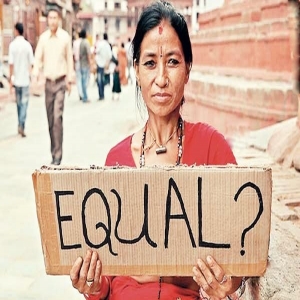


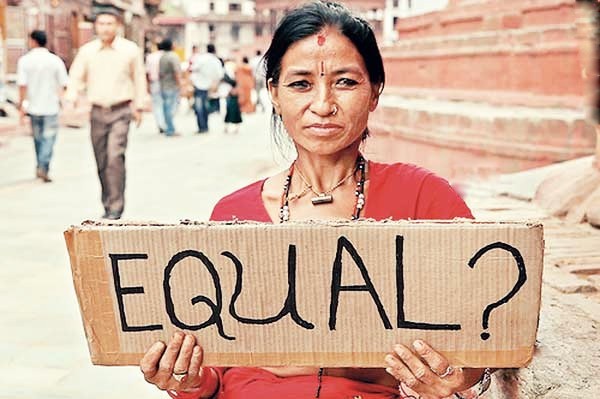
The seeds of women's emancipation were also planted when Rousseau advocated "Liberty, Equality and Fraternity," in The Social Contract. To say that women's liberation is one of the significant thoughts of the last century that changed the world's destiny is no exaggeration.
The very idea of women's liberation is founded on the basic principle of non-discrimination and gender equality, thereby relegating to limbo the wide variety of epithets dumped on women like 'the weaker sex,' 'man's slave' and so on, by philosophers and poets down the ages, round the globe. It is believed that the concept of women's liberation is an offspring of the social changes that took place after the Industrial Revolution like private property, job opportunities based on education, the birth-rights of individuals, equal share of wealth to both sexes and women treated on a par with men in a democratic set-up.
Yet, in India, it was altogether a different matter. The Industrial Revolution and the social changes it paved the way for could not disturb the Indians, whose minds were firmly rooted in the feudal culture. Hence, revolutionary thoughts like women's liberation were nothing more than words to them.
There was a time when women all over the world were treated as merchandise to be bought, got, bartered, sold, used, misused, abused or left unused and callously cast away. But the protest of women against male supremacy—thanks to the feminist movement—had already told the world that they are not degraded, demoralised toys, sporting goods, fun objects, footstools, or slaves. While the conditions of women are changing all over the world, nothing dramatic has happened to Indian women. Blamed is our culture.
An interesting Indian folktale describes a strange case brought to a king's court. Two women, wishing to test the king's judgement, brought their newborn babies—one male and the other female—and complained to the king that the midwife who took the babies for a wash was unable to remember from whose bed she had taken the male baby and from whose bed the female.
It was quite an unusual case indeed. However, the judge solved the problem with a weighing balance and two small clay containers of equal size and weight. He asked the two women to fill them to the brim with their milk. He then placed the first woman's container on the right plate of the balance and the second woman's on the left.
The plate on the right slightly went down. The judge immediately declared: "The boy belongs to the first woman." The women and the courtiers were astonished at the wit of the king. And to their unanimous question 'How?' the king replied: "A woman's body is soft and delicate, but a man's is hard, muscular, strong and rough. Nature blesses the mother of the male child with slightly thicker milk."
Scientifically disproved, yet this folktale glorifies men and looks down on women. Its aim is to tell that man, by nature, is superior to woman. Such myths and legends are passed on by word of mouth, and now the print and visual media inculcate in men his superiority over women.
Every son has a toy gun to play with at home, while all daughters' toys are Barbie dolls and tiny kitchen utensils. That speaks for the mind of the Indian father. The mother, too, allows her son to roam about in the wide world and never raises a finger when he comes home late, whereas she commands her daughter not to be out of home after school or college hours. Hence, the plight of Indian women grows along with her. Why, for that matter, it starts even when she is in her mother's womb. In these days of advanced technology, the pregnant woman opts for an abortion the moment she comes to know that she is carrying a female foetus. In villages, the newborn females are mercilessly killed even today.
All these things happen because every woman in India is nurtured in the belief that she cannot exist by herself and that she has to depend upon some male. Hindu dharma and community bindings, which were prevalent for centuries in India, looked down upon women and gave them a despicable status in society. The laws of Manu, too, say that women must remain obedient to their parents in their youth, to their husbands after marriage, and finally to their sons in their widowhood.
The division of labour – women for the home and men for winning food – has driven a wedge and splintered humanity. Further, every woman is told to obey her male supporters in her different stages of life, especially her husband, for she spends much of her lifetime with him. Be it a family or a society, it was firmly believed that a woman's life revolved around a man. The woman is advised to depend entirely on him. The attractive appellations like 'Uncrowned Queen of the Home' and 'Goddess of Chastity' that were showered on women simply show the cunning of men to enslave and exploit them.
Every father, be he a millionaire or a coolie, thinks that his daughter is a burden for she is to be married off. Over and above the tedious task of finding a suitable boy for her, marriage incurs a lot of expenditure, sometimes a fortune.
Every husband thinks that his wife cannot exist without him. He knows for certain that she will fall prey to slander and ignominy if she leaves him once and for all. To him, she is just another thing. To her son, she is an unwanted piece of furniture to be left uncared for.
Feminists all over the world are fighting for their rights and stress the point that they are in no way inferior to men. Divorces have become quite common these days. As the principles of feudalism caved in to give rise to healthy thoughts, the views on women by women underwent a drastic change. And so we see today women getting a proper education, thereby qualifying themselves for better jobs in order to stabilise themselves so that they need to depend on no one. Not only do they make laws, but the news, too. They govern not only the family but also the state and the country. And above all, their contribution to the growth of our Nation's economy is really laudable.
Dead is the society that treated women as slaves. Gone are the days when women wept over their so-called fate. A new society that treats women as equal to men is already on the rise. Doubtless, this welcome change is bound to play a significant part in improving our society.
Despite all the achievements made by Indian women, the male mind thinks that they are more secure in the kitchen and less safe in the outside world. No cultural revolution can pull them into the world of reality from an illusory world.
In India, no hungry child asks for food from its father but only from its mother because the child believes that the mother is in charge of the kitchen. Men still express, "Behind every successful man there is a woman," and believe that the woman is quite happy to remain behind them.
.jpg)
.png) Cedric Prakash
Cedric Prakash

 ICPA
ICPA
 ICPA
ICPA
 ICPA
ICPA
 ICPA
ICPA
 ICPA
ICPA
 ICPA
ICPA
.jpg)
 A. J. Philip
.jpg)
.png) Jacob Peenikaparambil
Jacob Peenikaparambil
.jpg)
.png) John Dayal
John Dayal