
.png) Dr Prakash Louis
Dr Prakash Louis

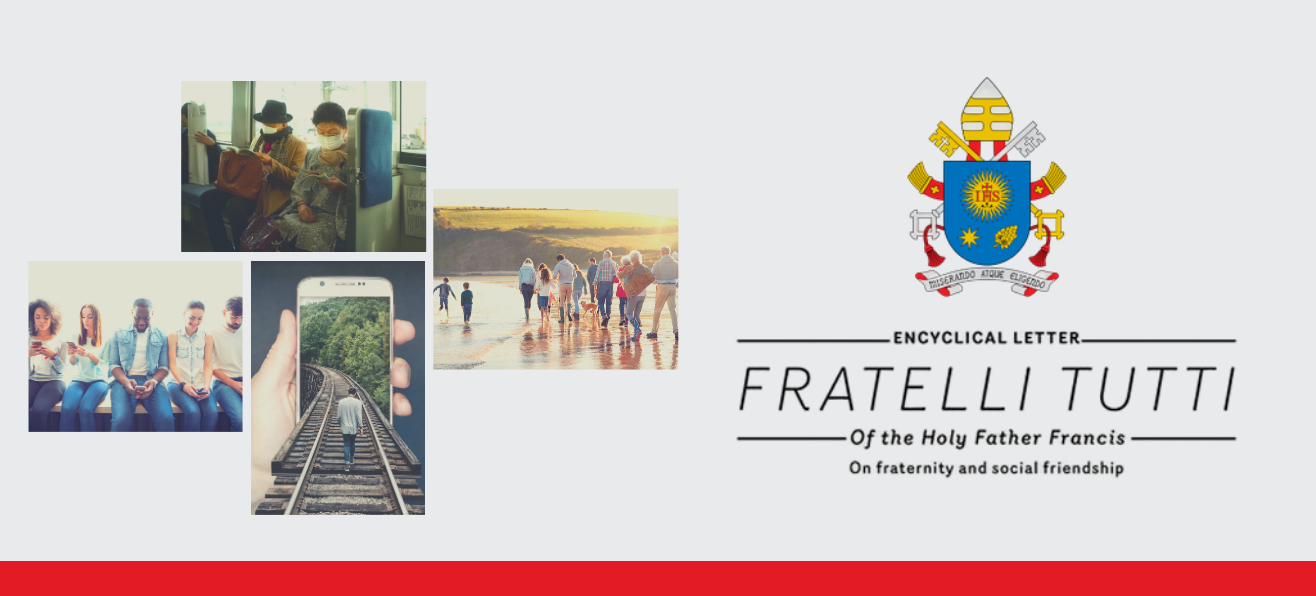
“God has created all human beings equal in rights, duties and dignity, and has called them to live together as brothers and sisters”. A sentence taken from the Document on Human Fraternity for World Peace and Living Together, jointly declared by the Holy Father Pope Francis and the Grand Imam Ahmad Al-Tayyeb when they met in Abu Dhabi on 4th February 2019. The concerns expressed in this sentence become the backdrop, the purpose, the motivating factor for the publication of the Encyclical, “Fratelli Tuti” by Pope Francis. It is also significant to note that this Encyclical was published at the tomb of Saint Francis, at Assisi, on 3 October, 2020.
Two interrelated themes run through the Encyclical that are central to the Gospel and in fact central to all the religions. They are: firstly, God is the creator, author and designer of all that is created. Hence, it is He and only He is the Master of the Universe.
The second aspect of this is that all created human beings are children of God. Hence, all human beings are brothers and sisters. Since we are children of God and in extension, we are sisters and brothers to one another, it is demanded of us to live and love each other as sisters and brothers. Any pretension to be whole, full, complete, satisfied, capable, clever, and content in and with oneself will only lead to destruction. Human life essentially and existentially is to be comprehended, completed and lived in communion. To be human is to be inter-human, to be human is to be interdependent and to be human is to be with and for other selves and in that find oneself. It is this central and Gospel truth that the Pontiff tries to bring back to our reading, understanding and putting into practice before it is too late. But he does not limit himself to only the Christian traditions to prove his points but takes recourse to the tenets of all religions so that his reflections can be truly for common good emanating from collective sense and action.
At a time when human dignity and rights are violated in countless forms and manners in countries and societies throughout the world – often in the name of religion – it is imperative that we re-emphasize this important value and, more importantly, apply it in our daily lives. All religions recognize human beings as fundamentally equal, whether this is understood as a consequence of their status as children of God (Judaism, Christianity, Islam), of their manifestation of the Divine (Hinduism), or of their common original nature and desire for happiness (Buddhism). Respect for human dignity is, therefore, another fundamental principle of all religions. With that equality comes a belief that all humans deserve a basic level of respect and dignity, regardless of their background.
This principle rules out discrimination against people on the basis of caste, class, gender, race, ethnicity, religion, region, ancestry, socio-economic-educational status, disability, and sexual orientation. Seen positively, the principle of equal dignity calls for respect for all human beings, even those with whom we most profoundly disagree or whose culture or lifestyle or background or orientation seem most alien to us. Recognition of the equal worth of all is, therefore, essential to building a world community of wholeness and peace in an age of globalization and localisation in an age of greater borders and barriers in an age of exclusion and exploitation.
While the above was applicable to a normal time, COVID-19 in an unprecedented has driven home the message that it is not individual glorification and gratification but it is only common good which will save the entire humanity. It also underscored the fact that we need to be committed to working towards collective good and common destiny.
As stated in the Encyclical, the Pope was contemplating of sharing his thoughts about the centrality of collective consciousness, collective action and common good.
The running theme of the previous Encyclical of Pope Francis was strategies for a solution to the degrading of nature demand an integrated approach to combating poverty, restoring dignity to the excluded, and at the same time protecting nature (Laudato si:139). The starting point of the Encyclical was through these pointed questions: ‘What is the purpose of our life in this world? Why are we here? What is the goal of our work and all our efforts? What need does the earth have of us?’ (160). Going further, he states that a great cultural, spiritual and educational challenge stands before us, and it will demand that we set out on the long path of renewal (202). Throughout the Encyclical, he calls for self-examination, conversation, dialogue, intense dialogue, new dialogue, forthright cum honest debate cum policies and genuine encounter with all people about our common home. Also asks all human beings to cooperate, contribute and be committed for ecological salvation (14,15,62).
Indian Christian Commitment to Fratelli Tuti
Being Indian Christian is our fundamental identity. Being Indian and Christian are integral part of our identity. Our Christian call demands that we as Christians are to live and extend solidarity with all the human beings both Christians and people of other faiths and cultures.
In the emerging India, as Indian Christians we are called to live and work towards building collective consciousness, mobilise all for collective action and stive for common good. It is all the more essential in an India which is witnessing lies and falsehood, deception and devaluation, discrimination and displacement. Pope Francis puts this in his characteristic style, “The best way to dominate and gain control over people is to spread despair and discouragement, even under the guise of defending certain values”.
Incidentally, it is in the name of defending the values of ‘ancient India’ division and discord is created among the various segments of the population. In this desperate situation, we are called to fulfilment or call to expose the divisive forces and uphold the life fostering values and goals.
It is amply clear that it is not by sticking to narrow identities of being Christian or minority that we can save ourselves, even if we cannot save others. It is only by joining others of ‘good will’ we can save our skins. As Indian Christians we are called to move beyond our individual self to families, families to neighbourhoods, villages, cities, nations and the whole human race. This is not just in terms of dialogue with all religions and cultures. But through a dialogue of action to build collective sensibility, organised around common action and work towards common good at all levels and for every sister and brother.
Christians are called to move out of our comfort zones and institutional set ups and become part of the masses of the country. Hobnobbing with the powers of the country and trying to maintain the status quo will one day bring destruction to us and our institutions.
It is also becoming clear like day light that today in India to be cultured is to be inter-cultural, to be religious is to be inter-religious, to be Indian is to be inter-Indian, to be Christian is to be Indian Christian, to be human is to be inter-human. May these call of the Pontiff guides our search for a project towards common good, “For Christians, this way of thinking and acting is unacceptable, since it sets certain political preferences above deep convictions of our faith: the inalienable dignity of each human person regardless of origin, race or religion, and the supreme law of fraternal love”[39].
.jpg)
.png) Cedric Prakash
Cedric Prakash

.jpg) Elsa Lycias Joel
Elsa Lycias Joel
.jpg)
 A. J. Philip

.png) Jacob Peenikaparambil
Jacob Peenikaparambil
.jpg)
.png) John Dayal
John Dayal
.jpg)
.jpg)
.png) Joseph Maliakan
Joseph Maliakan
.png)
.png) Robert Clements
Robert Clements
.jpg) Cedric Prakash
Cedric Prakash

 ICPA
ICPA