

.jpg) Patrick Crasta
Patrick Crasta

We know the importance of family in our day-to-day life. We call it the Church in miniature. For we believe that the quality of the Church, the spiritual vitality of the Church, depends upon the quality/the Evangelical Spirit prevailing in the families where the children are born and brought up. The love, care, and attention that they receive in the family context, and the faith-formation and value-system that they imbibe from the teaching and life-pattern of the parents and the elders set the foundation for their life so that they become solid pillars of their families, and firm and faithful members of the Church.
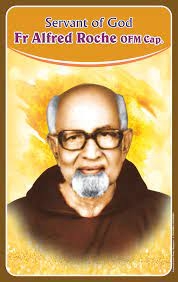
As we have reflected upon, the All-Loving Father had blessed Fr. Alfred Roche (Peter John) with loving and devout parents, two caring elder brothers, and two sharing elder sisters. Although his dad, late Mr. Isaac Roche, was a farmer by profession, he could find time and energy daily to cross the Sita River with a canoe and to render his devout service as a sacristan in his parish dedicated to St. Peter for more than forty years. It was nothing but an ex
Being born and brought up in such an atmosphere of love, care, and deep faith from his childhood, Fr. Alfred Roche had known the importance of healthy and God-centred families. This early home-formation was further consolidated through the seminary-formation that he got during the different stages of his religious and priestly formation in the Capuchin Order.
As an ordained minister of Jesus, the Prophet and High Priest, while strengthening the faith of his flock with his sermons based on the Word of God and while fostering deep devotion in the Holy Eucharist in and through his devout celebration of the Holy Mass and through regular Holy Hours with the Blessed Sacrament exposed, he tried to build up the families.
Let us listen to what Sr. Lucy Rodrigues, Snehalaya, Solur, would like to say: “Every family he visited, he spent time in praying for the family. In a family, if any member has to go in search of job, leaving the house, he would visit the family, pray and bless the person and give the needed direction.... He made time to visit the families to know their situation very personally in order to pray, console and encourage for better living” (Witness no 58).
When there were natural calamities, the concern of Fr. Alfred Roche was unique. During the rainy season, when people, irrespective of caste and creed, had lost their houses, cattle, and other belongings due to heavy floods, Lilly Teacher from Holy Family Church, Brahmavar, would like to bear witness to what he was doing: “Fr. Roche was a person of prayer. He had a special love for the poor. When there were floods, he used to get into a boat and visit every house. When he was walking along the edges of the fields, there were occasions when he had fallen into small pits.... He was visiting the sick and consoling them and comforting them with the words of Jesus. Thus, walking in the footsteps of Jesus he did spread the Good News of God” (witness no 55).
.jpg)
.png) Cedric Prakash
Cedric Prakash

.jpg) Elsa Lycias Joel
Elsa Lycias Joel
.jpg)
 A. J. Philip

.png) Jacob Peenikaparambil
Jacob Peenikaparambil
.jpg)
.png) John Dayal
John Dayal
.jpg)
.jpg)
.png) Joseph Maliakan
Joseph Maliakan
.png)
.png) Robert Clements
Robert Clements
.jpg) Cedric Prakash
Cedric Prakash

 ICPA
ICPA