
.jpg) Dr. M. D. Thomas
Dr. M. D. Thomas
.jpg)
Religion is a universal phenomenon. It is a significant reality in humans' lives. It exists and will exist worldwide in some form or other. It is subject to change under a variety of circumstances. Well, it has to keep changing according to place and time, lest it become irrelevant and futile.
It is often said that God created human beings, and human beings created religion. Although the degree of God-talk in them may vary, God is central to all religions. Human beings are definitely the beneficiaries of religious engagement.
The word 'religion' derives from the Latin root 'religare' or 'religio', meaning 'to bind, to bind or fasten together and to tie fast'. It would also mean 'obligation, bond, reverence', and the like. Even though religion reflects much of the sense that emerges from the root words, religions smack of several negativities characteristic of the temporal world, blatantly so.
Religion is a large and complex system of beliefs, myths, stories, theological theories, stipulations, rituals, and other observances. It motivates the respective believers to engage with it regularly. No wonder illiterate and poor people become all the more victims of superstitions and blind beliefs profusely found in religions.
Custodians of religious systems are accustomed to domesticating the believers in such a way that the followers become addicted to religious observances. The believers tend to or are forced to contribute to the custodians in the form of gold, silver, cash and kind in the name of the deity in question, too. The guardians are obviously the beneficiaries of the political and economic engagement.
More often than not, religion and faith are synonymous. Religion has faith as its essence. But faith is not strictly bound by the stipulations of religion. Religion cannot exist without faith. Faith can exist even outside the purview of religion. Religion is a closely knit and self-contained system. Faith is open-ended, inclusive, interactive, and qualitative in its character.
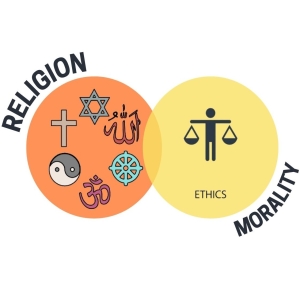
At any rate, ethics is the core of religion. In other words, the best part of religion is its ethical values. But for ethical values, religion amounts to an idiotic system of blind beliefs and silly practices. The ethical values are supposed to motivate and elevate its subscribers to a higher life morale. In principle, the religious provisions are oriented to boost the moral fibre of the believers, as well.
However, religion often does a reverse and contradictory job. Religion has been part of all the major and minor wars of the world in some form or another. When it has not instigated or supported them, it has been at least a passive spectator. Many misunderstandings, tensions, conflicts, and enmities involve religion as a culprit or solicitor.
Besides, many criminals and offenders perform religious rituals or contribute to religious centres and persons. Ethical behaviour seems far from most people who scrupulously perform religious rites. In other words, religious observances often do not produce the intended human quality. Human goodness and religious practices do not have a necessary connection.
Besides, it is not difficult to find villains and scoundrels among those who are professed to be religionists. In other words, there are lots of irreligious and inhuman persons within the layers of the religious system. A considerable number of evil people are very regular to places of worship, especially before they engage in their wicked ways, like murder or rape and other inhuman behaviour.
Even among those who are on the higher ranks of religion, there is a lot of ill feeling, hatred, jealousy, manipulation, rivalry, discrimination, injustice, violation of rights, and the like, in high doses. One doubts whether they have any conscience at all. When the curators of religion and those who pretend to be highly religious behave in worldly ways, it is nothing but a Himalayan scandal.
Religion is proclaimed to be the custodian of all that is good in the world. Unfortunately, it is not difficult to see that it accommodates even the worst of the world's evils. While preaching values of the highest level, it miserably fails to live them. Disagreement between theory and practice remains the biggest problem in religion.
There are lots of structured evils flourishing in civilizations and communities for ages in the name of or despite religion, like caste system and gender discrimination. Human sacrifices are done in certain superstitious traditions. Dowry, slavery, apartheid, sexual mutilation, bribery, tax evasion, administrative corruption, and the like are rampant, too, though in uneven degrees. The fact that religion accommodates such things is an anomaly.
Further, the foul nexus of religion with politics is a matter of grave concern. Religion has thrived with the patronage of politics since time immemorial. Politics uses religion as a ladder to climb up the rungs of power. Religion also takes the support of politics for its advancement. Both run the show of life together, like the dictum, 'You scratch my back, and I'll scratch yours.' The link between religion and politics is distasteful and objectionable.
The play of money and power within the religious systems is worse still. Often, money wins over power, and power commands money. Both together can manage anything in life. Nothing is impossible when the game is played in God's name. While it is true that secular power can be corrupted to any level, religious power, too, can degenerate to any extent.
It must be accepted that there is no hundred per cent in this world. Everything is limited. That would make one state that human frailties are to be granted. Even religion is created and managed by fragile human beings. Religion has not to be understood as a perfect system, either. No one can practice the ideals and values of religion perfectly, either.
Even so, the question arises of how such a high deficit in ethical values could be justified with religion's foolproof and infallible claims. Why don't the costly and ceremonial rituals produce even the minimum ethical effect? Religion's ethical fibre has to be strengthened by all means, lest it lose its basic credibility or be rendered an eternal scandal.
.jpg)
.png) Cedric Prakash
Cedric Prakash

 ICPA
ICPA
 ICPA
ICPA
 ICPA
ICPA
 ICPA
ICPA
 ICPA
ICPA
 ICPA
ICPA
.jpg)
 A. J. Philip
.jpg)
.png) Jacob Peenikaparambil
Jacob Peenikaparambil
.jpg)
.png) John Dayal
John Dayal