

.png) Jacob Peenikaparambil
Jacob Peenikaparambil

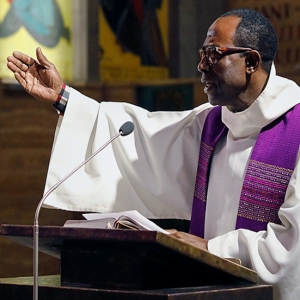
While addressing 800 priests of the Diocese of Rome in the Basilica of St. John Lateran on January 13, Pope Francis called the clergy to bear credible witness to Christ and to keep their homilies brief and direct, reported the Vatican News. He reportedly told the priests that their sermons "must go straight to the heart, cover issues in daily lives and steer clear of overly sophisticated subjects" and should be limited to 8 minutes.
There is a pertinent statement by the character Nicodemus in the movie, 'Jesus of Nazareth', directed and produced by Franco Zeffirelli. "I saw in him the word of God becoming alive". If a homily is to touch the hearts and minds of the faithful, it is to be lively. Now, the question is how to make a homily relevant and inspiring.
Mahatma Gandhi used to say, "Be the change that you want to see in others". Primarily, the life of a priest who delivers the homily should be a witness to what he tells people. For example, if a priest gives a discourse on honesty and integrity, he must be a person who practices honesty and integrity in his life. An insensitive priest speaking about sensitivity and compassion in his sermons will become a laughingstock. Today's most significant challenge to priests is bridging the gap between words and deeds.
Secondly, the speaker should be convinced of what he is saying. One can elaborately quote from different sources to show scholarship. A scholarly speech may have a literary appeal to the audience, but it need not touch their hearts. The laity is sufficiently intelligent to judge whether a priest speaks out of his conviction or has copied his speech from another source. These days, daily and Sunday homilies are available online and in print. Reading them to get new insights is advisable, but simply repeating them without applying one's mind and heart will not impact the faithful. Reflection or contemplation on the Gospel/scriptural passage is essential for the speaker to be convinced and generate conviction within his audience.
Thirdly, a homily will be effective and inspirational only if prepared well. A homily lacking preparation will have no focus; ideas will be disorganized and repeated, and the speaker may go on speaking without considering his audience's precious time. The priest/bishop giving a sermon is accountable to his audience. If the homily is not benefiting the people, he is doing a great injustice to them.
There are no hard and fast rules regarding the preparation of a homily. Each priest may develop his own method of preparing a sermon. It is ideal to focus on the Gospel passage and then relate the first and second readings to the theme of the Gospel passage, if needed. Some priests try to create an artificial link among the three readings. It will only make the homily boring.
The first step in preparing the homily is choosing the topic. Ideally, the preparation for the Sunday sermon should start a week ahead. After reading the scriptural passages, choose a topic on which the sermon will be delivered. For example, if the Gospel passage for a Sunday reading is the Good Samaritan parable, the homily topic could be "sensitivity and compassion". Another topic for focus is "Religiosity and Spirituality", as the Good Samaritan represents spirituality, and the priest and the Levite represent religiosity. A third topic could be "Philanthropy without name and fame".
Reading Bible/Gospel commentaries online or in print will help select the topic and get related insights. For example, William Barclay's commentaries on the New Testament (Daily Study Bible) are very insightful, with many practical applications to the daily life of the followers of Jesus.
Contemplation on the topic of the homily can be the second step. Let the topic for the sermon and the concerned Gospel passage brew in our minds and imaginations. A day can be dedicated to contemplating/meditating on the subject of the discourse. The one who prepares the homily may introspect specific questions: What was the context of the Gospel passage? What were its implications for the people in the time of Jesus? What message do I get today in the context I live in? What changes are needed in my life in the light of the Gospel message? What message can I share with my people?
The third step could be noting down the main points of the homily. It is ideal to write down the entire homily. Writing down the complete text has certain advantages, like sticking to the time limit, using appropriate words and phrases, arranging ideas logically, and having a proper introduction and conclusion. Each one can use their preferred style of speech. Some people start with an incident, a news item or a related story. Some others may start by referring to a quote from a great person or a verse from the Bible.
The fourth step is the delivery. Each person can adopt a method that gives them confidence. However, books on the art of public speaking recommend eye contact with the audience. In his book, 'The Art of Public Speaking', Dale Carnegie says that the speaker has to look into the eyes of the audience in such a way that each one of the audience members should feel that the speaker is focusing on them. In the Indian context, people tend to look down on homilies that are read out. A homily written and revised a few times can be delivered without reading the text.
Reading newspapers, magazines, biographies of great personalities and leaders and books on spirituality and contemporary issues is very useful in relating a homily to the people's life situation and making it thought-provoking and inspirational. As A P J Abdul Kalam says, reading ignites the mind with new ideas and insights. Hence, cultivating reading habits in seminarians is essential in preparing them as inspirational and influential speakers.
Certain issues should be avoided in a homily. It has been observed that some priests habitually criticize people or point out faults with them during the homily. The purpose of the homily is to inspire people to lead a life in tune with the ideals and values of Jesus. Hence, accusations against people should be alien to a homily. Necessary corrections can be given positively and attractively.
Avoid controversies. In a parish community, people can belong to different political parties and have different ideologies. Hence, overtly siding with or criticizing any political party can be avoided. However, issues related to good governance can be part of homilies. Anything divisive should be kept out of the homilies.
Reduce the use of "I" as far as possible. Boasting about oneself is unpalatable. It does not mean that one should not share educational and inspirational personal experiences.
If a newly ordained priest cannot give an eight-minute meaningful homily, it exposes a serious lacuna in the seminary formation. People may wonder what he did during his ten to twelve years of priestly training. A priest is a leader, animator and facilitator. He is also a representative of a local Christian community. As leaders, all priests must develop excellent communication skills during and after training. Developing communication skills and improving the quality of their homilies/speeches is also part of ongoing formation. Sometimes, a priest has to function as the principal of a school or college or head of an institution. In such a situation, he must often deliver public speeches, conveying a relevant and motivating message.
Proficiency in the local language (Hindi in the case of North and Central India) and English, both in writing and speaking, is essential to be an effective communicator in the context of India. Low self-confidence from a lack of communication skills sometimes prevents many priests from building and fostering public relations.
Lack of fluency in the local language is one of the reasons for the poor quality of homilies delivered by some priests. The paucity of relevant ideas due to a lack of reading and reflection is another significant reason for people not appreciating the homilies of some priests. Therefore, all priests have to take the advice of Pope Francis seriously by limiting their homilies to eight minutes on Sundays and feast days and improving the quality of their homilies. Homilies on weekdays could be limited to three minutes. At the same time, meaningfully breaking the word of God is an essential duty of a Catholic priest.


.jpg)
 A. J. Philip
.jpg) Jacob Peenikaparambil
Jacob Peenikaparambil

.png) Chhotebhai
Chhotebhai

.jpg) P. A. Joseph
P. A. Joseph
.png)
.png) Robert Clements
Robert Clements
.jpeg) A. J. Philip
A. J. Philip
.jpg) Jacob Peenikaparambil
Jacob Peenikaparambil