

.png) John Dayal
John Dayal
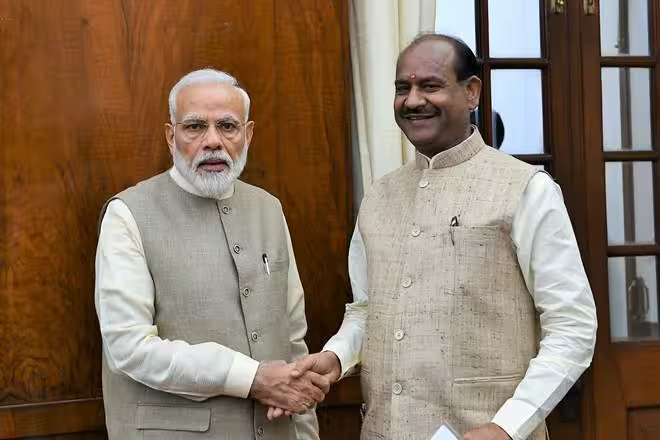
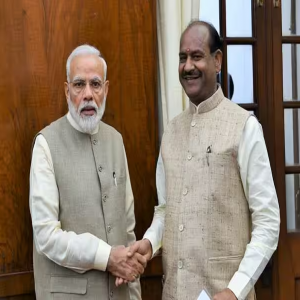
They could not be more different from each other. Vice President Jagdeep Dhankar and Lok Sabha Speaker Om Birla, both from Rajasthan, were chosen for their loyalty to the man who handpicked them.
Sitting now on their high presiding chairs in the bicameral Indian Parliament, both have withstood sarcasm, anger and perhaps even taunts to protect Mr Narendra Modi's government, in its diminished 2024 incarnation, from being battered by a rejuvenated Opposition.
They have wrested the obedience and earned the ire of talented and powerful grassroots leaders, women and men from the north and the south. Respect has been given to the Chair in an ingrained democratic tradition. However, the new members of parliament of the INDIA alliance instinctively know that the two presiding officers will not want to suspend them en masse as they had done in the concluding sessions of the 17th Lok Sabha and the Rajya Sabha.
In his third term in office, Mr Modi has sought to convince himself, more than his party and the country, that nothing has changed for him and that it is business as usual in this third term. His pet media continues to say he has equalled the record of Mr Jawaharlal Nehru, the freedom fighter and the first prime minister of independent India.
A shrunken man, however, he will now be more dependent on the two presiding officers as he tries to see if his writ will run and if he can force legislation or decisions as he did all of the last ten years of his government. He may well be in for a surprise sooner rather than later.
He had initially chosen the two, correctly assuming that their gratitude for getting high office would show in their loyalty and in carrying out his suggestions, demands, and orders, given directly or through his trusted assistant, Home Minister Ami Shah.
But a subtle change is visible. Mr Modi's political future is not in their hands, not yet. But in the debates on the Address of the President to the Joint Session of Parliament, Mr Modi would have noticed that Leader of the Opposition, Mr Rahul Gandhi, Samajwadi Party leader Akhilesh Yadav and Trinamool firebrand Ms Mahua Moitra in the Lok Sabha and Congress president Mr Mallikarjun Kharge, AAP leader Mr Sanjay Singh and Prof Manoj in the Rajya Sabha were allowed to blow the government text to smithereens.
Some remarks were later expunged from the official parliamentary records, but they will be etched for a long time in people's memory and in YouTube replays. The prime minister will forever remember Mr Gandhi's finger pointing at him and those stiletto words: "Modi doesn't represent all the Hindus, the BJP doesn't represent all the Hindus, the RSS doesn't represent all the Hindus." The chairman and the Speaker had let those words hang in the air until finally deleting them at midnight. The leaders, the parties, the members, including the ruling party, and the people of India all would be closely watching the future conduct of the two persons.
The two have had very different career graphs. The more sophisticated Mr Dhankar has had a long career as a successful Senior Advocate of the Supreme Court and the Rajasthan High Court. From the agrarian Jat community, his formative years were spent in a Sainik school, and the tall lawyer carries the bearing despite the visible stoop of age and wear.
It was in his assignment as Governor of West Bengal that Mr Dhankar gave new meaning to political pugnacity and ferocity. His long-running battle with the chief minister, Ms Mamta Banerjee, and her senior leaders tested the limits of constitutional federalism.
Critics say Mr Dhankar produced even more news headlines than his Kerala counterpart, Mr Arif Mohammed Khan, for confrontations with their state governments. As governor, he targeted the state government and the ruling Trinamool Congress on issues ranging from allegations of corruption to political violence and politicisation, and they called him the 'real leader of the opposition.'
But unlike the lifelong RSS cadre that Mr Om Birla is, Mr Dhankar was not always a BJP man and never really an RSS kar-sevak. His first politics was with the Janata Dal. He represented the party in the Lok Sabha from Jhunjhunu from 1989 to 1991.
He joined the Congress party in 1991 and contested the Ajmer Lok Sabha seat. He lost and was sent to the Rajasthan assembly from Kishangarh from 1993 to 1998. He joined the BJP in 2003. He was appointed vice-president on July 20, 2019, succeeding the career BJP leader Mr Venkiah Naidu.
In the Rajya Sabha, of which he is ex-officio chairman, Mr Dhankar presided in 2023-24, dealing heavy-handedly with the Opposition. As in the Lok Sabha, the Rajya Sabha also saw the suspension of large numbers of Opposition members.
Born in Kota on November 23, 1962, Mr Om Birla is proud of his RSS roots. His photographs in the old khaki shorts of the RSS and the leather belt are as viral on the internet as his photographs with his wife and his two daughters, both in Western attire, holidaying in the West. He allowed his daughter to become a fashion model, though later, she joined the railways service through the Union Public Service Commission examinations.
Mr Birla, however, insists he is wedded to Indian culture and would not hesitate to touch the feet of an older person, even in parliament. He repeated this when Mr Rahul Gandhi challenged him that instead of showing neutrality and equal treatment, Mr Birla had bowed low when shaking hands with Mr Modi after taking over as Speaker. At the same time, he was ramrod straight when accepting a congratulatory handshake from the Leader of the Opposition.
Birla began his political career with the BJP's youth wing, the Bharatiya Janata Yuva Morcha. He was elected to the Rajasthan Legislative Assembly from the Kota South constituency for three consecutive terms, from 2003 to 2013, coming to the Lok Sabha in 2014 from the Kota-Bundi seat.
Mr Modi appointed him Speaker when he won for a second time in 2019. He took over on June 19, 2019, and almost every session until 2024 was marked by acrid confrontations with the Opposition, which was at its weakest against the BJP at this time. Mr Birla governed the house with an iron hand, often invoking rules to suspend members. Eventually, the total number of Lok Sabha members suspended reached 141, leaving only 47 members on the opposition benches. There were fewer in the Rajya Sabha.
Mr Birla also presided over the passing of critical bills without any discussion. Among them were bills impacting individuals through laws on Transgender Persons, Surrogacy Regulation, and the Insolvency and Bankruptcy Code, which have profound implications for corporate insolvency resolution. Equally important was the Right to Information amendments, passed without much discussion despite their potential impact on the transparency and accountability of public authorities in India.
The political hot potato was the bill dividing the state of Jammu and Kashmir into two Union Territories. Despite its significant political and constitutional implications, the Jammu and Kashmir Reorganisation Act 2019 was passed without much discussion in the Lok Sabha. The Citizenship (Amendment) Act 2019 was passed without much debate in the Lok Sabha despite its controversial provisions on citizenship for non-Muslim migrants from neighbouring countries. This was followed by the very contentious Farmers Bills, which met with widespread protests from farmers.
The Personal Data Protection Bill 2019, which sought to regulate the processing of personal data and was criticised for not providing adequate safeguards for individuals' privacy, was also passed cursorily.
The new parliament may not be so lenient on such bills.
.jpg)
.png)
.png) Chhotebhai
Chhotebhai
.jpg)
 A. J. Philip
.jpg)
.png) Jacob Peenikaparambil
Jacob Peenikaparambil

.jpg)
.png)
.png)
.png) Robert Clements
Robert Clements

.jpg) Joe Eruppakkatt
Joe Eruppakkatt
.jpeg) A. J. Philip
A. J. Philip