

.jpg) Little Sister Leelamma
Little Sister Leelamma
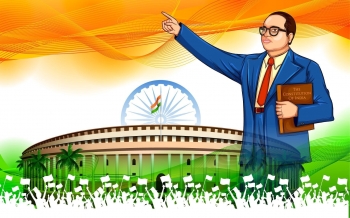
Constitution Day is celebrated on 26th November to commemorate the adoption of the Constitution of India.
How relevant is our Constitution in today’s society? What the Constitution means to the people? These are matters which everyone, including the last and the least, wishes to discern. We all know that our Constitution is the supreme law of the land. It is this living document that guides the three organs of the State -- legislature, executive and judiciary -- in their day-to-day functions.
The real place of the Constitution in the daily life of an Indian has been beautifully enunciated by Justice R F Nariman in one of his laudable Judgments. “Let every person remember that the ‘holy book’ is the Constitution, and it is with this book in hand that the citizens of India march together as a nation, so that they may move forward in all spheres of endeavor to achieve the great goals set out by this ‘Magna Carta’ or Great Charter of India”.
Our founding fathers nourished a vision for this country ruled by people of diversities that lived and worked in it. With this idea, they structured our Constitution. Our success as a country and its rise to the present status of world hegemon today proves that a country can be successfully run on a democratic framework.
Based on Reason and Revelation
The natural rights of man constitute the basis of the civil rights adumbrated in the Constitution. James Madison, the Father of the American Constitution and an Expansionist, claims: Constitution is the product of the transcendent law of nature and of nature’s God.
Safety and happiness of society are the objects at which all institutions aim. Constitution contains both guarantees and protections for its people. A well-ordered society requires citizens with the appropriate knowledge, skills and traits of character. This necessitates the people to have civil education, political knowledge and engagement. People are turning to Government to solve problems. Government is expected to come to the table on anything and everything.
Constitution is a vehicle of life, and its spirit is always the spirit of the age. Constitution will change with time as a living tree embracing realities of life. As we move forward as a nation, the Constitution must move forward as well in order to properly keep up with demands of the time. Progress should be engendered by long-term public interest rather than short-term personal gain. Republics are created by the virtue, public spirit and intelligence of the citizens.
Polarized populism and consequential ineffectiveness of legislature in lawmaking has driven the people to the Courts, their place of last resort, seeking guidance on laws and policies. Courts have presented themselves as fearless and independent and make landmark judgments that change the precedents and legal landscape of the country. It has stood as the guiding force during our times of struggles and turmoil.
Never Enough
Our Constitution has established ‘dual sovereigns’ at the Centre and States. It envisions unity where it is necessary as a people to speak with one voice…, but it allows countless voices to be heard on matters pertaining to the general welfare. It helps to maintain the unity and integrity of the nation within the federal settings. Constitution is an engine of growth and a means of social and democratic transformation. The growth of a democratic nation is assessed not in terms of GDP, but based on the prevalence of democratic norms and constitutional values. The present state of affairs in the society is indeed not enough to satisfy people’s wants and to achieve democratic aspirations.
Constitution is not merely a Declaration. It is the fulfillment of the promise of the people. It is a document of pragmatic character and utility. It really advances human good and our pursuit of happiness, making us better as citizens, workers, business owners, neighbours, fathers, mothers, children and so on.
A well-structured constitutional government of enumerated power must hear every voice in the democratic process, secure investments and jobs, and guard us from external threats to peace. Constitutional limitations on the exercise of legislative and executive power in fact leaves to each citizen a great expanse of freedom. It is up to each of us to employ the freedoms wisely and with responsibility.
We must know that free speech may lead to search for truth and wisdom and its abuse may turn to falsehood and libel. Similarly, property can lend economic security to family and human flourishing, but it can also be abused to magnify environmental harms or deny just wages and decent working conditions. Founders understood the golden truth that only virtuous people can be free. If India’s constitutional story has thus far unfolded well- and we believe it has- it is because “We the People of India” have largely resolved to be so.
On a New Frontier
A new past for a new present would take India’s constitutional history on a new frontier. Constitution not only designed a Government, but also placed limits on it to prevent arbitrariness. The purpose of the Constitution is to build an egalitarian society to secure life of quality to the people with right to equality. Constitution stands for the common man and works for the common man. The ambition of Mahatma Gandhi, the greatest man of our generation has been ‘to wipe every tear from every eye’. As long as there are tears and sufferings, our pursuits will not be over.
The Preamble, Fundamental Rights and Directive Principles in the Constitution taken together aims at the establishment of a free and just social order based on the rule of law. They aim at betterment of the individual as an integral component of the society and establishment of a sovereign, socialist, secular and democratic republic, promoting among its citizens, justice-social, economic and political.
The structure of the Constitution has been erected by architects of consummate skill and fidelity, its foundations are solid, its components are beautiful and useful, its arrangements are full of wisdom and order, and its defenses are impregnable from without. It has been reared for immortality. It may, nevertheless, perish by the folly, or corruption or negligence of its keepers, WE THE PEOPLE OF INDIA.
Constitution reflects the hopes and aspirations of the people. The cherished goals of the Indian Constitution as indicated in the Preamble, aspires for justice, liberty of thought, ex
Life in a Democracy
Life in a democracy should include equality in all aspects and should provide every man and woman to develop to the best of ability. Quality, sustenance and success of democracy depend on political freedom, economic equality and social justice. People out of jobs are the stuff out of which dictators are made.
The democratic institutions including the judiciary should work consistent within community values. Courts should keep an eye on community values and should uphold the same, failure of which would result in erosion of public confidence in judiciary. In India, Judiciary has been making endeavor and embarking on innovative methods to make the constitutional guarantee of socio-economic rights meaningful.
Democracy is a great institution. Nevertheless it is liable to be greatly abused. The remedy is not avoidance of democracy, but reduction of possibility of its abuse to a minimum. A good Constitution in a democratic set-up is important, but much more important is the system it contemplates and the manner in which it works. The same Constitution can work well depending on the people entrusted with the powers and roles assigned under it.
B R Ambedkar, the chief architect of the Constitution, observed: “However good a Constitution may be, if those who are implementing it are not good, it will prove to be bad. However bad a Constitution may be, if those implementing it are good, it will prove to be good”.
On this occasion, let us recollect Winston Churchill’s words of “the little man with a little pencil with little ballot vote” who constitute the heartbeat of democracy.
.jpg)
.png) Cedric Prakash
Cedric Prakash

.jpg) Elsa Lycias Joel
Elsa Lycias Joel
.jpg)
 A. J. Philip

.png) Jacob Peenikaparambil
Jacob Peenikaparambil
.jpg)
.png) John Dayal
John Dayal
.jpg)
.jpg)
.png) Joseph Maliakan
Joseph Maliakan
.png)
.png) Robert Clements
Robert Clements
.jpg) Cedric Prakash
Cedric Prakash

 ICPA
ICPA