

.jpg) F. M. Britto
F. M. Britto
.jpg)
Instead of going to school, the ten year old Neeraj Murmu went to labour in the mines to earn some money for his poor tribal family in Duliakram village, Giridih district of Jharkhand.
Poverty had forced many such rural kids to quit their school and toil in the local mica mines. The 2016 survey revealed that about 20,000 kids worked in mica mines in Jharkhand and the neighbouring Bihar. Some were as young as five year olds, both boys and girls, and there were many school drop-outs too. Besides stunting their future career, this hazardous occupation also afflicted their health.
So the activists of the Bachpan Bachao Andolan (BBA) of the Nobel Peace Laureate Kailash Satyarthi’s foundation selected this village in 2011 to become a Bal Mitra Gram (BMG) (Child Friendly Village). Promoting child-centric rural development, BMG ensures kids are not employed, married or exploited. On the other hand, it provides them quality education by empowering parents and the communities.
Neeraj was thus rescued from the child labour and was enrolled in the local government school in the 8th grade. Two years after, Neeraj joined the BBA’s Yuva Mandal (youth group) to rescue other child labourers and to enroll them in the school.
He began to address many other socio economic problems too affecting his village. He helped them to bring electricity, got gas connections for the marginalized, installed and got repaired hand pumps.
In 2014 he travelled to Chennai to rescue four employed children and brought them back and enrolled them in their village school. He has rescued about 20 kids employed in the mica mining and sent them to the school.
Pursuing his graduation, Neeraj began a school in his village in 2018 to give free and quality education to children. He named it Kailash Satyarti School. He motivates the students with his child labour experiences and inspires them to dream big. He has taught more than 200 children.
Neeraj has also led many rallies condemning child labour and making aware of the importance of education. This has led to many enrollments in the local schools. Some of these rescued children too bring positive changes in their villages.
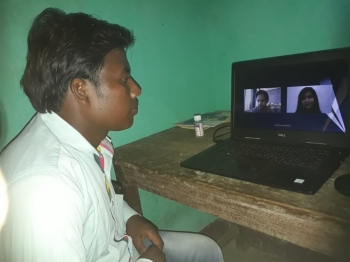
For creating such changes, the 21 years old Neeraj was awarded the prestigious British Diana Award on July 1, 2020. The award instituted in memory of the late Princess Diana of Wales is given to children aged between 9 and 25 years old, who have worked on social issues. Due to the Corona pandemic, the award was given to Neeraj in a virtual ceremony.
Appreciating Neeraj, the BMG Executive Director P. Nagasayee Malathy remarked, “Neeraj is a role model for many children in our Bal Mitra Grams.”
Congratulating Neeraj and thanking Kailash Satyarthi, Chief Minister Hemant Soren of Jharkhand stated that his example is inspiring.
The excited Neeraj commented, “I used to feel scared working in the mica mine; but there was no other way. But now I tell parents that children need to study.”
“Children should fill their mind, instead of their pockets.”

.jpg) Stanislaus Alla
Stanislaus Alla
.jpg)
.png) Cedric Prakash
Cedric Prakash

.jpg) Elsa Lycias Joel
Elsa Lycias Joel
.jpg)
 A. J. Philip

.png) Jacob Peenikaparambil
Jacob Peenikaparambil
.jpg)
.png) John Dayal
John Dayal
.jpg)
.jpg)
.png) Joseph Maliakan
Joseph Maliakan
.png)
.png) Robert Clements
Robert Clements
.jpg) Cedric Prakash
Cedric Prakash