

.jpg) Dr. Paul Pudussery
Dr. Paul Pudussery

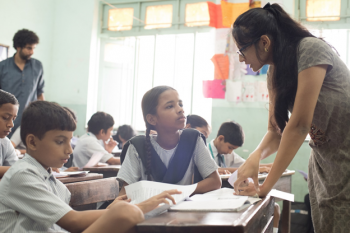
5th September is set aside to acknowledge, appreciate and admire our teachers who have had a positive influence on our lives and on the society. Any adult person has encountered numerous teachers who have shaped their lives and their thought pattern. Teacher is a person, a role model, a coach, a guide, a philosopher, a task master, a second parent and the list can go on and on. Our great Indian tradition placed the teacher on high pedestal showering upon them a state of respect and honour. Let us on this day reminiscence the memory of every teacher who contributed in making us who and what we are today.
The profession or the way of life of a teacher is undergoing a crisis. Crisis is accelerated by the advancement in communication technology, inflation and due to the changing perception of a teacher. In earlier times and till the pandemic, a teacher was considered as a person who contained knowledge and transmitted that learned and experienced knowledge to the students. This process of transmission, earned in the minds of students especially in the younger ones a sense of indebtedness and admiration. The transmission of knowledge was done with care, understanding, commitment and love. It embodied multiple virtues and nurtured those virtues in the taught. This transmission took into consideration the receptivity and the capacity of the students and made it palatable for most of them. The teacher presented himself or herself as an embodiment of knowledge, reservoir of information and lived that knowledge in simplistic way. The demeanour, the way she or he conducted themselves in public, attracted students to them.
Teacher presented himself or herself as a moral compass and had the knowledge of traditional values and ethos of a community. The very presence of a teacher served as a light house through their eloquent silence. Teacher is not only an embodiment and transmitter of knowledge but a guard of social conscience. The society looked up to the teacher to declare what is wrong and what is right, what is allowed and what is not allowed in the given context of a society. The students imbibed those values and the teacher nurtured it with utmost care and detachment.
The teacher in a village setup not only taught but created discourses that affect the village. Initiated conversations about health, hygiene, sanitation, religion, development and many other topics. People pitched into these conversations that become opinions and eventually policies that all adhered to. The teacher choreographed the life of a society – the young and the old alike. The teacher earned respect and became the philosopher and guide engendering a new generation with hope.
The new inventions in communication technology, de-institutionalised knowledge and that process got accelerated during the pandemic, leading to an emerging narrative of a teacher. The teacher lost the image as the container or as the embodiment of knowledge. Teachers had to struggle to cope with the demand of the students enabling them to learn to harness the power of technology. Some teachers found it difficult to embrace technology and they continued to use chalk and talk pedagogy. The refusal to adopt technology made them unpopular and even irrelevant. The teachers lost a voice to be engaged in the nation-building and character formation. Society is losing the tacit knowledge of an experienced nation- builder.
The explosion of information could be accessed by anyone provided they have the technology to acquire it. Once this unfiltered information is received, many consume it without applying a cognitive mind. Such platforms have become a breeding ground in promoting agenda of the content writers. The idea of knowledge and the teacher acquired a new meaning. A post-Covid narrative emerged which may be termed as “Post-Truth Era”. Many remained at the level of information-gatherer rather than knowledge constructor.
Social media was used by many to spread information for emerging consumers, mainly young. To hook the young, things are presented by those expensive advertisements which profiled the idealistic dreamers to journey of fulfilment. The advertisers present an alluring image, attractive young go-getters, with glowing complexions and sharp business dress, providing inspiration amidst strategically placed Bunsen burners and an uplifting sound track. Many of our current generation enslaved themselves and made life decisions based on this misplaced information. They are failing to convert information into knowledge by applying a method of computational thinking.
National Education Policy 2020 envisages a teacher who is qualified, talented and trained. A teacher who has excellent subject knowledge, pedagogical knowledge and technological knowledge. A teacher who is able to engage students to imagination, facilitate interaction with the subject, through an immersive process. To attract talented persons to teaching, a new recruitment policy is created, a new curriculum framework is in the process, standards of assessment, promotion and pay being defined. Will this new vision reinstall the position of our teachers in the society? Will these changes increase the commitment and tenacity of our teachers in preparing our next generation to the uncertain future?
The role of a teacher has changed from transmitter of knowledge to a promoter of learning. The teacher, today, has to teach students to become life long and self-driven learners. A paradigm shift is taking place in the narrative of a teacher. Will this paradigm shift disturb the honour, respect and the role, the teacher played as a committed, responsible and caring public intellectual? Will the 21st century present itself a teacher who is merely a professional with minimal commitment. Will this new narrative of a teacher jeopardise the construction of a just and compassionate world?
5th September cannot just pass with few greetings, garlands and pious words of gratitude. It calls on policy-makers, public intellectuals and decision-makers to redefine the “Teacher” for our time to carve a better future for the generations to come.
(The writer is a freelance social science researcher and may be contacted on pudusseryp@gmail.com)
.jpg)
.png) Cedric Prakash
Cedric Prakash

.jpg) Elsa Lycias Joel
Elsa Lycias Joel
.jpg)
 A. J. Philip

.png) Jacob Peenikaparambil
Jacob Peenikaparambil
.jpg)
.png) John Dayal
John Dayal
.jpg)
.jpg)
.png) Joseph Maliakan
Joseph Maliakan
.png)
.png) Robert Clements
Robert Clements
.jpg) Cedric Prakash
Cedric Prakash

 ICPA
ICPA