

.png) Cedric Prakash
Cedric Prakash
.jpg)
Rosary School in Vadodara (Baroda) Gujarat is one of the premier educational institutions of the State. It is co-educational and run by the Society of Jesus. It caters to about 2,300 students from all walks of life. The School that was begun in 1935 boasts of alumni who have contributed significantly to the nation -- in public service, sports, academic and research engagements and other spheres. It is therefore not without reason that the Rosary School is much sought after by parents for the education of their children.
On 4 November 2023, the school had its Annual Day. The first part, which lasted for about an hour, was devoted to the customary items like lighting the lamp, prayer dance, the Principal’s Report, the Chief Guest’s speech, the prize distribution etc. Then one would have expected the ‘traditional’ items of song, dance and playlets which are the ‘normal’ stage presentations on such Annual Days!
But NO! The huge gathering, parents, well-wishers and friends of the institution, was treated to a performance, which few will ever forget. The theme of the Annual Day was ‘Promoting and Safeguarding the Constitutional Values.’ The huge backdrop catchingly emblazoned the theme with a picture of Dr. B.R. Ambedkar, the father of the Constitution, and a picture of the Constitution of India. The entire programme, which went on for a non-stop two hours, highlighted the four non-negotiable values of the Constitution: justice, liberty, equality and fraternity. It was a spectacle in song, dance and mime. Class after class (from the KG to Std. XII) they came; they regaled and engaged the audience in a very meaningful way. More than seven hundred students took part in a performance, which was simply brilliant and heart-stopping.
The tiny-tots of the kindergarten set the ball rolling. They were all beautifully dolled up in the image and likeness of those who fought for the freedom of India and brought to us 15 August 1947. The children paraded in royal style, to the cheers of the audience and with the commentator highlighting the significant role each of these played in making India a free nation. It was simply an out-of-this world performance by tiny tots, who helped bring back memories of those who sacrificed so much for our freedom.
The audience was then transported to 29 August 1947 when the seven-member Drafting Committee for the new Constitution was appointed. The seven members of this Committee were certainly look-alike of the original. The student who played the role of Ambedkar was certainly a ‘chotta’ version of the original. The accents and articulations of each of these members, besides their names, beautifully communicated their cultural and ethnic backgrounds, which spoke volumes of the wealth of diversity in India.
Against the background of these stalwarts discussing the key values of the Constitution: the students came out in groups (according to their classes) and poignantly highlighted through ‘real life’ incidents why these values are important in democracy and how they are being negated on a daily basis. The discrimination of the girl child, for one, so rampant in the country today, was brought to the fore. The ‘father’ of the child, whilst emphasising ‘gender equality’ very proudly stating that “my daughter is not tension’ but equal to ‘ten sons’!
Other forms of discrimination and injustice were also brought to the fore. Corruption in public and private places certainly made the audience wince. The need and importance for communal harmony and peace, for fraternity was depicted of how people are conveniently targeted because of their beliefs, customs and practices. The programmes touched upon several other grim realities and Constitutional violations, which exist today. The mimes were all topical and would have surely made many from the audience say to themselves, “yes it is true, what the children are presenting to us, is happening on a daily basis!”
Then there a series of dances: the students came out in gusto dancing their hearts out to the words, tunes and steps of the various states of the country. They truly showed how beautifully different the country is; why we need to appreciate and learn from each other; and why we need to celebrate pluralism.
The entire programme was painstakingly and meticulously choreographed; the commentary and voice –overs showed that much care was taken to be as factual as possible. The costumes of the children were besides being beautiful were also very appropriate. The slides, which came on and off, were not merely educative but helped in setting the tone for what was being enacted. The ambience, the music (sounds) and the lighting belonged to the realm of a professional presentation and not to a performance by schoolchildren.
‘Celebrating Constitutionality’ was certainly a feeling that one could take home after witnessing such a wonderful performance. Fr. Patrick Arockiam SJ, the Principal of Rosary School since 2019, is the brain behind this extra-ordinary programme. He has no hesitation in commending the excellent and selfless support from his entire staff, the whole-hearted cooperation of the parents, the alumni, and above all the enthusiasm and the willingness of all the children to participate in a path-breaking programme.
In his typical unassuming manner Fr Patrick states, “I was keen on such a programme because it is the need of the hour’; it is an effort to instil in the children the sanctity of the Constitution and to help them imbibe the values and the spirit enshrined in them. This should be high up on the priority for all educationists. When I put it across to my staff, they agreed with me one hundred percent and gave their best in ensuring that it materialised in such a wonderful way!” The practices (during school hours) went for about three weeks. Incidentally, at the daily Assembly of the Rosary School, the students recite the Preamble of the Constitution and most have memorised it by now.
Rosary School has surely shown the way for all other educational institutions throughout the country to do likewise. It would be interesting to see how many schools will actually do so. The Constitution is the only sacred book for every citizen of India. The values enshrined in it are non-negotiable and must be internalised by all children from the moment they enter the portals of an educational institution. The sanctity of the Constitution of India today, however, is not only being trampled upon and desecrated, but being torn to shreds. Educationists need to exert a powerful and defining direction by taking up cudgels to promote and safeguard Constitutional values. They should regard it as their primary duty.
On the eve of the enactment of the Constitution, 25 November 1949, in a passionate speech to the Constituent Assembly, Dr B.R. Ambedkar gave three unambiguous warnings: the need to give up the grammar of anarchy, to avoid hero-worship, and to work towards a social – not just a political – democracy! Ambedkar was, at that time, perhaps visioning what India could become in 2023, and how these three aspects could not only destroy all that was sacred in the Constitution, but could result in the dismantling of the democratic framework.
In powerful interview recently (13 November) in ‘The Wire’ with Karan Thapar, one of the foremost scholars of the Indian Constitution, Prof Tarunabh Khaitan, professor of Public Law at the London School of Economics, says Modi has ‘Killed the Constitution by a 1000 Cuts’. He states, “many of India’s political parties and institutions have sleep walked into (Modi’s) authoritarianism whilst others are complicit in Modi’s undermining of democracy; many people didn’t realise what was happening whilst huge swathes of constitutional machinery was aware but let it happen. There is incremental, subtle but systemic style of autocratisation which chips at the fundamentals of democracy”.
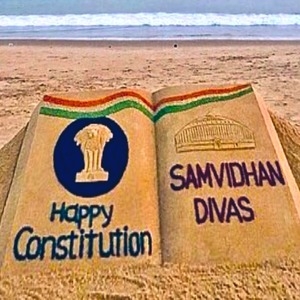
With National Elections just six months away, the people must get their acts together. As we observe another ‘Constitution Day’ (26 November) let us pay heed to Dr. Ambedkar’s final words to the Constituent Assembly on 25 November 1949, “If we wish to preserve the Constitution in which we have sought to enshrine the principle of Government of the people, for the people and by the people, let us resolve not to be tardy in the recognition of the evils that lie across our path and which induce people to prefer Government for the people to Government by the people, nor to be weak in our initiative to remove them. That is the only way to serve the country. I know of no better.”
Rosary School Baroda has shown us all how to ‘Celebrate Constitutionality’!
(Fr. Cedric Prakash SJ (GUJ) is a human rights, reconciliation and peace activist / writer. Contact: cedricprakash@gmail.com)

.jpg) Stanislaus Alla
Stanislaus Alla
.jpg) Stanislaus Alla
Stanislaus Alla

 Adv. Rev. Dr George Thekkekara
.jpg)
 A. J. Philip

.jpg)
.png) John Dayal
John Dayal
.jpg)
.png) Jacob Peenikaparambil
Jacob Peenikaparambil

.jpg)
 P. A. Chacko
.png)
.png) Robert Clements
Robert Clements