

.png) Jacob Peenikaparambil
Jacob Peenikaparambil
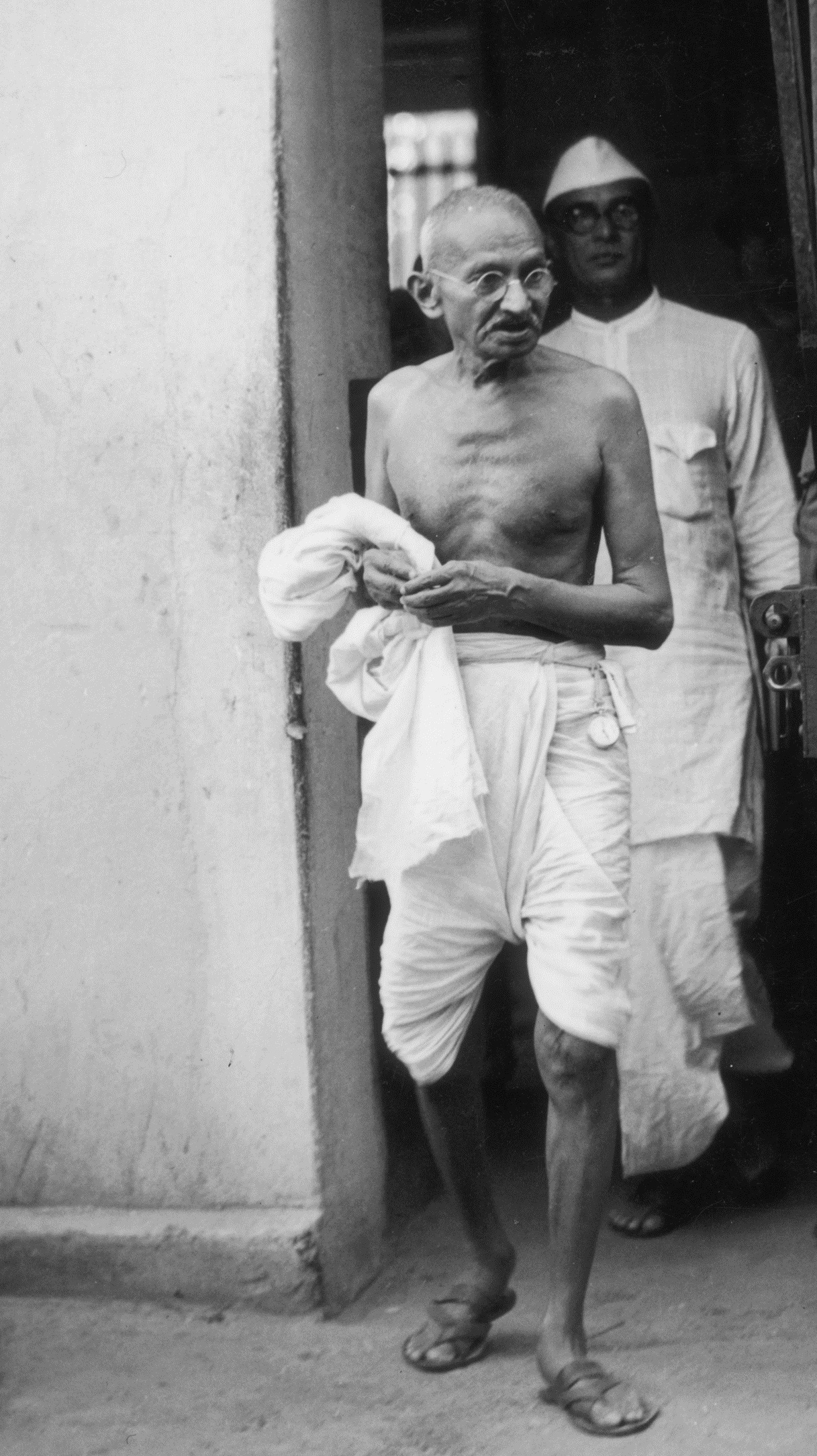
Every year, India celebrates October 2 as Gandhi Jayanti to pay homage to the Father of the Nation and recommit ourselves to the principles and values he practised in his personal and public life. In a world plagued by conflicts, wars, growing inequality between rich and poor, and rising religious fundamentalism, Mahatma Gandhi's legacy is more relevant than ever. In the context of India, which is slipping into a culture of hatred and revenge, a reassertion of Gandhian values and principles is urgently needed. In fact, India requires a second liberation struggle to build a harmonious, inclusive, just, equitable, and sustainable nation, as envisioned in its Constitution.
As part of a one-week leadership training program at the Universal Solidarity Movement (USM) in Indore, participants are shown the film Gandhi by Richard Attenborough. After watching the movie, an interactive session is held with the participants, mostly high school students, where they are encouraged to ask questions and express their views. Some acknowledge that they had wrong perceptions about Gandhi, which they realised were baseless after watching the movie. They simply believed what others told them or what they learned from social media without referring to any authentic sources like Gandhi's autobiography "My Experiments with Truth" or other reliable biographies of him.
During the discussion, an important question posed to the students was: "What is Gandhi's legacy, and how is it relevant in today's context for India and the world?" The participants' responses highlighted three main Gandhian principles: 1) Non-violent resistance to injustice and non-violent conflict resolution, 2) Acceptance and respect for all religions, 3) Environmental Sustainability and 4) Ethics in politics and leadership. Despite India's progress since Independence, there has been a significant erosion in the practice of these core ideals.
Non-violent resistance to injustice and non-violent conflict resolution
Gandhi's life and struggles in South Africa and India demonstrate that he always adhered to non-violent means while he resisted and opposed injustice and discrimination. He was ready to suffer rather than inflict pain on others. When Gandhi was unjustly thrown out of a first-class train compartment in South Africa because of his skin colour, he decided to fight racial discrimination using non-violent methods. His 21 years in South Africa were dedicated to this struggle for equality and human dignity, even though he was repeatedly arrested and jailed.
Upon returning to India, Gandhi applied the same method of Satyagraha and non-violent resistance to India's freedom struggle. Between January 10, 1908, when he was first imprisoned, and May 6, 1944, Gandhi spent 2,338 days in jail cumulatively in colonial South Africa and India. He believed in non-violence in thought, words, and action. "Non-violent revolution is not a seizure of power. It is a program of transformation of relationships ending in the transfer of power," he said. Thus, Gandhi held no enmity toward the British, and even after they left India, Britain remained a friend of India. The Gandhian method of non-violent resistance was later successfully applied by Martin Luther King Jr. and Nelson Mandela in their struggles against racial discrimination, leading to the achievement of equal rights for all.
For Gandhi, the ability to forgive was a key component of non-violence. He believed that forgiveness was even higher than non-violence and that vengeance was a sign of weakness. "The weak can never forgive. Forgiveness is the attribute of the strong," he said. One of the root causes of conflict is the unwillingness to forgive and the desire for revenge. This is why UNESCO's preamble states, "Since wars begin in the minds of men, it is in the minds of men that the defences of peace must be constructed."
Unfortunately, contemporary Indian society has drifted far from Gandhi's ideals of non-violence. Many political and social protests are marred by violence, and at times, the state responds to legitimate protests with force. Non-state actors also take the law into their own hands, often with little intervention from authorities.
Another alarming trend in India today is the rising hatred against certain communities. Social media platforms are flooded with fake news and hate speech. Some political and religious leaders even indulge in hate speech with impunity, which can incite violence. India cannot become a "Vishwa Guru" (world leader) unless its people and leaders liberate themselves from hatred and revenge. Gandhi strongly advocated non-violent conflict resolution, and his principles are deeply relevant today. Major wars, such as the Russia-Ukraine conflict and the Israel-Hamas war, are currently ongoing. If global leaders were committed to resolving conflicts using Gandhian non-violence, much bloodshed could be avoided.
Acceptance and respect for all religions
The second key component of Gandhi's legacy is interfaith harmony. In both his South African communities (Phoenix Settlement and Tolstoy Farm) and his Indian ashrams (Sabarmati and Sevagram), people of different faiths lived and worked together. Gandhi encouraged interfaith prayers and believed religious diversity should lead to mutual respect and a deeper connection to God. His vision was that a Fellowship of Faiths should help a Hindu become a better Hindu, a Muslim become a better Muslim, and a Christian become a better Christian.
Gandhi saw religion as a personal path to spiritual growth and service to humanity. He believed in Sarva Dharma Sambhav (equality of all religions). His respect for all religions is evident in his statement: "It is only through a reverential approach to faiths other than mine that I can realise the principle of equality of all religions." He was also unafraid to critique the flaws he saw within Hinduism, advocating for its purification.
In light of Gandhi's views, there is an urgent need to foster understanding and harmony among people of different religions in India. People should be seen as human beings first rather than defined by their religion or caste. We must unite to address common issues like poverty, illiteracy, unemployment, and corruption instead of fighting in the name of religion.
Environmental Sustainability
Another dimension of Gandhi's relevance today is his vision for a more sustainable way of living. Though he lived in the early 20th century, Gandhi espoused principles that resonate deeply with today's environmental consciousness. Gandhi famously said, "The world has enough for everyone's need, but not for everyone's greed." This idea touches at the heart of today's environmental crises—climate change, resource depletion, and unsustainable consumption. Rampant consumerism has led to the overexploitation of the resources of the Earth and the generation of too much waste. Gandhi's critique of unchecked industrialisation, consumerism, and exploitation of natural resources underscores the need for responsible and ethical development.
Gandhi's emphasis on self-reliance, frugality, trusteeship and simple living was a precursor to the sustainability movements of today. His idea of Swadeshi—using local resources and promoting local industries—challenges the current global economic system that relies on mass production, overconsumption, and global supply chains that exploit people and the planet. Gandhi's principles point toward a more harmonious and less exploitative relationship with the Earth in our current age of climate change, environmental degradation, and a growing ecological footprint.
Ethics in leadership and politics
The fourth aspect of Gandhi's legacy is adherence to ethics in leadership and politics. There was no disconnect between what Gandhi preached and what he practised, which is why he could convincingly say, "My life is my message." He was deeply aware of seven social sins, which he wrote about in Young India on October 22, 1925. The antidote to these sins is to follow the corresponding ethical principles in public life to build a peaceful, harmonious, and sustainable society.
Corruption plagues many countries, including India. Political leaders often accuse each other of corruption, yet many engage in it themselves to gain or retain power. This is a result of politics without principle. To overcome these social evils, people of all religions must grow in spirituality rather than religiosity, which fosters legalism, ritualism, and prejudice. True spirituality is about practising core values like forgiveness, compassion, non-discrimination, justice, and environmental care.
As we celebrate Gandhi Jayanti, it is important to remember what Albert Einstein said about Gandhi: "Generations to come, it may well be, will scarce believe that such a one as this ever in flesh and blood walked upon this Earth." Every Indian should take pride in Gandhi's contributions to India and the world. Along with practising his core teachings, we must also counter the negative narratives spread to malign his image.

.jpg) Stanislaus Alla
Stanislaus Alla
.jpg)
.png) Cedric Prakash
Cedric Prakash

.jpg) Elsa Lycias Joel
Elsa Lycias Joel
.jpg)
 A. J. Philip
 Jacob Peenikaparambil
.jpg)
.png) John Dayal
John Dayal
.jpg)
.jpg)
.png) Joseph Maliakan
Joseph Maliakan
.png)
.png) Robert Clements
Robert Clements
.jpg) Cedric Prakash
Cedric Prakash