

.jpg) J. Prashant Palakkappillil, CMI
J. Prashant Palakkappillil, CMI

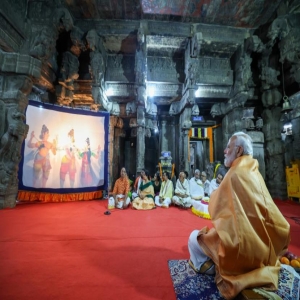
Though the terms' karmakaand' and 'anushthaan' have more or less related meanings, they appear to signify different things or degrees of performing religion-related observances. Both imply 'ritualism' in religion, and the terms are generally employed against India's Hindu Sanaatan dharma tradition. With the Ram Temple of Ayodhya becoming the cynosure of all sorts of activities in UP and, perhaps, across Northern India, the terms have gained greater significance. The terms have been referred to in connection with the rituals enacted in Ayodhya in connection with the praanpratishtha (ceremonial installation) of the idol of Sri Ram.
In the Indian philosophical tradition, which explores the sheaths of human consciousness, the ultimate core of consciousness is described as 'aanandmaya' (bliss). In other words, the ultimate aim of existence could also be understood as unadulterated bliss - which could be termed God, Paramaatma, or the Ultimate. In psychological terms, it could be seen as the realm of self-actualisation as described by Maslow [1].
The kind of enthusiasm shown by the BJP government in the centre and in UP appears so contagious that it has spread to almost all domains of public life. Secular systems like universities have also been caught up in the tide, and Lucknow University recently issued an official circular to all affiliated institutions to ensure that they don't fall behind in preparation for this great event, instructing them to decorate and illuminate their premises and ensure swacchtaa of the surroundings. While these directives have the bearings of a typical theocratic nation, the fourth estate appears smugly oblivious to this. It seems to be going all out to project the news around such activities as if that were the new normal. This trend is evident in the local language print and visual media, whereas it is toned down in English.
That a political party has come to power based on a religious manifesto and is making an all-out effort to fulfil that and regain or emphasise the heritage and cultural tradition of the dominant majority is to be accepted as a reality in the democratic process mediated through majority rule, but the government and its functionaries to confuse and mix their official roles and personal preferences does not really augur well for a democracy, still established as secular according to the constitution.
The elected governments, while going all out to fulfil the mandate of the Ram temple, especially with the sanctions of the highest body to spell out the rightness of actions in the light of the 'scripture of the nation' (the constitution), are accomplishing some good beyond religiosity: 1) the effort to infuse technology of the latest order in reorganising the city of Ram - demonstrating that tradition (paramparaa) needn't be opposed to progress (pragati) 2) to build up infrastructure along with the structure of an architecturally magnificent temple - roads, hotels, airport 3) purposefully naming the new and state-of-the-art international airport after Maharshi Valmiki - killing two birds in one shot (i) reemphasising Ram and Ramayana and (ii) boosting the morale of the suppressed groups in the broader Hindu fold - the Dalits, as Valmiki is said to be representing a backward caste in many parts of North India. and 4) promoting swacchtaa (cleanliness) as a spiritual attribute to welcome the deity, Lord Ram, clearly tapping the opportunity for a much-required field of action, and leading the drive through personal involvement of the leaders.
However, one is surprised to learn that the President of the nation, especially with the rare epithets of belonging to a tribal community and being a woman, is not included in the guest list for the installation of the idol of Sri Ram, who had the sagacity to accept from the tribal ascetic Shabari the 'jhuthan ber' (the Jujube berries she had tasted to check for their edibility)!
I felt that this occasion could have been tapped by the political leadership for building up the nation further on the path of communal harmony, fellowship and everyone's growth (sab ka vikaas, sab ka saath, sab kaa vishwaas and sab kaa prayaas) by being a little more broad-minded after the much-touted axiom of 'vasudhaiva kutumbakam'.
(i) By appreciating the Muslim community for amicably accepting the Supreme Court judgement and by rendering all support to ensure that a suitable structure for substituting the demolished masjid is erected along with the Mandir. That would have been more Maryaadapurushottam Ram-like.
(ii) By inviting all the religious heads of the various religious groups of the nation for the ceremony, appealing for harmony, and shedding the religious jingoism observed in the preparations happening around.
(iii) By respecting the separation of religion and government as enshrined in the constitution and avoiding constitutional authorities utilising their positions to explicitly favour and promote their faith.
While the average citizen with a Hindu tag (even those who were deprived and systematically subjugated by the typical caste practices, now happily wearing the tag, despite the continued oppression under those systems in several parts of the nation) appears to be jubilant about the whole thing, the question of being truly 'religious' - being in the right relationship with the Ultimate, with fellow beings, with one's self, and with the planet remains alive. Do all these 'actions' around solemn rituals rebuild the rhythm of the right relationships (rta, as said to be 'heard' in Rgveda)? Do they help them progress towards the ultimate religious goal of aanandamaya atman? Do they help in being self-actualised persons?
The ancient description: 'ramayte iti raam', implying Ram is the one who unifies (could also be read as reconciles) the individual self (aatma) with the ultimate self (paramaatmaa), if accepted, the efforts have much further to go - go beyond the ceremonies to action for reconciliation. So starting from the Ram of Ayodhya, the deity who was Maryaadapurushottam among men, who respected the opinion of people, who took care of and respected the tribals, women and the elders, who was willing to sacrifice one's personal gains for that of the society, who helped other nationalities to thrive along with his own (Kishkindha, Lanka) promoting good governance there, the followers of Ram can establish the Ram beyond the Kingdom of Ayodhya, as the indweller who can fulfil the deepest of human longings, aananda, the state of harmony among the individual selves and with the Ultimate self.
My prayer is that in this modern 'bhakti kaal', the Rambhakt Kabirdas' prophetic saying be found inaccurate:
Raam raam kar sabai bakhaana Raam naam ka maram na jaana!!
(Everyone praises saying 'Ram Ram', but they have not grasped the core of the name of Raam).
1 Maslow, Abraham, "A Theory of Human Motivation" in Psychological Review, 1943.
.jpg)
.png) Cedric Prakash
Cedric Prakash

.jpg) Elsa Lycias Joel
Elsa Lycias Joel
.jpg)
 A. J. Philip

.png) Jacob Peenikaparambil
Jacob Peenikaparambil
.jpg)
.png) John Dayal
John Dayal
.jpg)
.jpg)
.png) Joseph Maliakan
Joseph Maliakan
.png)
.png) Robert Clements
Robert Clements
.jpg) Cedric Prakash
Cedric Prakash

 ICPA
ICPA