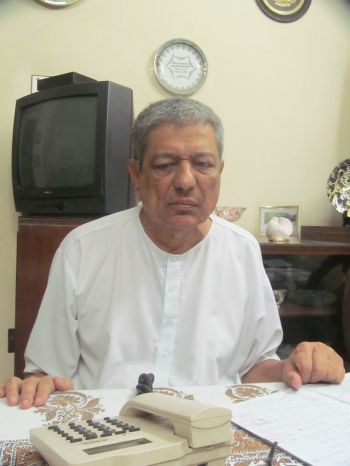


.jpg) Lancy Lobo
Lancy Lobo

The inter-religious dialogue we speak about is more effective at the dialogue of life, rather than at the level of doctrinal tenets, beliefs and liturgies. Indeed, we need more of inter-religious dialogues especially of life and work in a multi-religious country like India.
J.S. Bandukwala, a Bohra Muslim, has been an elder brother to me ever since I met him 20 years ago when he was looking for a credible trustee for the Centre for Culture and Development, Vadodara, a Social Science research centre. It was Professor Priyavadan Patel of the Maharaja Sayajirao University of Baroda who introduced me to him. He was the founding trustee of the Centre and remained an honoured trustee until he could no longer physically move out of his house.
We met often and sometimes weekly and talked on the phone regularly. Over the phone his conversations usually began with the sentence ‘what can I do my brother’? We discussed and shared a lot of issues regarding personal, familial, and political. A highly respected academic, he studied at St. Xavier’s School and College, Mumbai and obtained his doctorate in physics from the USA. On receiving his doctoral degree, he met a Catholic nun at a meeting who asked him about his future plans. She told him, “go back to India and serve your people”. He took that counsel seriously, came back to Vadodara and taught physics at the M.S. University, Baroda until his retirement.
In fact, his retirement was no retirement. He was a Gandhian at heart and fought for the rights of Dalits and tribals. He was a liberal Muslim and inclusive in his values. It was no wonder that he had friends from every religion, every stratum of society. A God-fearing person, he prayed, read the Quran and also the Bible during the month of Ramzan. He may not have been pietistic but certainly he lived by the core values of Islam. He was a reformer in his own Bohra Muslim sect and often faced the ire of the authorities therein.
Prof. Bandukwala was as tough as stone when it came to fighting injustice but soft as a flower to the downtrodden. His mannerisms were extremely refined and delicate. He believed in dialogue even with his opponents. It was two days after he went to address an RSS organized gathering that his house was vandalized and burnt down in the year 2002. He and his daughter barely escaped with their lives as a couple of friends protected them. Barkha Datt’s interview on NDTV with Bandukwala and his daughter on the above issue brought tears to many.
Politically he was constantly asking, “Do we want a Gandhian India or a Godse’s India?” As a matter of fact, he was rather disheartened about the political developments in the country. He read much and had great regard for Abraham Lincoln. Prof. Bandukwala wrote letters often to newspaper editors and had a collection of several hundreds of such letters. Till he was physically able, he often wrote articles on critical issues in the Indian Express.
He was the PUCL president of Gujarat unit and fought many battles against atrocities and injustices meted out especially to the poor. It was a known fact that he took up the cause of the residents of Kalyannagar in Vadodara, a slum evicted by the Corporation and he saw to it that they got alternative housing to move into for living. A compassionate man, he very often dragged himself to government offices despite his ill health.
His reflections on life and changes in the mainstream society made him focus on his Muslim community which was less literate and poor. He often said that education was the only highway for Muslims as they cannot rely on the Government sources. He began a Trust called Zidni Ilma where he collected yearly donations both as Zakat and Lilla to the tune of Rs. 90 lakhs during Ramzan and invited applications for scholarships from all over Gujarat. He personally ploughed through the applications and selected students for scholarships from his Trust. This kept him busy and engaged for several years.
When his daughter married a Hindu he faced flak from his own community. However, he weathered the storm and upheld the values of the Republic -- freedom of choice of the individual.
He was often invited to speak to people from all backgrounds and he willingly went to these functions. The Christian seminary at Vadodara, Sevasi had invited him to give the inaugural address. The Centre for Culture and Development, Vadodara whose founding Trustee he was and continued for nearly twenty years had dedicated its conference hall in his name. Whenever anyone required his assistance and service, he was always available and supported the centre. We, at the centre, always celebrated his birthdays, but lately it was celebrated at his house where he was confined. It was unfortunate that he passed away on the 29th January 2022 at the age of 77 years.
He lived alone as both his children were in the USA but communicated with them regularly. Bandukwala was known for his simplicity and was hospitable to all, especially to the poor for whom he was always available. His loss of hearing did not deter him from being in touch with visitors. For the last year or two he was a victim of Covid-19 which debilitated him and he was confined to his home completely and lately he was hospitalized.
It was not very long ago that I had typed and sent him a few inspiring verses from the Quran which he had given me in his handwriting some years back. He was very happy to receive these verses and he told me, “Now I am asking Allah to call me home”.
It is with anguish that I say that we have lost a great India citizen, educator, social activist, and democratic dissenter of this country who respected its Constitution and lived by it. May he rest in peace, and I know that he will most certainly, for a life exceedingly well lived. But he may not be at peace at the direction in which the Republic is forced to move!

.png) Julian S Das
Julian S Das
.jpg)
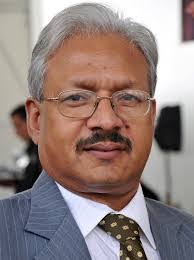 A. J. Philip
.jpeg)
.png) Jacob Peenikaparambil
Jacob Peenikaparambil

.png) Cedric Prakash
Cedric Prakash

.jpg)
.png) John Dayal
John Dayal
.png)
.jpg)
.jpg) Thomas Menamparampil
Thomas Menamparampil
.png)
.png) Robert Clements
Robert Clements
.jpg) A. J. Philip
A. J. Philip