

.jpg) P. A. Joseph
P. A. Joseph

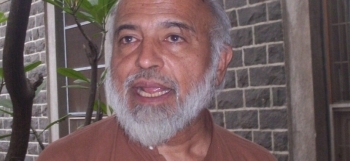
Fr. Subhash Anand, a priest of the Catholic diocese of Udaipur, a renowned theologian and philosopher, went for his eternal reward on May 23, 2022. He had served the Jnana Deep Vidyapeedh, Pune, for 33 years as a professor of philosophy and religion. After his retirement, he served the diocese in various capacities in faith sharing, dialogue, writing, conducting study sessions on theological themes, etc. His talks were highly appreciated by progressive minds.
Fr. Anand had taken doctorate in Indian philosophy from Benares Hindu University. He had delved deep into Indian mind and culture, and it helped him to integrate Christian thoughts in Indian perspective. Indian ethical values Sathya, Dharma, Ahimsa, etc. were given due importance in his reflections. He would say: one has to be authentically Indian and genuinely Christian. This caused great challenge in life and practice.
He loved to go profound in to the Gospel and invite believers to be authentic rather than get stuck in enslaving traditions. Little wonder he was confronted on different occasions as a philosopher-theologian. Fr. Stanislaus Alla, a theology professor of Vidya Jyoti, Delhi, hails as admirable the renowned philosophy professor’s power and enthusiasm during theological discussions and debates. As Sister Shalini Mulakkal PBVM testifies, Fr. Anand was a clear thinker, a bold theologian, who dared to question some of the fundamental beliefs of Christian faith. He was a scholar in every sense of the word.
His latest book Seven Baskets Full is a scholarly work on Eucharist. Sr. Mulakkal was edified to see that during the inter faith meetings, he would quietly celebrate Eucharist using his small mass-kit.
Fr. Anand was thoroughly human and compassionate. He was equally detached from everything and was fully satisfied with what he had. He was always supportive of the poor and marginalised people around him. He was thoroughly rooted in Indian values and Christian faith. He was very proud of his critical stand which sometimes was difficult to be understood. His Indian rootedness made him accept the name Subhash Anand in place of his old name Benedict Alwarez which had a foreign origin.
Subhash was open for dialogue as he found that he had something precious to offer to the other persons. He could not but be provocative in his writing and talks. His themes were rich in diversity, culture, and religious ex
He was a versatile writer. He authored a number of books such as Bible Bhashya in Hindi. This is a scholarly volume of 1192 pages written in collaboration with a number of biblical scholars. Similarly, he wrote the book Post Modern Sage and Premodern Wisdom. His latest book is Seven Baskets Full running into 880 pages. These are published by Media House Delhi. Apart from these he has authored many more books.
Similarly, he had published a number of scholarly articles in various journals in India and abroad. It is interesting to note that on important and controversial issues he used to write long letters to Cardinals, Archbishops, Bishops and priests with copies to his selected readers. In this context it is worth quoting a paragraph from the book review of Seven Baskets Full which appeared in Vidya Jyoti, Delhi:
“The Eucharistic meal is the core centre of his research and reflection leading to the central theme of Jesus’ teaching to establish God’s kingdom. By this he has unveiled the unholy shrouds that have developed around the Eucharist such as cultic presence, sacrificial presence, transubstantiational presence, etc. to the neglect of sacramental presence of the Lord. Eucharist is the sole centre of the Christian faith as the love command of Jesus. His scholarly presentation is seen in his wide range of information, analytical thinking, prophetic insight, deductive method and all-round critical ambience…. As he has repeatedly pointed out, in course of time, the prophetic Jesus got lost amidst liturgical rubrics, costumes, and other paraphernalia, resulting in clericalism, exclusivism, injustice to women and Dalits, etc. making a huge road-block in Church’s move to ecumenical frontiers, to make one sheep and shepherd as dreamt by the Lord.”
.jpg)
.png) Cedric Prakash
Cedric Prakash

.jpg) Elsa Lycias Joel
Elsa Lycias Joel
.jpg)
 A. J. Philip

.png) Jacob Peenikaparambil
Jacob Peenikaparambil
.jpg)
.png) John Dayal
John Dayal
.jpg)
.jpg)
.png) Joseph Maliakan
Joseph Maliakan
.png)
.png) Robert Clements
Robert Clements
.jpg) Cedric Prakash
Cedric Prakash

 ICPA
ICPA