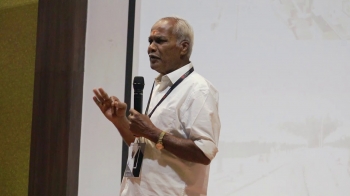


.jpg) F. M. Britto
F. M. Britto
.jpg)
Odanthurai in Coimbatore district of Tamil Nadu was a non-descript panchayat in India. But it has become a model for self-governance and income-generation. Winning many awards, it has attracted dignitaries like the World Bank President, South African countries’ ministers, researchers, government officials and students from 43 countries.
The credit goes to R. Shanmugam, who took over as the panchayats president in 1996, though he had studied only up to 10th grade.
Since most of the villagers are poor farmers, he set up village poverty reduction committee in each of the 12 villages, to identify the needy. The pilot project of late Chief Minister Jayalalitha’s Pudhu Vaazhvu Thittam (Poverty Reduction Scheme) was first executed here.
By implementing the state government’s Green House Project Scheme, more than 850 houses were built, the highest in the state, and handed over to the poor. The panchayat was then declared hut-less. “Local bodies should make full use of the government schemes and provide people what they need,” says Shanmugam.
Earlier there were only primary schools in the panchayat. The village-body then arranged a bus to ferry the middle school going children to the 10 km away Mettupalayam town. But now the panchayat is having its middle and high schools too. No drop-outs. Whereas earlier only 40-50 children studied, now it has 350-400. The literacy rate in the panchayat in 2011 had gone to 71.3 per cent.
The panchayat had just one bore well for a population of 1,750 when Shanmugam became the chief. The panchayat then decided to pump water from the nearby Bhavani River and supply it by pipeline to all its houses. In 1999 the centre announced the Rajiv Gandhi National Drinking Water and Sanitation Mission, where the community had to contribute ten percent of the total cost. The villagers agreed to contribute the 4.8 lakh.
Bacteria-free and 24/7 water began to be supplied to all the 1,600 households with a population of about 6000 living in an area of 1,200 hectares. “Support from the villagers was a key reason for the development,” says Shanmugam.
In 2005 the panchayat set up 350 kilowatt capacity windmill at the cost of Rs. 1.55 crore at Maivai near Udumalai. After supplying to all the villages, the surplus two lakh units, out of the 6.75 lakh units, is sold to the Tamil Nadu Electricity Board (TNEB), making revenue of Rs. 20 lakh a year.
It also set up nightlights and good roads. Prior to his becoming the chief, the annual income of the panchayat was only Rs. 20, 000. It rose to 3.75 lakh.
“If Odanthurai panchayat can transform to becoming independent panchayat in a decade with no one below poverty line, this is possible anywhere in India,” says Shanmugam. “If any village wants to bring development, there should be no corruption, only then success is possible,” he adds.
“A politician thinks of the next election. A statesman thinks of the next generation.”

.jpg) Stanislaus Alla
Stanislaus Alla
.jpg) Stanislaus Alla
Stanislaus Alla

 Adv. Rev. Dr George Thekkekara
.jpg)
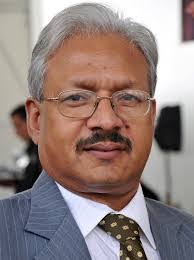 A. J. Philip

.jpg)
.png) John Dayal
John Dayal
.jpg)
.png) Jacob Peenikaparambil
Jacob Peenikaparambil

.jpg)
 P. A. Chacko
.png)
.png) Robert Clements
Robert Clements