
.jpg) Ladislaus Louis D’Souza
Ladislaus Louis D’Souza

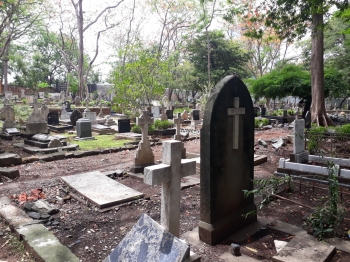
Father Michael Pinto, Parish Priest of Our Lady of Lourdes, Orlem, Malad West in Mumbai, made a significant call on the 4th Sunday of Easter for surrender of 'family graves' due to serious burial space crunch. This clarion call will go a long way, if followed by others in Mumbai and elsewhere, in solving a major problem during this pandemic.
Never before in history has humankind been brought face-to-face with the spectre of death looming over all and sundry. This sends shivers down the spines of diehards with the realization that neither the virus nor death per se knows or even cares for the difference between one human life and another, leave alone perceiving the difference between grave owner, landowner and slum-dweller! Indeed, whether laid to rest in a mausoleum or a family grave, in a temporary parish/municipal grave or cremated per se, we are all, whether pope or politician, priest or pauper, headed in the same direction: turning into the dust we've all come from, awaiting the Resurrection of the dead on the last day.
Another touchy issue
As a matter of fact, the issue concerning the surrender of permanent/family graves is a twin issue, its counterpart being the graves occupied by embalmed bodies. If the gruesome dance of death being currently witnessed doesn’t serve as an eye-opener on the futility of allowing valuable burial space to be blocked permanently, be it by a regular corpse or by an embalmed body, nothing will! Given the increasing number of permanent entombments of embalmed remains in cemeteries, parochial and municipal, if our Clergy could, in consultation with all concerned, come up with reasonable ways to convince owners of permanent graves to surrender them on the one hand and the families of the deceased lying embalmed to have the remains exhumed forthwith and cremated on the other, at least a major part of the grave crisis in the country can be resolved overnight. Indeed, what purpose does burying a body in an imperishable state serve anyway?
‘Niche’ issue
While we are at it, even the 'niche' issue needs to be scrutinized thoroughly. With no canonical sanction per se for holding back part of the mortal remains of our departed people by way of internment in ‘niches’ that can be opened at will, it's time the concept is thrown out lock, stock and barrel. It is sincerely hoped that wiser counsel will prevail and the matter concerning the three issues, viz surrender of permanent/family graves, vacating of graves holding embalmed remains, and discontinuance of the internment of remains in ‘niches’, is brought to a logical conclusion for the good of all.
Finally, speaking from close personal experience and observation, we do need to seriously change our attitude in terms of relating to those afflicted with the Coronavirus and other incurable ailments [like AIDS], rather than treat them and members of their respective families like lepers or, worse, like pariahs. And the best, surefire way to do this is to place oneself in their shoes. And so, no disease ought to allow family bonding to be replaced with the kind of aloofness that makes for abandonment, and good neighbourliness to be replaced with the kind of distancing that makes for ostracization.
It does logically follow that to the list of people we pray for, viz doctors, nurses and other healthcare workers, we need to conscientiously add all undertakers and grave-diggers, ambulance service providers and all those assisting at burials and cremations, not forgetting the Parish Office staff and, above all, our own dear priests who risk their lives each time they preside over burials in today’s Covid times.
.jpg)
.png) Cedric Prakash
Cedric Prakash

.jpg) Elsa Lycias Joel
Elsa Lycias Joel
.jpg)
 A. J. Philip

.png) Jacob Peenikaparambil
Jacob Peenikaparambil
.jpg)
.png) John Dayal
John Dayal
.jpg)
.jpg)
.png) Joseph Maliakan
Joseph Maliakan
.png)
.png) Robert Clements
Robert Clements
.jpg) Cedric Prakash
Cedric Prakash

 ICPA
ICPA