
.png) Jacob Peenikaparambil
Jacob Peenikaparambil
.jpg)
If democracy is a government of the people, by the people, for the people, people have the right to ask questions to the government, criticize and protest against its policies and make the government accountable to them. Accountability to the people is the core of a democratic government. Opposition parties and the media play a vital role in making the government accountable to the people. When the opposition parties and the media fail, people themselves have to come forward to protect democracy and that is what the farmers of India have done. Freedom of ex
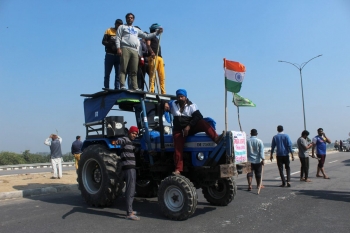
Sometimes the protests by the people take the form of a movement and that can frighten the government. The independent India has seen many such movements. J P (Jaiprakash) Movement, of which the Rasthriya Swayam Sevak Sangh (RSS) and the Bharatiya Jan Sangh were partners, ultimately led to the formation of Janata Party and ousting the Congress government under the leadership of Indira Gandhi in 1977. The protest against Citizenship Amendment Act (CAA) took the form of a movement. Unfortunately, the outbreak of pandemic Covid 19 provided an excuse to the government to suppress the movement by making use of the provisions of the Epidemic Disease Act of 1987, as the pandemic was declared as a national disaster. The protest by the farmers against the three controversial farm laws passed by the BJP government has taken the form of a powerful and robust people’s movement.
The protest by the farmers has received support not only from many sections of the people of India, but also from international celebrities. They include pop singer Rihanna, climate change activist Greta Thunberg, US lawyer and activist Meena Harris-the niece of American Vice President Kamala Harris- and law makers in the UK and USA. The Indian government slammed them for endorsing the support of the farmers, saying that some of the vested interest groups have tried to mobilise international support against India.
A group of Indian celebrities tweeted condemning the tweet by Rihanna and Greta Thunberg as interference in the internal affairs of India, and they expressed their support for the stand of the government. A lot of discussions have taken place and writings have appeared in the media both for and against the support by the international celebrities to the farmers’ protest.
Prime Minister Narendra Modi’s reference to a new 'breed' of agitators called 'andolan jeevi' and “Foreign Destructive Ideology” (FDI) during his speech in Rajya Sabha on 8th February is to be assessed against the backdrop of the protests the BJP government had to face since 2019. The prime minister sarcastically said that a new "breed" of agitators called "andolan jeevi" has emerged in the country, who cannot live without agitation and the nation should guard against them.
Thousands of farmers have been protesting against Centre's farm laws at the various border points in Delhi--Singhu, Tikri and Ghazipur for more than two and half months. While holding dialogue with the farmers, the government resorted to various strategies to discredit the farmers’ movement. It has been the usual technique of the BJP government to brand any protest against its policies as “anti-national” or a seditious plot supported by terrorists, Maoists etc. In the case of farmers’ strike also the government and the BJP tried their best to defame the movement by calling it a Khalistani movement and a movement supported by foreign powers in order to weaken India. The Modi government has not faced such a powerful protest movement as strong and determined as the farmers’ protest ever since it came to power in 2014. The BJP government could somehow suppress other protest movements by branding them as anti-national. Instead of withdrawing the laws as demanded by the farmers the government continues to adopt new techniques to defeat the strike by the farmers. One among them is controlling the social media platforms.
The government has asked Twitter to block 1,178 accounts for allegedly spreading misinformation on the farmer protests and provocative content. Twitter has not complied with the order of the government. It boldly stated, "Because we do not believe that the actions we have been directed to take are consistent with Indian law, and, in keeping with our principles of defending protected speech and freedom of ex
A recent circular of the Ministry of Home Affairs (MHA), Government of India, inviting citizen volunteers to police online content, appears to be part of the strategy of controlling online information sharing. This programme will be piloted in Jammu and Kashmir and Tripura. In this scheme, MHA asks volunteers to flag and report child sexual abuse, rape, terrorism, “radicalisation” and “anti-national” activities.
The Indian Express in its editorial titled, “Citizen vs Citizen” on 10th February has severely criticized the dangerous step taken by the government. The editorial has given six reasons to show that it is an overreach by the government.
1) The existing legal framework does not define what constitutes ‘anti-national’ activity. There is enough evidence to show how this has been weaponized. It is an invitation, even extortion, to misuse and harassment.
2) No statutory backing exists for such a volunteer force, nor is it clear what need it might serve.
3) Even if the ministry’s stated mission is to counter cyber-crime, it cannot outsource a fundamental state responsibility to a rag-tag corps of volunteers.
4) Making citizens vulnerable to such unofficial surveillance and scrutiny is a violation of their fundamental rights to freedom of speech and ex
5) By turning citizen against citizen, it risks deepening polarisation and mistrust in society. 6) It also ignores the guidelines laid down by the Supreme Court, when it comes to criminalising online speech. The court, while striking down Section 66A of the Information Technology Act, 2000, had ruled that a distinction must be made between speech that is simply “offensive or annoying” and that which is guilty of inciting a disruption of public order, or violence.
The government seems to be confused and directionless. That could be the reason for the government resorting to steps that can harm not only the country but also itself. Its overreaction to the tweets by the pope singer Rihanna and climate change activist Greta Thunberg damaged the image of India and of the Modi government at the international level. The similar type of tweets by Indian celebrities defending and supporting the government also did not bring any dividend to the Modi government. There is also allegation that the government might have motivated the Indian celebrities to tweet in support of its stand on the issue of farmers’ strike.
Former Finance Minister Yashwant Sinha in an article published in NDTV News on 9th February has appealed to the government to roll back the three farm laws. The process of passing the three laws was defective, as the democratic process generally followed in the parliament in passing the laws was not complied with in the case of these three laws. Statesmanship requires that the government accepts its mistake and rollback the laws instead of being obstinate, Yashwant Sinha reminded the government.
The farmers have set an example before the opposition parties and the civil society that the right to dissent should be kept alive in the face of repression by the state agencies. The government may continue to use its resources and power to stifle voices of dissent in order to cover up its failures and implement its narrow, discriminative and exclusive agenda. But the voice of the people in a democracy cannot be silenced forever.
The need of the hour is politicians like M P Mahua Moitra who has the courage to take on the government on its repressive measures. Her passionate speech in the Lok Sabha during the Motion of Thanks to the President's address on Monday 7th February gives hope for Indian democracy. She castigated the Modi government on issues ranging from its wrong policies to repression of dissent and mismanagement of the ongoing farmer’s protest. She challenged the Government for its authoritarian ways over the last 6 years and opting for “brutality over morality”.
.jpg)
.png) Cedric Prakash
Cedric Prakash

 ICPA
ICPA
 ICPA
ICPA
 ICPA
ICPA
 ICPA
ICPA
 ICPA
ICPA
 ICPA
ICPA
.jpg)
 A. J. Philip
.jpg) Jacob Peenikaparambil
Jacob Peenikaparambil
.jpg)
.png) John Dayal
John Dayal