

.png) Ram Puniyani
Ram Puniyani
In the process of formation of the nation, one of the major pillars is the concept of Fraternity. The words, Liberty, Equality, and Fraternity are flagship of French revolution, the revolution which overturned the feudal system, the kingdom and heralded the coming in of Modern Nation state, the concept of democracy. The path of these values has not been easy in India, where the process of ‘India as a nation in the making’ begins in the colonial period, running parallel to development of values of a modern state. As an aside since Fraternity, the classical part of triad, is male oriented so we should use ‘National community’, with all its inherent diversity in place.
This process of formation of national community in India ran along with the anti-colonial movement and came as an overarching Indian identity above the identities of religion, caste, region, ethnicity and language. The national movement integrated all these sections as Indians. History does not run in a smooth line, as National movement led by Gandhi united the people, there were communal elements, Muslim League, Hindu Mahasabha and RSS which focussed on religion based identity. These tendencies were at the root of sectarian politics, which acted as a counter to the uniting influence of the national movement.
Nearly seven decades after Independence we are facing a situation which is very close to when Gandhi made all efforts to unite the people cutting across the lines of religion. The rise of communal politics during last three decades has widened the gulf between the religious communities, particularly Hindus on one side and Muslims and Christians on the other. Those wanting to uphold the values of Freedom movement and values of Indian Constitution have been scratching their heads as to how to cultivate and restore the bonding which made India, a nation. One effort has been to make bridges among different communities through respecting the traditions and faith of ‘others’. These efforts have also talked in the language of religion; have attempted to follow the moral values of religion. Moral values of religion were the core of teachings of Bhakti-Sufi saints. These also formed the base of Gandhi’s practice of Hinduism, which was inclusive and attracted the people of diverse religions.
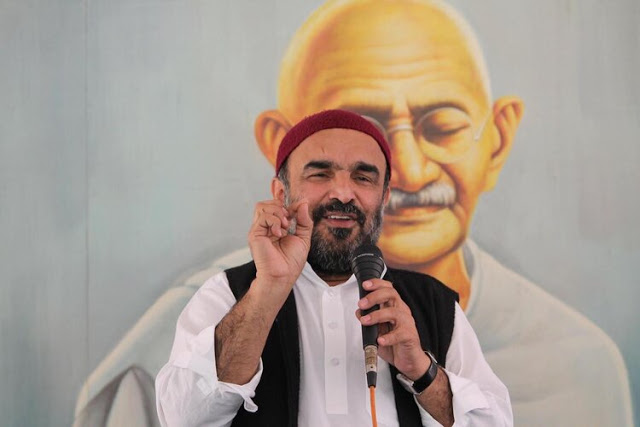
In contemporary times there are activists who are endeavouring to walk this path. It may sound innocuous few decades ago, but not any longer. Now we see the case of arrest of Faisal Khan, who has tried to revive Khudai Khidmatgar, the organization floated by Khan Abdul Gaffar Khan, Seemant Gandhi. Gaffer Khan was ardent supporter of the path of non violence. He stood for respecting all religions and was totally opposed to the partition of the country, for which he had to spend years in the jails of British rulers and later in the ‘Muslim Nation’ Pakistan.
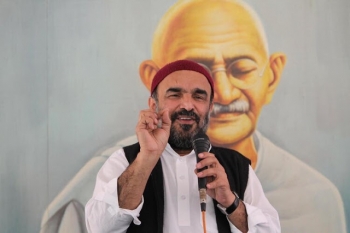
Faisal Khan, yearning for amity love and peace began his journey for communal amity with other peace workers. He decided to revive Khudai Khidmatgar to pursue the path to strengthen the spirit of Indian Community and on these lines has been trying one after the other move to bring the religious communities together.
He set up Apna Ghar for people of all religious communities to share and enhance the intercommunity bandings while celebrating festivals of all religions. He is also a trustee of Sarva Dharma Sadbhava Kendra Trust located in Ram Janaki Mandir Sarju Kunj, Ayodhya. There is a plan to develop an all-faith communal harmony centre in this Temple. Faisal Khan has offered Namaz several times in this temple. People of all faith and caste including Dalits are welcome in this temple. At another level he is part of organizations for Human rights like NAPM and at global level with Hindus for Human rights in US.
Recently he undertook a five day peace yatra in Brij region in UP along with four of his friends. This peace yatra was '84 Kos Parikrama' of Braj in Mathura during which they paid a visit to Nand Baba Mandir. As Faisal visited the temple he received prasad from temple priest and recited verses from Ramcharitmanas to the priest. The priest happily allowed him to offer namaz inside the premises on October 29, 2020. The petition that has been launched on Change.org, says, “When it was time for the midday namaz (Muslim prayer), Faisal was going to pray outside, but the priest invited him to pray right there in the temple. Faisal and one of his associates, Chand Mohammed, prayed in the temple compound.”
He has been arrested on charges which are related to inciting intercommunity tensions and is in jail for last few weeks. When we are talking of promoting intercommunity amity such an act is what gives the signal of intercommunity harmony. The state is duty bound to promote fraternity, the sense of Indian community, which Faisal Khan and his friends were trying give a message of. Many people accuse that secular forces have failed to address the people as they have been talking in a language which is away from the language of people, people who are steeped in the religiosity. Faisal Khan is doing precisely what many sympathetic critics are alleging is the failure of secular forces.
Gandhi and Khan Abdul Gaffar Khan saw religion as a moral force, as a spiritual path. They succeed to a large extent. After their passing away from scene, communal forces have overshadowed the moral ethical component of religion and presented religion as pure identity, and have used it as divisive force.
Today we are in a strange situation. The religious gulfs are rising and those trying to bridge it are accused precisely of things which they are fighting against. Society needs to introspect and take the path of Gandhi and Khan Saheb, to cement to gulfs which have crept in due to the divisive politics of sectarian nationalism. People like Faisal Khan need to be understood and respected for the path they are pursuing to promote the idea of inclusive India.
.jpg)
.png) Cedric Prakash
Cedric Prakash

.jpg) Elsa Lycias Joel
Elsa Lycias Joel
.jpg)
 A. J. Philip

.png) Jacob Peenikaparambil
Jacob Peenikaparambil
.jpg)
.png) John Dayal
John Dayal
.jpg)
.jpg)
.png) Joseph Maliakan
Joseph Maliakan
.png)
.png) Robert Clements
Robert Clements
.jpg) Cedric Prakash
Cedric Prakash

 ICPA
ICPA