
.jpg) REVATHI SIVA KUMAR
REVATHI SIVA KUMAR
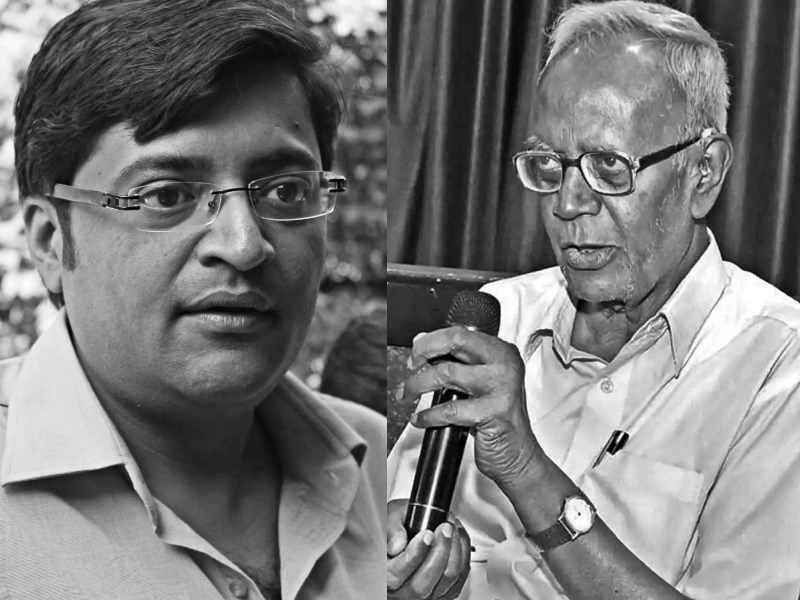
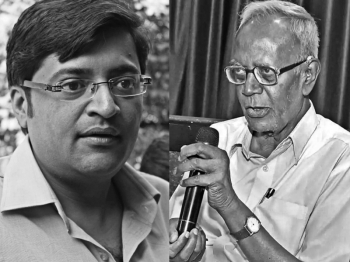
The arrest of Arnab Goswami evoked howls of protests from the centre, politicians and ordinary people, while that of octogenarian activist Stan Swamy under the dreaded UAPA barely registered. This “counter-terrorism law” is a convenient weapon for governments to arrest human rights defenders, journalists and protesters and Swamy was a symbol of activism, the voice of tribals and their struggles to address their broken hopes and aspirations related to displacements and land alienation beyond caste and religion. The laws and policies that have been passed without consultation through Parliament need a huge, collective protest and outrage, says REVATHI SIVA KUMAR
STAR anchor Arnab Goswami’s arrest on November 4, 2020, from his home in Mumbai and his bail process, has sparked off a political war and protests in many places. But the nation sadly does not seem to want to know why 84-year-old Stan Swamy is still in prison post-November 5, 2020, the date till when his judicial custody was extended.
While Goswami is whipping up a sympathy wave for his “persecution”, octogenarian activist Swamy’s simple request for a straw and sipper in prison to drink water as he had Parkinson’s disease was deferred by the National Investigative Agency for 20 days. Other details of his arrest on October 8 from his Ranchi residence are distressing.
Why was it done at night? What was there to fear from a gentle Jesuit priest? Why was Swamy in judicial custody until October 24 and why was his remand extended for two more weeks? What could be the reason for taking him as the 16th detainee under the Unlawful Activities (Prevention) Act (UAPA) in “terrorism”-related charges?
Arnab Goswami was arrested for his alleged role in the death of Anvay Naik, who committed suicide in 2018, and held under Section 306 and 34 of the Indian Penal Code. Yet his imprisonment stirred a lot of protests about “press freedom” and “political vendetta”.
However, the reasons for arresting Swamy, a veteran tribal rights activist, under UAPA was neither clear nor was there any concrete evidence against him, even though the charge-sheet against him runs into 10,000 pages.
Fact and Fiction
What are the purported reasons, anyway, for Stan Swamy’s detention? Firstly, it was seemingly to prevent him from perpetuating unlawful activities, due to an alleged past record of having “incited a mob to violence” at Bhima-Koregaon in Maharashtra on January 1, 2018.
Fact: The Jesuit priest never visited Bhima-Koregaon or the festival, 1,800 km away from Ranchi. How could he have engineered a riot, even if he did, from a place so remote in another state?
Second accusation: He had Maoist links.
Fact: Stan Swamy had no links with Maoism except to challenge the arrest of a number of Adivasis and Moolavasis accused of Maoism. The charge-sheet claims that a lot of “incriminating” documents of his links were found through digital evidence in the form of “emails, call records, writings, speeches and past conduct”, allegedly related to a “conspiracy”. Swamy denied them all and called the evidence fabricated.
Thirdly, he was said to have converted a number of Adivasis.
Fact: Being an activist, Swamy was more interested in supporting Adivasis to fight for their land rights, not in getting them converted. Moreover, if he was really a Maoist, he would be an atheist, so “conversion” would be a paradox.
The evidence against him appears flimsy, but he has not been given the right to challenge it in court till his next hearing on November 26. The People’s Union for Civil Liberties recorded that in October 2018, the police had clearly told the Bombay High Court that Fr. Stan was “only a suspect and not an accused”. Yet, he was questioned in Bagaicha for 15 hours over five days and still the NIA remained silent. On April 14, the NIA swooped down on him and other activists “under a completely fabricated and non-existent conspiracy”.
UAPA, a Convenient Tool
Purportedly, the UAPA, a “counter-terrorism law”, seems to be a convenient weapon for governments to arrest human rights defenders, journalists and protesters. Though it first became a policy in 1967, it has today enlarged its ambit to detain individuals who can be held for almost 180 days. The UAPA exceeds even international law as well as standards, slowing down investigations and bail provisions, ensuring that detainees are held much longer during pre-trial. About 3,005 cases were registered under UAPA from 2016 to 2018 and 3,974 people were arrested.
The distressing aspects of UAPA were called out in May 2020 by the UN Special Procedures mandate holders (independent human rights experts), who released a public communication outlining their concerns and calling upon the authorities to amend the Act in sync with international human rights obligations. It equates non-violent opposition or criticism of policies and institutions as anti-national or “terrorist”. While there is support for the UAPA detainees from progressive, liberal individuals and institutions, the opposition is not visible or glamorous to the public, who prefer to shed tears over the arrest of Arnab Goswami.
However, the real reason for slapping Stan Swamy with Elgar Parishad charges was probably to deflect attention from the anti-establishment issues that he was grappling with. He had been working with Adivasi communities on issues related to land, forest and labour rights in Jharkhand for over three decades and questioned the non-implementation of the Fifth Schedule of the Constitution, which mandated the setting up of a Tribes Advisory Council.
He had opposed many government laws and policies, even filing a PIL for the release of undertrial prisoners and pursuing the conduct of a speedy trial and appointment of a judicial commission to probe delaying of the trial process. He also opposed setting up “land banks” to free up community land for small and big industries. “This, I believe, is the main reason why the state is keen to put me out of the way,” Swamy said in a video released before his arrest.
What does Stan Swamy represent?
Hence, Swamy’s arrest is not just about arresting one person. It is about what he represents – a threat to the government and its ideology. He summed it up best: “…what is happening to me is not something unique happening to me alone, it is a broader process taking place all over the country”. He added that in a way, he was “happy” to be part of the process, so that he was not a silent spectator but became part of the game. “I am ready to pay the price whatever be it,” were his brave words.
Swami is thus a symbol of activism, the voice of tribals, and their struggles to address their broken hopes and aspirations related to displacements and land alienation beyond caste and religion. To silence people like him, the UAPA was used as a form of feudalisation of democracy. It was meant to translate negative energies into positive ones, not do the opposite. It has been used indiscriminately against others too such as Gautam Navlakha, Delhi University associate professor; Hany Babu, Goa Institute of Management professor and Anand Teltumbde, Jyoti Jagtap, Sagar Gorkhe and Ramesh Gaichor, activists of the Bhima Koregaon Shaurya Din Prerna Abhiyaan group. And among those who were not mentioned in the charge-sheet include human rights activist Sudha Bharadwaj, who was jailed in August 2018 by the Pune police, along with Vernon Gonsalves and Arun Ferreira.
Hence, while Arnab Goswami’s arrest is regarded as an infringement of his rights and privileges, the arrest of octogenarians and other innocent prisoners goes beyond just the misuse of law. It is the UAPA itself that is brutal. The process itself, then, is the punishment, even if there is no evidence.
The laws and policies that have been passed without consultation through Parliament need a huge, collective protest and outrage. Is that possible, when the opposite is happening in a highly polarised country, with the central government, politicians and protests shouting for his release?
(Courtesy:www.theleaflet.in-- Revathi Siva Kumar is a Bangalore based independent journalist.)
.jpg)
.png) Cedric Prakash
Cedric Prakash

 ICPA
ICPA
 ICPA
ICPA
 ICPA
ICPA
 ICPA
ICPA
 ICPA
ICPA
 ICPA
ICPA
.jpg)
 A. J. Philip
.jpg)
.png) Jacob Peenikaparambil
Jacob Peenikaparambil
.jpg)
.png) John Dayal
John Dayal