

.png) Dr Prakash Louis
Dr Prakash Louis
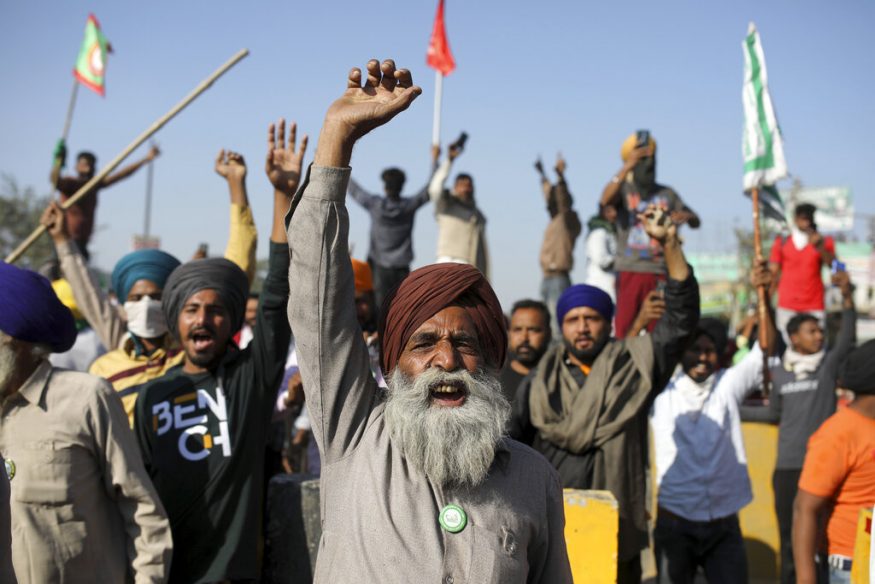
“Bar Council of Delhi asks Prime Minister Narendra Modi to withdraw Farmers Acts”. This was a headline on 2nd December, 2020 in Bar and Bench – a publication of the lawyers. The news item cautioned: “BCD (Bar Council of Delhi) has stated that the surreptitious insertion of provisions in the Farmers Acts on bar on civil courts will pose a serious threat to the existing judicial institution and the principle of separation of powers”. In its letter dated December 2, the Bar Council of Delhi claimed that apart from being against the farmers, the Acts are also detrimental to the interest of legal professionals.
The letter goes on to state, “We can’t be unmindful of the fact that a strong judicial institution to check administrative arbitrariness and unfair treatment is essential in a democratic republic and not an amenable executive authority. Introduction of Conciliation Board to be constituted by SDMs, headed by his junior officer as Chairman, is distractive and unaccepted...SDMs/ADMs are always under the command of their bosses, which is anti-thesis to judicial independence and discipline.”
On Tuesday, 1st December, Justin Trudeau, the Prime Minister of Canada, commented on the ongoing farmers’ protests in India. "The news coming out of India about the protest by farmers is concerning and we are all worried about family and friends. I knew that is a reality for many of you," Trudeau said, adding that "Let me remind you, Canada will always be there to defend the rights of peaceful protests."
Writing about this in NDTV media, Vir Sanghvi stated on 2nd December that two things were immediately obvious in the Trudeau statement. One: Trudeau's remarks crossed the line about not commenting on another country's internal affairs that most world leaders respect; two: Various Indian leaders across political parties said that Canada had no business interfering in our internal affairs. But many people on Indian social media supported Trudeau. This is because most of these people support the genuine demands of the farmers and their protest against the anti-farmers’ policies and programs of the present regime.
Vir Sanghvi went on to state, “Once upon a time, this sort of view would have been unthinkable or restricted to a tiny fringe. But this time around, it had considerable support. Judging by the views of the people I interacted with on social media came from a deep frustration at the way things are going in India. ‘Since we are now a majoritarian nation, we need the world to stand up for the rights of minorities’ was a common response. Others pointed out that the government had changed the rules itself by vilifying minorities, by painting Muslims as traitors or fanatics and Sikhs as Khalistanis. In such a situation, said many people, and in the absence of any viable internal opposition, we would be mad to stop the rest of the world from interfering as India turned on its own citizens”.
Advocate and activist Prashant Bhushan tweeted, "I am happy that Canadian PM Trudeau has spoken out for Right to Protest in a democracy & for our farmers’ rights. It is important for all leaders worldwide to stand up for the democratic rights of people in all nations. Those saying that this is an internal matter have got it all wrong."
NDTV on 6th December published that “Thousands Protest In London To Support Indian Farmers, Several Arrested.” Police officers in face masks asked people to disperse from the ‘We stand with farmers of Punjab’ demonstration, warning about COVID-19 curbs on demonstrations. It is reported that a crowd of demonstrators converged at the Indian embassy, located on Aldwych, a major artery in the centre of the British Capital, and groups marched around the Trafalgar Square area in London.
This London protest came after a group of 36 British MPs led by Sikh Labour MP Tanmanjeet Singh Dhesi had written to UK Foreign Secretary Dominic Raab asking him to make representations to his Indian counterpart S. Jaishankar over the protests in India. While the Indian Embassy in the UK and the Indian government vehemently criticised the protesters saying it was holding negotiations with the farmers and at this time any protest was uncalled for.
Church’s Silence
What is extremely disturbing and painful is that the Indian Church pretends that it has nothing to do with this protest of the farmers. Even if the official leadership does not join the protest, it must issue a statement that the Church is deeply disturbed by seeing the plight of the protesting farmers on the road in the severe winter of Delhi.
If issuing a statement is considered as going against the ruling elite, at least it could have asked its followers to pray for the protesting farmers. As in the past, the Indian Church is at a historic juncture where it has a great opportunity to stand with those who are exploited and marginalised by governments.
But it looks that the Church, as usual, will shrink in its minority complex and not even take cognizance of the millions of farmers who are waging a struggle against an autocratic, authoritarian, undemocratic and anti-farmer government. It is deplorable and depressing that the Church does not want to be seen with the farmers who are fighting for their rights and seeking withdrawal of three farm laws which they consider would go against their interests.
The farmers do not want to be bullied by an oppressive government. They want to ensure a government which is not only ‘for the farmers, by the farmers and of the farmers’ but also ‘for the people, by the people and of the people’. The government seems to have been emboldened to legislate the new farm laws as there weren’t many major protests and demonstrations since it came to power except the anti-CAA protests.
What the Church Could Do?
First and foremost, the Church should realise a fundamental fact: “NO FARMERS – No FOOD”. It is the hard labour of the farmers in sun and rain, day and night which provides food to all. If the farmers are denied their rights, which the present government is up to, then people in general will suffer; the worst hit will be the ordinary people. It could even lead to starvation deaths.
Hence, the Indian Church should come out of its slumber or comfort zone and join others in support of the protesting farmers. Media reported that the Delhi Police on 1st December stopped Bilkis Bano, the ‘Dadi’ who became a symbol of the anti-CAA protests at Shaheen Bagh in the national Capital, from entering the protest site at Singhu on Delhi-Haryana border. She was on her way to join the protests in solidarity with the farmers. One could see the shameful act of around 20 police personnel escorting octogenarian Bilkis away from the site. This shows the anti-democratic and dictatorial face of the government.
Reports suggest that several medical personnel are supporting the protesting farmers by providing free medical camp. The Church, with its vast medical establishments, could have provided health care to the protesting farmers in the name of humanitarian service. Instead of aligning with the ruling establishment every time to save its minority status, the Church should be seen with the people to resist the sinister plans of this government.
It is reported that several athletes marched to Rashtrapati Bhavan to return their awards. Though they were stopped by the police, they made a political statement in solidarity with the farmers. Social media is full of heartening news of Gurudwaras and Mosques taking initiative in feeding the protesting farmers. Such gestures of solidarity go a long way in establishing that the farmers are not fighting just for their cause but for the nation and its citizens. The Church is known to do emergency relief by providing food and other material for the affected people in disaster situations. But in this case, it seems to have utterly failed.
On 7th December, both the protesters and lakhs of people across the country fasted in support of the rights and dignity of the farmers. The Church which organises prayers and fasts when its interests are affected should have called for fast and prayers to save the Constitution and democracy in the country. But it failed.
Even if it feels scared and frightened of the consequences of organising any protest, it should, at its level, should join various actions like fasting in solidarity; social media engagements; spreading awareness through posters; pulpit speeches to create awareness among its faithful; etc. If none of these is possible, at least exhort the faithful to pray for the farmers.
Missed Opportunity
It is an undeniable fact that the farmers’ protest, which began with the demand to withdraw the three controversial farm laws, has now become a focus for wider, larger and broader national struggle for democracy and independence from a repressive regime. It has snowballed into a struggle to uphold farmers’ sovereignty over agriculture and in extension on their land, labour and livelihood. Above all, this national protest has become a historic farmers-led resistance and struggle to reclaim democracy from a regime unmindful of people’s interests.
The Church should realise that if it does not express solidarity with the protesting farmers, it would be equated with the andha bhakts (blind followers) of the BJP-RSS stream. The andha bhakts can be forgiven since their needs are taken care of and they are sucked into the slogan of Hindu is a member of Hindu Rashtra which is India and all those who are not Hindus are not members of Hindu Rashtra, thus India.
The Church cannot remain a mute spectator, nor pretend to be safe. If this opportunity is lost, the people of this country will not stand by the Christians when an authoritarian and autocratic government would try to wipe out a meagre 2.3% of its population. Christ Jesus is sure to say about the Indian Church, “Truly, I say to you, as you did not do it to one of the least of these, you did not do it to me”.
.jpg)
.png) Cedric Prakash
Cedric Prakash

 ICPA
ICPA
 ICPA
ICPA
 ICPA
ICPA
 ICPA
ICPA
 ICPA
ICPA
 ICPA
ICPA
.jpg)
 A. J. Philip
.jpg)
.png) Jacob Peenikaparambil
Jacob Peenikaparambil
.jpg)
.png) John Dayal
John Dayal