

.jpg) F. M. Britto
F. M. Britto
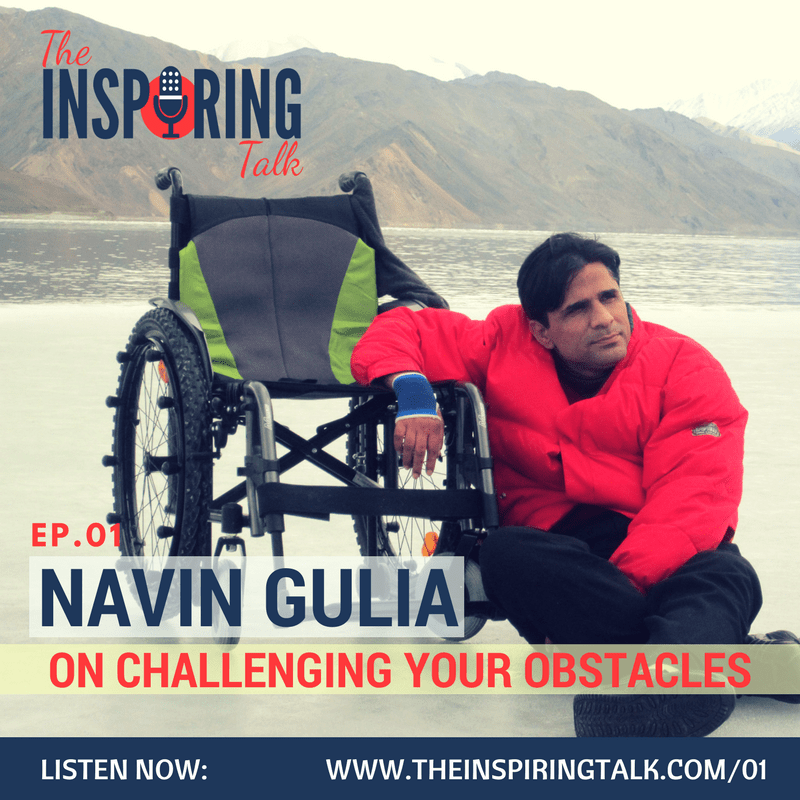
As a boy, Navin Gulia was a below-average student and since he was also physically weak he never participated in sports. But the constant mockery of his classmates and the adventurism of his brother drove him forward. Finally he became one of the most accomplished sportsmen in the school.
After four years of training at the Indian Military Academy in Dehradun, the 19 years old trainee reached the Passing Out Parade on April 29, 1995. Required to complete an obstacle course, he was at the top of a high ramp. There by mistake his companion pushed him. As he tumbled down from the pedestal, Gulia landed on his upper back, damaging his spine.
Lying paralyzed in a hospital bed for two years, he was told by the doctors that he would never be able to move about. During the bedridden days, he read many inspiring survivor stories. Completing his Masters in Computers from Pune in first division and the UGC NET examination, Gulia became a computer teacher.
Not to be confined to a classroom, the quadriplegic decided to drive to Marsimik La, the highest motorable pass in the world. Gulia hit headlines in 2004 for driving non-stop for 55 hours on a Tata Safari from Delhi to Marsimik La. He was awarded for that the Global Indian of the Year, the Karmaveer Chakra, Kavin Care Ability Mastery Award, the National Role Model Award and the Limca Book of Records. As an adventure-seeker, Gulia also flew hang-gliders and adventure aircraft, driving over one lakh km.
Touring around as a motivational speaker, Gulia enlightens his audience, “I did not always have a positive mindset. I had to cultivate it over the years. It requires constant hard work.” He compiled his experiences in a book in English and Hindi. He narrates in “In Quest of the Last Victory”, “Amazing things are possible with just a little perseverance.”
Enamored by him from the Facebook, Khushi came from Goa to Delhi to marry him in 2004. They live in Gurgaon with his parents.
Seeing a girl crying of hunger and cold in a winter, Gulia decided to dedicate the rest of his life to help underprivileged children. So he started the NGO Apni Duniya Apna Ashiana (ADAA) in 2007 to support the street children and Jan Jagriti to combat the sex ratio in villages. He began working with beggar-children living in hutments in Gurgaon and nearby villages. Spending his time with them, he says, “The real joy comes from seeing these kids smile and getting happy when they receive small things.”
He has many more future plans for the ‘good of society’. He says, “Now my main aim is to be constructive for society.” He adds, “The progress of a country is not measured by a successful mission to Mars, but by what we do for those at the lower rung of society.”
The wheel chair bound Navin Gulia says, “Each time a difficult task crosses our paths, remember it’s our thoughts that stop us, not our abilities.”
.jpg)
.png) Cedric Prakash
Cedric Prakash

.jpg) Elsa Lycias Joel
Elsa Lycias Joel
.jpg)
 A. J. Philip

.png) Jacob Peenikaparambil
Jacob Peenikaparambil
.jpg)
.png) John Dayal
John Dayal
.jpg)
.jpg)
.png) Joseph Maliakan
Joseph Maliakan
.png)
.png) Robert Clements
Robert Clements
.jpg) Cedric Prakash
Cedric Prakash

 ICPA
ICPA